







TL;DR: Lorem ipsum

A boy hides behind a curtain in a Prussian house and watches the man his father fears come up the stairs and lay hands upon the tongs and demand of the smoke rising from the hearth eyes here, eyes here. He is six or seven. The year is somewhere around 1790. The man at the hearth is named Coppelius and is not named Coppelius and is named several other things by the end of the story. The boy carries the night with him into manhood and into love and into a strange university room across a courtyard from a window where a woman sits unmoving for hours at a stretch and into the catalog of an itinerant glassmonger who lays out his spectacles on a tabletop until they cover the whole of it and stare back at him in their dozens, in their hundreds, lensed and bloodshot and patient.
Two hundred and ten years on, the story still works. It works the way old machinery works. You can hear the cogs.
What Hoffmann understood, and understood very early in the life of the form (this story is featured in our first installment of 1001 Books to Read Before the Dirt), is that the most durable horror is not the figure that crosses the threshold from outside but the figure that emerges from inside the house already wearing some traveler’s coat. Coppelius is a man. Coppola is a man. They may be the same man and they may not be and the story is content to leave the reader suspended in that grammar like a fly in amber. The thing is framed in letters. Nathanael writes to his almost-brother Lothair, and Lothair writes back through Nathanael’s betrothed Clara, and Clara composes a letter so devastating in its plain reason that for a moment she becomes the only sane person in Europe. Then the narrator breaks in. He confesses he could not find words bright enough to render his mental vision and could not see how to begin and asks the reader to accept the letters as outline and proceed from there. This is 1816. Edgar Poe is seven years old. Frankenstein has not seen print.
The man behind it is one of the strange figures of nineteenth-century letters. Ernst Theodor Wilhelm Hoffmann was born in Königsberg in 1776 and trained as a lawyer and held a series of bureaucratic posts under the Prussian state and was eventually appointed to the court of appeal in Berlin where he became a Councillor in 1816, the same year “Der Sandmann” appeared as the lead piece in his Night Pieces. He composed music. He conducted operas. He drew caricatures of his military superiors at a Posen carnival ball in 1802 and was promoted to Płock in New East Prussia, which was Prussian bureaucratic shorthand for exile. He changed his middle name from Wilhelm to Amadeus out of veneration for Mozart and signed himself E.T.A. ever after. He drank as men of his time drank, which is to say catastrophically, and died at forty-six of paralysis attributed to neurosyphilis hastened by alcohol. In the years between his last appointment and his coffin he wrote the stories for which he is now remembered. He wrote on the side. He wrote the way a man writes who has another desk to sit at in the morning and a shorter ledger of days ahead than he knows.
This Pushkin Press edition gathers “The Sandman” with two companions, “The Golden Pot” of 1814 in Thomas Carlyle’s English of 1827, and “The Cremona Violin” of 1818 in J.T. Bealby’s of 1885. The translations are old. They read old. The Carlyle in particular sounds like Carlyle, which is to say like a Scotsman wrestling a German into the cadences of the King James while neither will quite submit. There is friction in the prose. The friction does the book good. A modern frictionless English would file Hoffmann down to nothing.
“The Golden Pot” is the lighter ware of the volume, a Romantic fantasia with snakes in it and an apple cart and a student named Anselmus who falls out of the world and into another. It is a fairy tale that knows it is a fairy tale and does not apologize for itself. “The Cremona Violin” is quieter and stranger. A man builds a house without an architect, calling for windows where he wants windows, and what follows around him should be allowed to do its own work. What both companion pieces share with the title piece is the figure of the maker whose private mania has consumed his public life until the two are no longer distinguishable. Hoffmann was that man. He knew the type from the inside.
But the engine of the volume is Nathanael, and there is a reason his story has not been allowed to die. The dread it produces is not the dread of the slow ratification of a child’s wrong belief. Clara is right. Spalanzani may be right. The narrator allows himself doubt enough that the whole apparatus wobbles. Nathanael spirals not toward the truth but toward whatever he has already decided the truth must be, and the story watches him do it without comfort and without reprieve. When the spectacles come out of the glassmonger’s coat the reader knows precisely what they are even though they are only spectacles. The horror is that the lens is not a lens. The horror is the fact of having looked through it.
The book’s pleasures are not contemporary pleasures. The prose is mannered. The digressions wander. The narrator interrupts himself to apologize for things requiring no apology. A reader arriving from twenty-first century horror will find the rhythm strange and the diction stranger. That reader should stay. What is on offer here is the foundational machinery, oiled and still warning, of a tradition that runs through Poe and Baudelaire and Kafka and the whole psychoanalytic vocabulary of the uncanny, all of it traceable to a Prussian magistrate composing in lamplight against the deadline of his own undoing. Freud called him the unrivalled master of the form. Freud was not exaggerating.
Two hundred and ten years and the story is still working. The lens is not a lens. The eyes are still in the satchel.

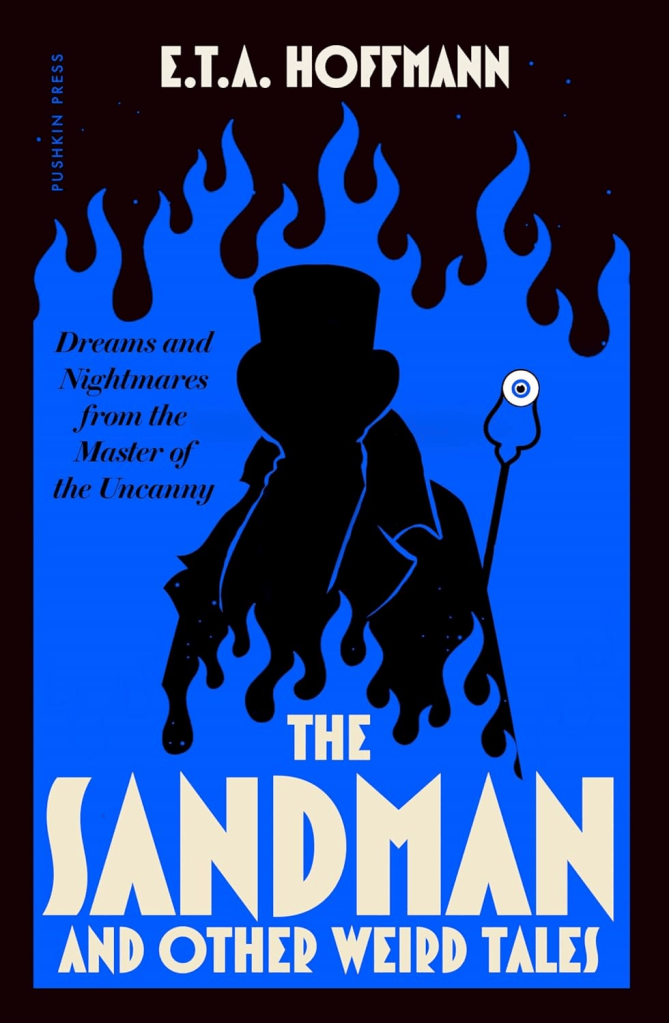
The Sandman and Other Weird Tales by E.T.A. Hoffman, published September 1, 2026 by Pushkin Press.



Leave a Reply