
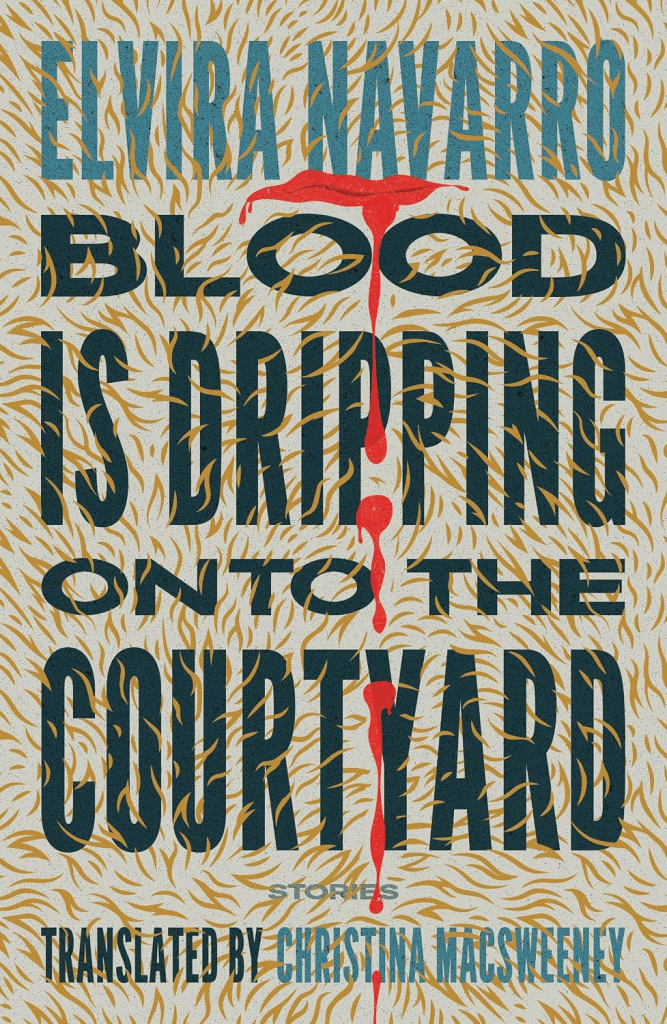






TL;DR: I didn’t expect to care this much about a washing machine. Navarro sets these in half-built houses and empty apartment blocks and never raises her voice. Quietest scary book I’ve read in years. The one about the highway worker who starts bringing injured animals home is as good as short stories get. Buy it.

Skip the introduction. I say that with a full heart. Sarah Rose Etter wrote it and she loves this book, you can hear her loving it, and partway down she tells you how the best story in it ends, so I read that story with its ending in my lap like a cat somebody handed me at a party. Don’t let it happen to you. Go to page one, where a woman in a Madrid block is pouring a capful of Flor into the softener drawer and finds the drawer full of something brown.
She thinks it’s dirty water. Her husband has the nose. These pants smell odd. They dip a paper towel in and there it is, steak-tray blood, old, and then on a Monday in July it’s fresh, and she stands in front of the machine the whole forty-seven minutes of the cycle and watches the drum go carmine and never once thinks to press stop. (She illustrates children’s books. I don’t know why that’s the detail that got me. It got me.) The police come. But that’s impossible, señora. At sundown the skinny boys and the twins make a ring around the stain in the courtyard and sing, and in the singing is the word murderer. A reporter from a paranormal show hollers fraud at her in the kitchen, and Navarro says the insults were aimed less at the illustrator than at the reporter’s own wish for the thing to be untrue, and I have been that reporter. The title is what the husband says. Blood is dripping onto the courtyard. Then he gets the kitchen roll and lays it on the tiles. That’s the book in one man. The awful thing said flat, and then the paper towels.
Navarro writes horror like a building inspector. Brick showing. No tiles upstairs. One front door fitted in a whole complex in Alcobendas. A plot by the Henares with no planning permission. Nobody in this book has a house. They have a project, a lease, a mother’s pension, a job in the next town. There is not a finished wall in the whole book. That’s where she keeps the dread.
The animal collector sweeps the A-2 from Guadalajara toward Soria at night with a half-deaf man named Tomás who drives and eats Magdalenas when the light comes and smokes Chesters only outside the van. His first one is a hoopoe, crushed and alive, and its mate is eating it before it’s done dying. A white cat waits for them in a gutter near Atienza night after night like it has an appointment. A greyhound cries in the trash can and Tomás gets the broom. So the man starts taking them home. Lord, the hare, with a cast on her leg in his daddy’s old rabbit cage. A barn owl that screams like a monkey being robbed. His girl Isa, a nurse in Vallecas who never could stand the Pomeranian, says it’s that critter or me, and he doesn’t answer, and that silence is the breakup. I have carried a dog to the vet in a bath towel at three in the morning doing ninety on Highway 6 and I know the thing in that man’s chest. Navarro has said the man is her, pushed as far as she’d go, that she cannot leave a hurt animal in the road. Nobody invents a buzzard on a dead utility pole, or an old cat with a bad haircut sitting in the road at dawn waiting on her beaten egg. You have to have fed one. The story is about mercy as a load, how it gets on a man and into his tracksuit and his beard and the ticks in the mortar joints of his wall, and the last two pages (which I’m not giving you, which the introduction already gave you, God help us) are forty feet up with no net, and they land.
Then a father in Galicia, a parish called Vilatuxe, in a house with the brick still showing when the lockdown comes down. The boy Bruno draws mutant faces on the walls with a wax crayon and then with the black marker off the food containers, the father stomps the Hot Wheels flat (like tiny quail bones, MacSweeney gives us), and the wife goes upstairs to the floor with no walls and sits in the gray and says she’s resting. One clear night he goes up after her and sees a meiga, a witch, standing in the middle of a circle nobody drew. He would rather she be that than what she is. Navarro lets him. That’s a cruelty I admired.
A man in Alcobendas whose fiancée left after the invitations went out gets a uniform and a nightstick from his best friend the developer. He patrols the empty complex he bought into, hears people talking in the hand dryer by the pool (the soap is a green pear, jasmine, somebody’s grandmother’s, and I could smell it), and sings a cartoon duck’s song in the halls for protection until the night he remembers the second verse. Teenage girls in sequins under raincoats crossing the highway after midnight to a lot full of rubble. I don’t know what they’re doing out there either.
Mari, in some town on the paramo too big to be a town, with the family butcher shop gone bankrupt and the bank account frozen and €222 a month, the power and water turned off on purpose, jerricans filled at a fountain whose sign has said don’t for ten years, dozing through the siesta in half a can of bathwater in the dark like a cat. Her father’s stone says A Prayer. Her brother, who sings “Un Ramito de Violetas” in a wig in Sitges, sent artificial violets for the grave, and she hauls them up the hill on her bicycle, and the next morning they’re on the ground. And the next. She wires them down. I’ll leave it there. Her mother is in a home forty kilometers off, strapped to the bed at night, cold to the touch in a heat wave, and Mari walks the hall touching the other old women to see if they’re cold too. I’ve done that. I didn’t know anybody else had.

Now the Paris pieces, three of them, out in the banlieue around the turn of the century, two with a girl named Almudena in them. The first is two pages of walking toward a basilica and ends on a line that’ll put a hand on the back of your neck. The second, “Spider Web,” is a boy named Étienne with yellow tulips and a friend named Ismaël who won’t quit, and it’s still a sketch of something that happened to somebody once. The last story goes back for her, years on, and it’s the best of the three by a mile, and it still reads like Navarro arguing with a notebook. And “Idiotic Love.” Forty-some pages in numbered parts about a woman with an anal fissure and a man named Pep who weighs 180 kilos and got hepatitis off his math teacher at sixteen, the two of them keeping a club in Chueca called the ÑÑ the way other people keep a marriage. A maple syrup diet in Gandía among the German retirees. A sex shop whose back room is silicone like raw chicken breasts. It is not horror. It’s barely a story. I didn’t skip a line of it.
MacSweeney’s English is plain as a receipt and that is the whole trick. Geckos dying in the hoses “exuded their cold nectar.” The gap where a dishwasher should go, with the boy hiding in it: “one absence inside another.” A sky under Sahara dust “like the lid of an aluminum saucepan.” There’s not a pretty sentence in the book and I’d give a finger for four of them. She never swings for it. She sets it down and goes for the kitchen roll.
Navarro was born in Huelva in 1978, took a philosophy degree at the Complutense in Madrid, and spent an Erasmus year in the Paris suburbs at the turn of the century that she has called the great failure of the European project. Since 2010 she’s kept a blog called Periferia, walking the outskirts of Madrid as just another passerby. The Jaén Novel Prize for La ciudad feliz, Granta’s Spanish-language list in 2010, A Working Woman, Rabbit Island on the National Book Award longlist in 2021, then The Voices of Adriana. This one came out of a BBVA Foundation grant in 2015 that was supposed to buy three novels and bought one novel and this instead, the stories written between 2021 and 2023, around what she calls the inability to make a home. She says she’s closer to Cela and Goya’s black paintings than to the new gothic she gets shelved beside. MacSweeney has carried all of her into English and took the Cercador prize last year for somebody else. The washing machine story is in the October Harper’s, if you want to test the water before you spend the seventeen dollars.
There’s a buzzard in the animal story. It shows up one day on an old wooden utility pole with no wires on it at the edge of the man’s land by the river, and he starts laying the ones that die at the foot of the pole, and it stays a week and then it doesn’t. I’ve looked at every pole on the Taylor road since. Nothing on them yet.
Blood Is Dripping Onto the Courtyard by Elvira Navarro, published September 22, 2026 by Two Lines.



Leave a comment