







TL;DR: A rape-revenge weekend on the Oregon coast, cut like a click track and raining from page one, from a debut novelist who knows the exact chip, the exact cigarette, and the exact moment a hookup turns. Blondeau overwrites the sky and nails the ground. Her monsters are a checklist. Her women are the truest thing in horror this year.

She has a Gadsden flag on her hip. The coiled rattlesnake, tar on snow, and under it in cursive, Noli me tangere, which is what Christ says to Mary Magdalene in the garden when she reaches for him. Touch me not. Ginger is on her knees reading it. Somewhere in her head her two girlfriends back in Portland are saying fash skank, and the book tells you, flat, that this only makes it hotter, and I put my hand over my mouth and kept reading, because so did she.
Three hours earlier she was buying gas. Ginger is a thirty-one-year-old trans woman, six foot two and slouching to look girlier, a horror writer with a drawer full of rejections and a 1995 Honda Fireblade she can fix herself, riding out to an Airbnb on Cullaby Lake for forty-eight hours away from a fight between the two women she lives with. She stops at a place called Daddy’s Fill-Up. Two men at the counter. One has hot dog breath and mustard in his beard. The other scans her Mexican Coke and says, Name’s Dante, by the way, but you can call me Daddy. Blondeau writes it the way it actually goes, slowly, with the price of the gas in it, the two of them drifting closer, the pepper spray in her jacket pocket she can’t use until one of them touches her first. Then one of them touches her first. She peels out crying, and here is the sentence that told me what kind of book I was in: She hated feeling angry. It made her feel like a man.
Then she orders Chinese food. The delivery driver, Beatrice, is a small blonde woman with a cleft lip her father never paid to fix and two rows of scars up each forearm, some of them burned shut, and she says, I was flirting with you, just to be clear, and the best forty pages in the book are what happens next. Saw III with the subtitles taking up a quarter of the screen. Her babysitter took her to see it. Ginger’s babysitter is in prison. Killing his girlfriend. We didn’t stay in touch. It’s funny and it’s shy and then it’s a long, explicit, tender sex scene about finding out what you want and whether you’re allowed to have it, and then it turns. The turn is done in italics, a few words at a time, a voice in Beatrice’s head naming what she’s looking at, and I’m not quoting it, and you will know the exact line when the temperature drops. Ginger goes to make coffee. A K-cup, a Goonies mug, whatever Donut Shop is, fruity with the slightest hint of cardboard. She’s carrying two mugs back to the bedroom when the mugs and the weekend break in the same second.

I’ll tell you what I came for. I came for the movie in the acknowledgments. Blondeau thanks Xavier Gens for Frontier(s) and Alexandre Aja for High Tension and Meir Zarchi for I Spit on Your Grave, and she thanks Trey Parker and Matt Stone for the words but and therefore, and if you know that rule you know it’s going to move. It moves. The chapters are timestamps, 12:47 PM, 8:15 PM, 3:03 AM, Friday to Monday, and they cut like a click track, short and hard, and it rains from the first page to nearly the last. The epigraph is Dante, Canto V, the lustful, blown around forever in a wind that never quits. The father is named Dante. She’s not hiding anything. What I did not come for, and what I got, was Beatrice.
She’s the gamble. Blondeau takes the woman who does the worst thing in the book to Ginger, a woman with her father’s opinions about “transgenders” in her mouth, and writes her from the inside without excusing one word. Beanie Babies on the top shelf, Hello Kitty on the middle, the Big Four on the bottom. A black velvet crucified Christ from an antique mall on the wall of her trailer, and she thinks it’s pretty. A lighter with a dolphin on it. A ninth-grade presentation on Junko Furuta, for which she got an F. A nine-year-old she babysits, who sings War Pigs in the tub off a Hello Kitty boom box while Beatrice does the kid’s chores so she can be a child for one morning, and a reason to protect her that I’m leaving in the dresser drawer where Blondeau put it. Her father is the old sheriff. He takes his friends fishing, and hikers and runaways go missing, and she has spent thirty-four years not asking what the fishing is. She is a bigot and she is lonely and she was hurt as a child by the people whose job it was to stop that, and the book holds all of it in one hand and does not let you set any of it down. Dante keeps a Branson, Missouri ashtray on the counter and thinks Branson is a nicer town than this one. His old deputy has a signed photo of Reagan over the couch made out to the wrong name.
Ginger is the other half, and the book is fair to her, which is not the same as nice. She tells her therapist the murders she daydreams are book ideas. At three in the morning she’s naked on the kitchen floor in refrigerator light with her mouth full of cold lemon chicken and she is still, she knows, a soft wet thing to be used and thrown away. Her girlfriends come after her in a Ranchero with Ace of Base on the radio and clove smoke in the cab, and the drive out of Portland into billboard country is five hundred words and it’s the truest thing I’ve read this year about what a sundown town is from inside the car. We go missing every day, one of them says. People don’t look for us with the right name.

So where does it lose me. Two places. The bad guys are a pile-up. By Sunday afternoon Dante has committed every crime a man can commit in Clatsop County and the book is still finding new ones for him, and somewhere in there the family stops being people and turns into a checklist, and the novel is so much better when it’s two women in a room than when it’s a room full of ghouls saying the bathroom-bill shit out loud over PBR. I’ve bought gas from those people. I don’t believe they narrate their politics to each other like a panel. And the prose has a second gear it should stay out of. Blondeau at ground level is deadly, she knows the exact chip (Juanita’s), the exact cigarette (Camel Crush), the exact television (a 27-inch Trinitron), and then she looks up and writes “Languid specters lurked high in the night sky” and “an eldritch conjuring of wind and water,” and I want to take the sky away from her. The violence, when it goes, goes with comic-book sound effects. Krnch. Splursh. Crrrnch. There’s a point past which cataloguing fluids stops being horror and becomes inventory, and this book crosses it more than once. The copyedit needed one more pass. None of that is fatal, and all of it costs something.
And then there’s the chicken. Somewhere on Sunday, and I’m not setting this up for you, two people who have done things to each other that I’m not going to describe are sitting with their knees pressed together at a cramped trailer table with a grocery store rotisserie chicken between them, macaroni salad on one side, rotini on the other, and one of them takes the knife away from the other because she is destroying that bird. Sweetie, c’mon. Don’t fucking call me sweetie. That’s the scene. I read it out loud to my kitchen. It’s the tenderest thing in the book and the knife is right there on the cutting board the whole time and both of them know it, and that is what Blondeau is good at, better than the gore, better than most of the movies she’s paying tribute to: the violence and the tenderness are not taking turns. They’re the same woman at the same table.
This is a first novel. Blondeau is a film critic and pop-culture journalist in the Pacific Northwest, with bylines at The AV Club, Paste, Anime Herald, Anime Feminist, and Mothership, and a podcast called Cinema Cauldron. Max Booth III bought the book for Ghoulish in August of last year and called it “unique and brutal and absolutely mesmerizing.” She has called it “a wet, messy, queer kiss to New French Extremity and female revenge cinema,” and, in a more sober sentence, a book “about the walls we put up between each other, and the violent ways in which they are enforced.” The second sentence is the truer one. You can see the critic in the acknowledgments and the novelist in the trailer kitchen, and the novelist wins, and I hope somebody tells her.
Beatrice rebuilt her Jeep from parts and painted it herself, the exact red of the one in the first Terminator. The first one is the horror movie.

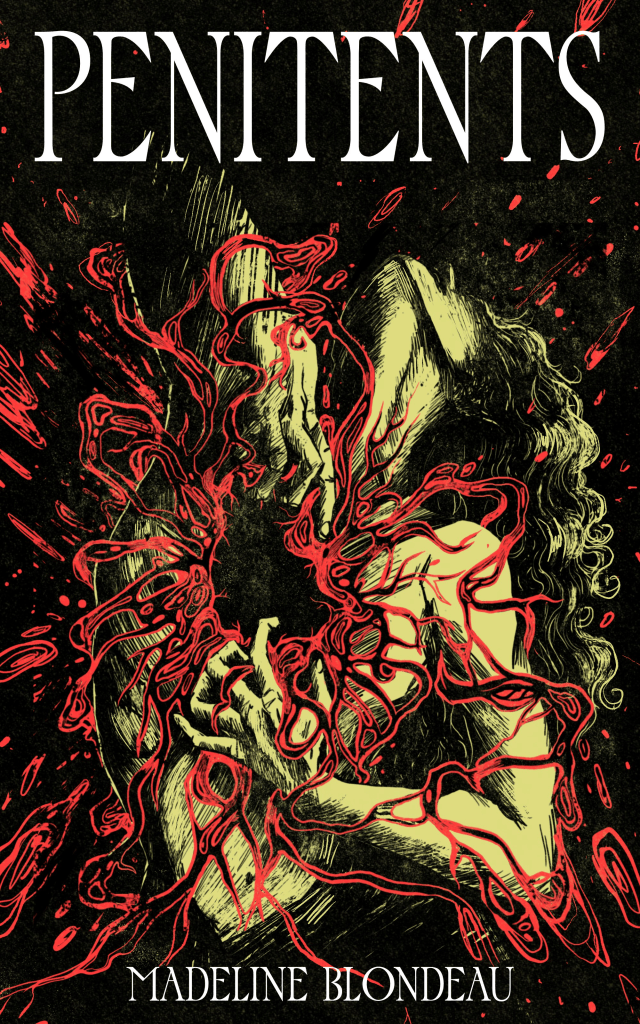
Penitents by Madeline Blondeau, published October 13, 2026 by Ghoulish.



Leave a Reply