The Gothic Birth Canal (1764–1824)
Alright fuckers, here’s the bit.
1001 Books to Read Before the Dirt is a twenty-month project. About fifty books a month. Chronological by original-language publication date, because pretending a 2009 Enríquez story belongs next to 2022 English releases is the kind of editorial cowardice we don’t do here. No more than three books per author, because I’m tired of horror lists where Stephen King eats up the fucking real estate. Each post ships with a historical essay. Not a summary. A statement. The genre has an actual evolutionary history and nobody’s written it well in list form, so fine, we’ll take a crack at it.
You are not going to finish this list. The average reader dies somewhere around entry 340. That’s fine. You were going to die anyway and now you have a project.
This first post is short, only twenty-seven entries, because the first sixty years of the modern horror novel are a narrow channel and padding the count with Minerva Press chaff would be lying about what the archive actually contains. Maybe thirty novels from 1764 to 1824 are still worth reading. Hundreds got published. You can do the math on the survival rate.
There is also the question of where the European tradition ends and other traditions begin, which is the first question this list has to answer honestly. The European Gothic got invented in 1764 by Horace Walpole. But supernatural fiction as a concept did not get invented in 1764. Supernatural fiction had been a going concern in China, Japan, and South Asia for roughly a thousand years, and during the same eighty-year window this post covers, three of those traditions were putting books into print that belong on any serious horror list. So four of this post’s entries are non-European. They are parallel founding documents, placed chronologically where they actually fall. Also worth acknowledging up front: by the time Walpole was having his helmet dream, Antoine Galland’s French translation of One Thousand and One Nights (1704–1717) was already thirty years old and fully absorbed into European literary culture. Beckford is writing Vathek partly because of Galland. Every Romantic was reading the Nights. The European Gothic was never not in conversation with Eastern supernatural material, which is to say the European Gothic was never the sealed self-contained thing it’s usually presented as. Keep that in mind as we go.
The books that made it out of this era are weirder than you remember. Most of the people who wrote them thought they were writing medieval romances. One of them thought he was writing down a dream. One of them wrote it in ten weeks at nineteen, to shock his mother. One of them was a teenage girl who got pregnant on a Swiss vacation and produced Frankenstein. One of them was an Irish Protestant minister who wrote the best Catholic-damnation novel ever written in English. One of them literally convinced himself he was a werewolf and shot himself with a silver bullet. Two of them were working in Chinese traditions older than anything Walpole had read. One was working in a Japanese tradition also older than anything Walpole had read. One was in Calcutta translating horror cycles older than Christianity. These are not normal people. This is not a normal genre. Let’s fucking go.
1. Horace Walpole’s The Castle of Otranto (1764, England)
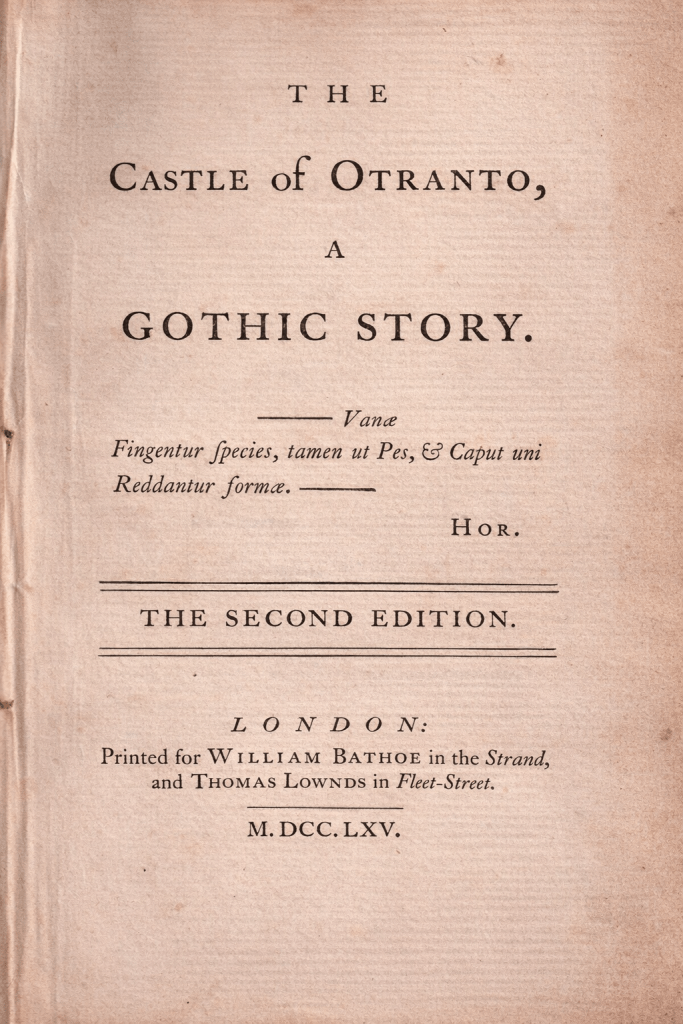
A giant fucking helmet falls out of the sky in chapter one and squashes the heir of Otranto flat. This is how the book opens. This is how the whole Gothic opens. Two hundred and sixty years of horror literature descended from a novel where the first beat is a death-by-absurd-hat, and we mostly pretend that’s fine. It’s not fine. It rules. Everything you’ll find ridiculous reading it, the fainting women, the bleeding statues, the tyrant father brooding around making every scene about himself, is ridiculous, yeah, and also the entire engine, because Walpole isn’t writing a novel the way we use the word. He’s writing down a dream. Literally had the dream one night at Strawberry Hill, his fake medieval castle in Twickenham, which, yes, he’d built himself because he was a viscount with too much money and clearly some deep unresolved feelings about aristocratic legitimacy. Wrote the book in two months. Published it anonymously as a fake translation of a fake thirteenth-century Italian manuscript. Claimed authorship only after it became a hit and nobody got mad. The whole Gothic is the house he built on top of his weird dream. Start here.
2. Pu Songling’s Liaozhai Zhiyi (Strange Tales from a Chinese Studio) (1766, China)
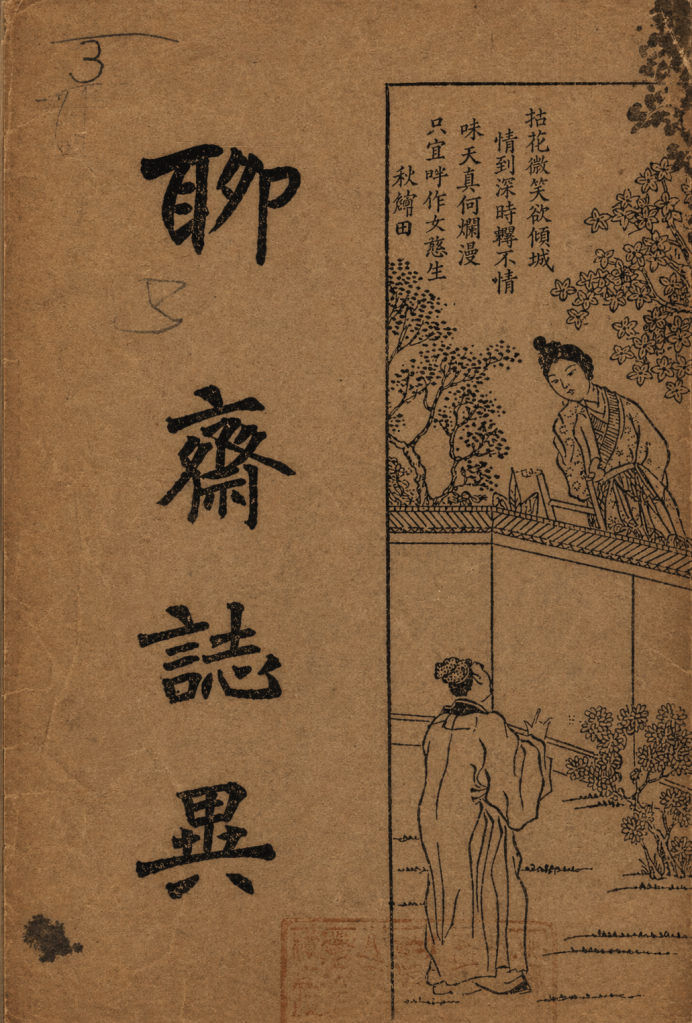
Pu Songling wrote approximately five hundred supernatural tales over forty years between the 1670s and early 1700s, circulated them in manuscript among his friends for decades, kept failing his civil service exams because he was too busy writing ghost stories to study the Confucian classics, died broke in 1715, and the complete collection wasn’t properly printed until 1766. Which is two years after Walpole’s helmet-dream novel. Two years. The parallel is not flattering to Walpole. Liaozhai is the single most important Chinese supernatural collection in world literature. Fox spirits disguised as beautiful women who seduce lonely scholars. Ghosts who marry the living and produce children. Taoist monks conjuring pear trees from walking sticks. A merchant reborn as a pig. An entire ghost city that materializes on the surface of a lake at dusk and vanishes by morning. “The Painted Skin,” where a scholar takes in a beautiful young woman who turns out to be a demon wearing a human skin she peels off and hangs up at night to paint in the morning. Kafka read this in translation and called it exquisite. Borges wrote a prologue for “The Tiger Guest.” Yuan Mei’s Zi Bu Yu (coming at entry 8) exists because Liaozhai set off a hundred-year publishing craze for this kind of literature in Qing China. The Minford Penguin translation is the standard English edition, 104 stories in 560 pages. Do not try to read it straight through. Read five tales in a sitting. They were built for sitting.
3. Ueda Akinari’s Ugetsu Monogatari (Tales of Moonlight and Rain) (1776, Japan)
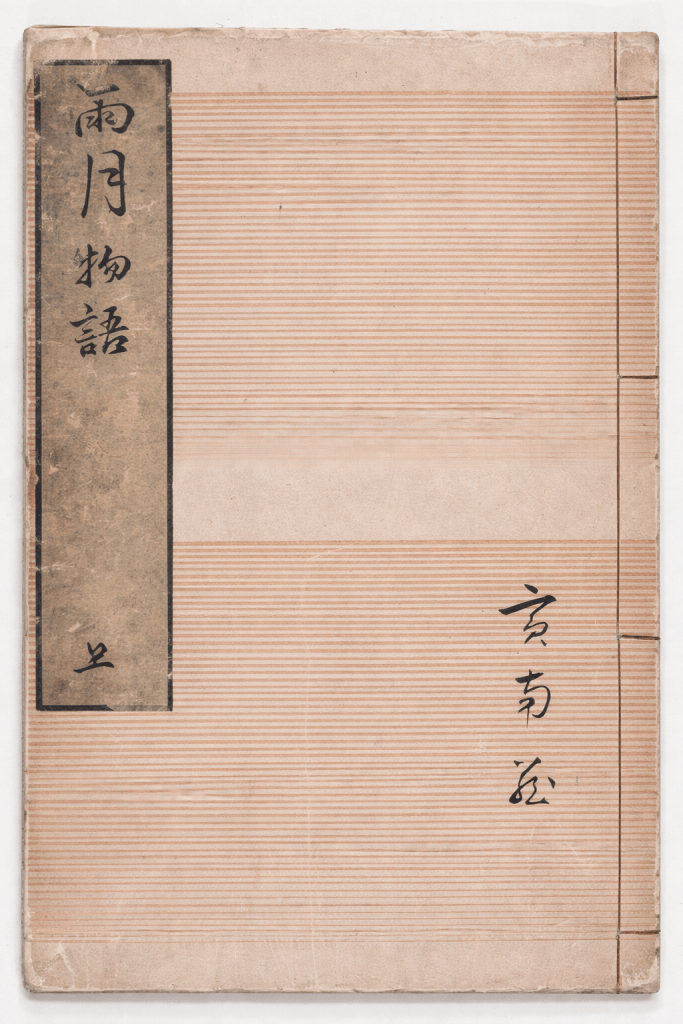
Nine supernatural tales by a Japanese scholar-physician, published in 1776 and running in a complete parallel universe to the Walpole-Radcliffe Gothic happening in London at the same moment. Akinari is writing in the native Japanese kaidan tradition. Vengeful yūrei, lovers transformed into serpents, the drowned returning to finish their business, karma crossing lifetimes. The tradition had been developing in Buddhist and Shinto contexts for centuries and owed Walpole precisely fuck-all. “The Reed-Choked House,” where a husband returns home after seven years away to find his wife still patiently waiting, is as good a ghost story as anything written in any century, in any language. The fact that most Anglo horror lists skip Ugetsu is an indictment of those lists, not of Akinari. Read the Zolbrod translation. Watch the Mizoguchi film after.
4. Clara Reeve’s The Old English Baron (1778, England)
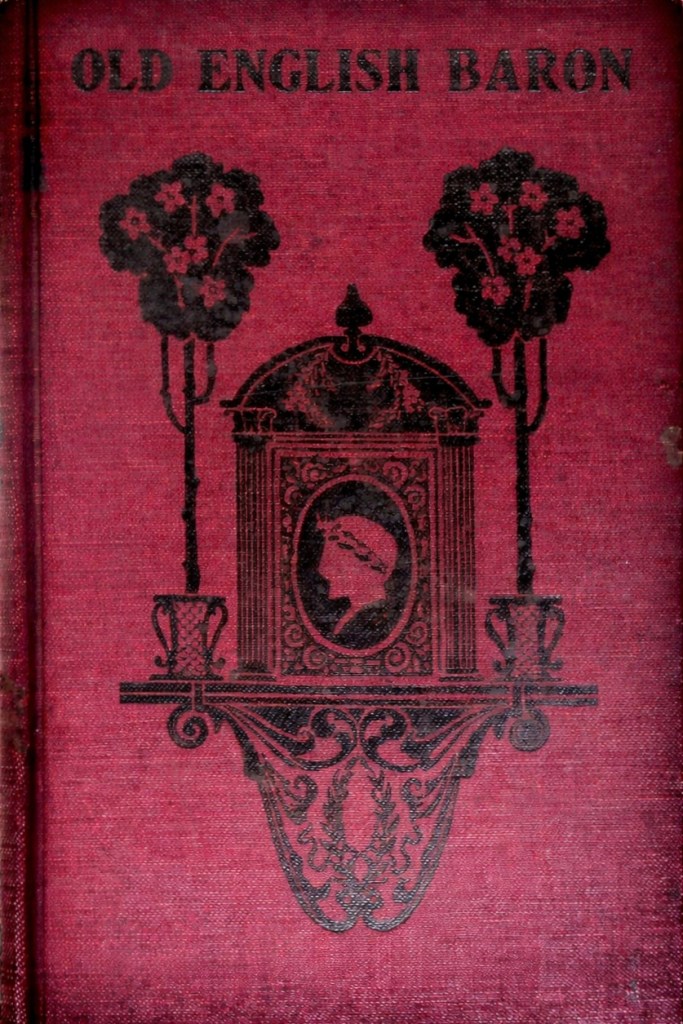
Reeve read Otranto and thought: great concept, too horny. She rewrites it thirteen years later with the supernatural on a leash. Her ghosts have manners. Her knights eat eggs and bacon and complain about toothaches. Nothing is allowed to get out of hand. The result is unintentionally hilarious and historically essential, because Reeve’s sincere attempt to “fix” Walpole is the control group that shows you what Walpole got right by accident. You can skip this one and still follow the plot. But read ten pages of it and you’ll understand the rest of the century better.
5. Sophia Lee’s The Recess; or, A Tale of Other Times (1783–1785, England)
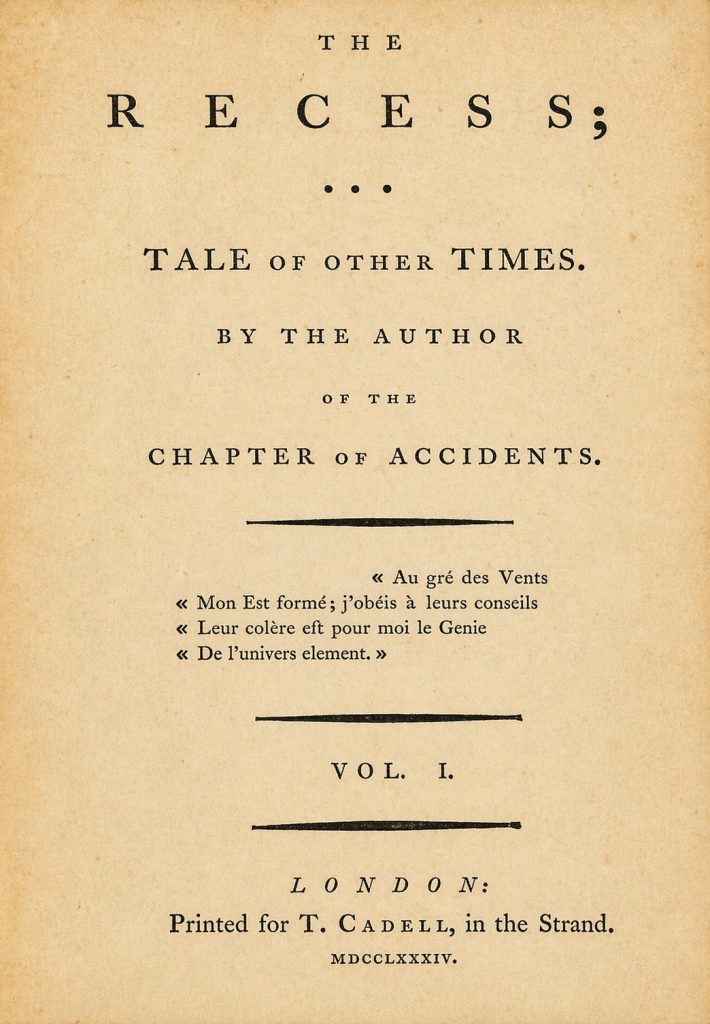
Queen Elizabeth I has two secret daughters, raised from birth in a hidden underground chamber, and the book tracks them out into the early modern England that will proceed to systematically destroy both of them. Gets filed as historical romance, which sells it short by a mile. The Recess is the first Gothic novel where the monster isn’t a ghost or a tyrant but the political apparatus itself. The state is the haunting. Radcliffe reads this, takes copious notes, and ten years later builds an entire career on the idea.
6. William Beckford’s Vathek (1786, England, written in French)
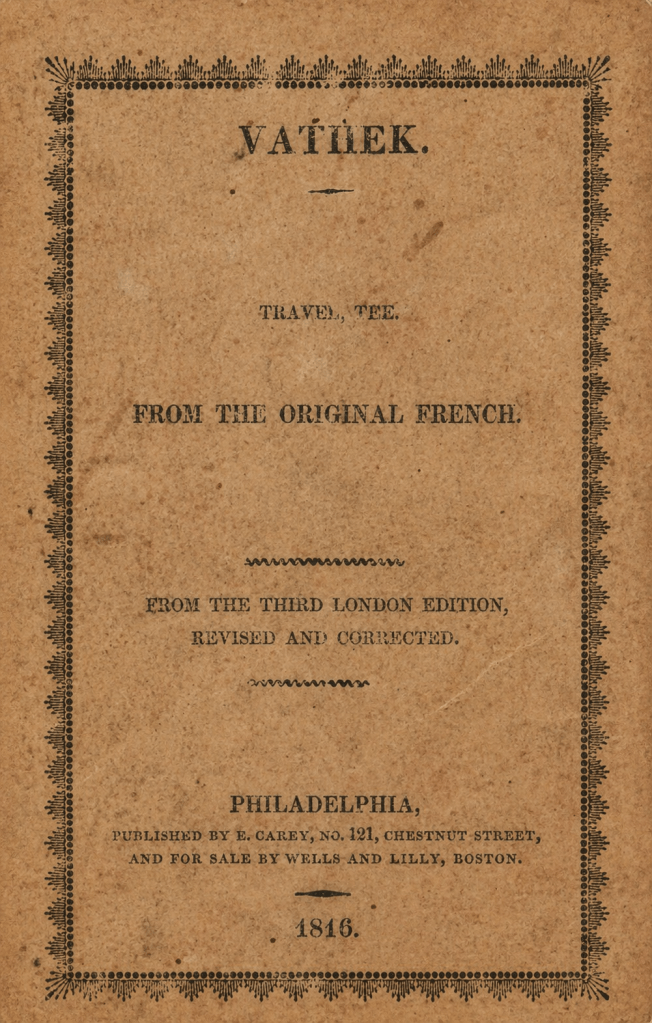
Imagine a twenty-one-year-old English millionaire who’s just met Voltaire, is about to be run out of the country over a gay scandal, and writes a novel in French in ten days about a Caliph who builds a tower to peek over the edge of God’s judgment and ends up in an underground hall where the damned walk around with their hearts visibly on fire behind their ribs. That’s this book. Beckford never wrote another Gothic novel because he was busy spending the rest of his life building an even stupider fake-medieval folly than Walpole had, at a place called Fonthill Abbey, which eventually collapsed because he refused to let the foundation cure properly. Genuine question: were any of these eighteenth-century Gothic guys okay? Answer: no, they were all like this. The Hall of Eblis is still one of the great horror setpieces in any century. Joshi calls Vathek “an eccentric masterpiece par excellence.” Joshi is correct.
7. Friedrich Schiller’s Der Geisterseher (The Ghost-Seer) (1787–1789, German states)
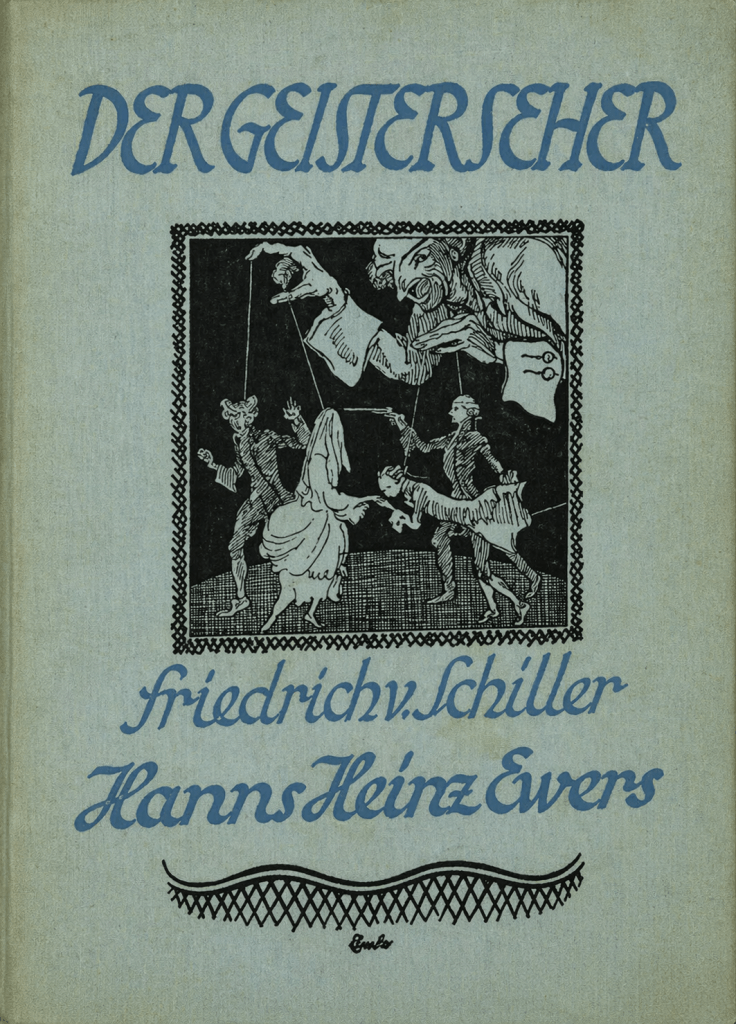
A German prince goes to Venice and gets tangled up with a secret society that stages fake supernatural events for political purposes. Schiller serialized it in his own magazine for two years, then got bored and walked away without finishing it, which is such an absolute move. The Ghost-Seer is the first Gothic novel where the uncanny is weaponized, deliberately engineered by humans, and you can draw a clean line from it through every conspiratorial horror of the next two hundred and fifty years. Pynchon, the X-Files, contemporary folk horror where the cult is the haunting, all downstream of a serialized German novel its own author couldn’t be bothered to finish.
8. Yuan Mei’s Zi Bu Yu (What the Master Would Not Discuss) (1788, China)
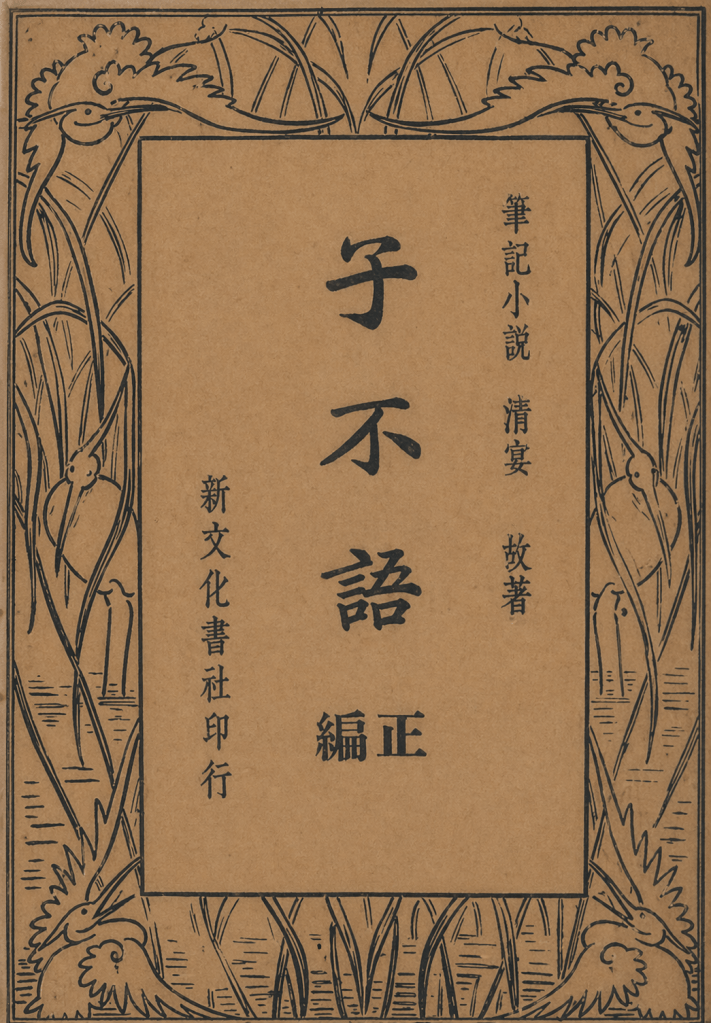
Title is a middle finger. The Analects record that Confucius “did not speak of anomalies, feats of strength, disorders, or spirits.” Yuan Mei, a respected Qing scholar-official who could have been doing literally anything else with his retirement, titles his collection of seven hundred-plus strange tales What Confucius Wouldn’t Discuss, which is peak eighteenth-century Chinese literary petty. The stories are the full zhiguai buffet. Fox spirits. Corpse-brides. Officials haunted by people they wronged. Ghosts conducting tax audits in the afterlife. The restless dead generally having a much more interesting social life than the living. Read fifty of them in a sitting and you will feel like a completely different person. Santangelo’s 2021 academic translation is the most complete English edition; older partial translations exist. Yuan Mei is writing two decades after Pu Songling’s collection finally got into print, is openly imitating the form, and knows he’s imitating it. He is still very funny, very weird, and very much worth reading on his own terms. Suck it, Confucius.
9. Ann Radcliffe’s The Romance of the Forest (1791, England)
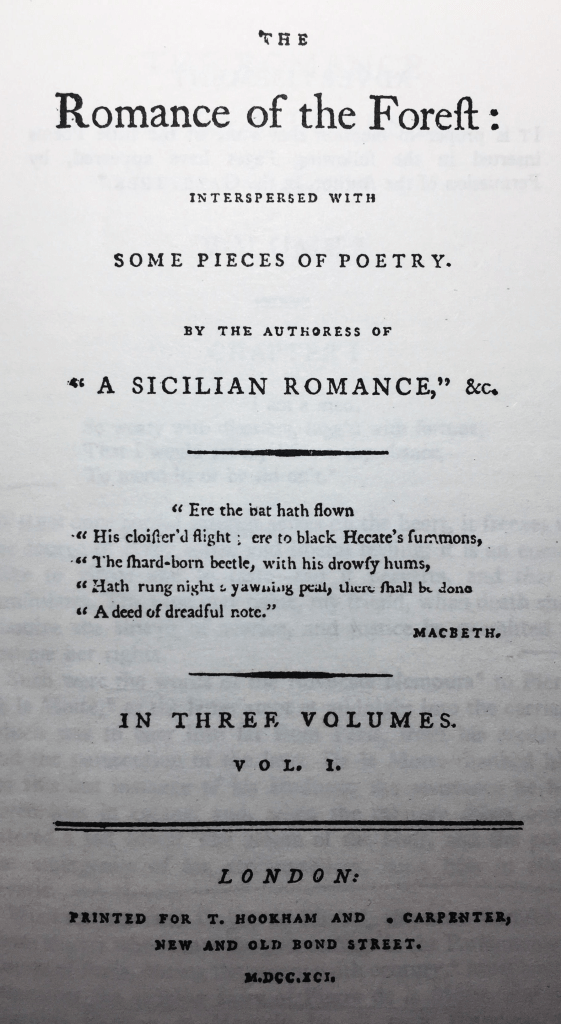
Radcliffe’s third novel, her first fully dialed in, the one where she figures out what she’s actually good at: suspended dread. An orphaned young woman gets taken to a ruined abbey by a fugitive family, finds a manuscript in a secret chamber, and slowly unpicks the crime the whole abbey is built on top of. Radcliffe’s thing is terror as opposed to Lewis’s horror, the anticipation rather than the shriek. She also invents the “explained supernatural”: every ghost turns out to be a draft, a shadow, a misread sound. Modern readers sometimes find this deflating. Wrong read. What she’s actually doing is putting the reader’s imagination on the hook, which is still the dominant mode in contemporary literary horror. Every atmospheric dread novel you’ve ever been unsettled by owes Radcliffe rent.
10. Marquis de Sade’s Justine (1791, France)
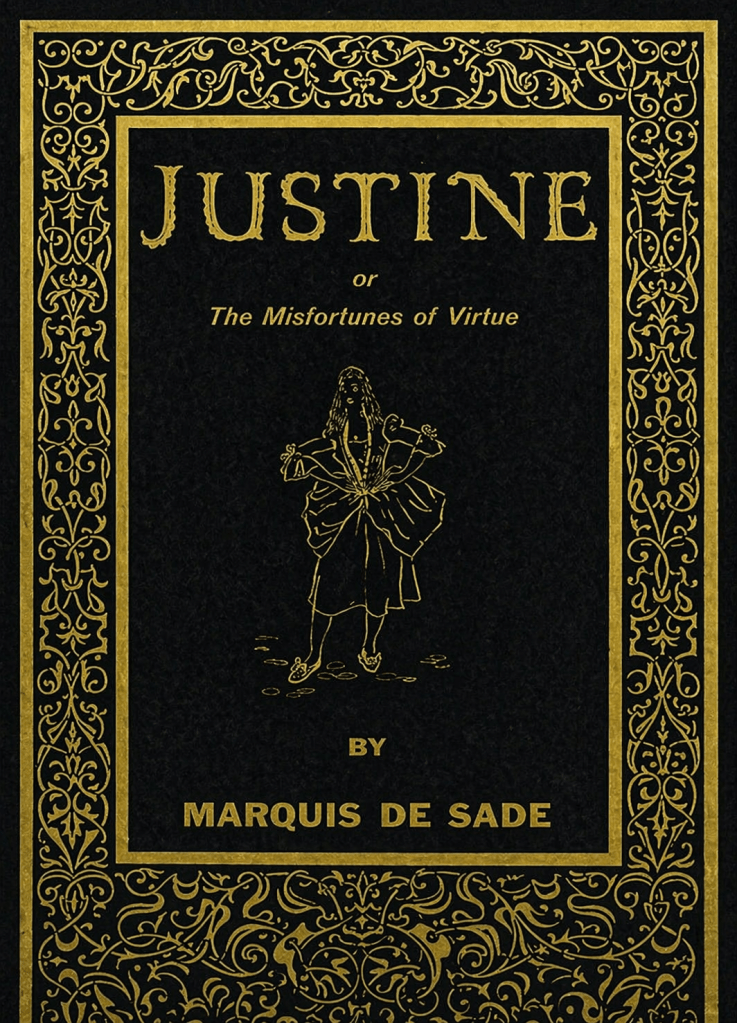
Okay, listen. Sade is going to come up exactly once on this list and we’re going to deal with him right here. Justine is not fun. It’s not fun by design. A virtuous young woman gets dragged through a theological argument disguised as the worst plot in Western literature, and every chapter is Sade banging the same drum: the universe is morally indifferent, virtue is a con played on the weak by the strong, and anyone who tells you otherwise is either lying or about to be robbed. He’s wrong about a lot of things but he’s not wrong about the first part, and the first part is the philosophical skeleton cosmic horror will eventually grow flesh around a hundred years later. Lovecraft’s indifferentism starts here. Lewis’s The Monk wouldn’t exist without Justine. Skip if you need to skip. Nobody will think less of you. But it matters.
11. Eliza Parsons’s The Castle of Wolfenbach (1793, England)
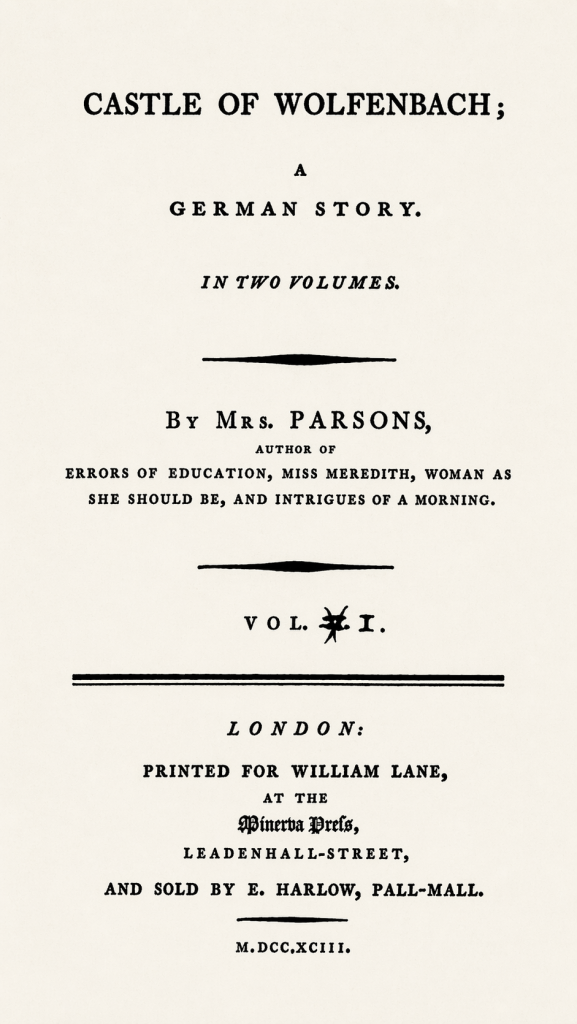
One of the seven “horrid novels” Jane Austen name-checks in Northanger Abbey, meaning Parsons was the pop-culture wallpaper of 1800 and is now completely forgotten, which is the standard outcome for pop-culture wallpaper. Wolfenbach isn’t the best Gothic of its decade. It’s included because Minerva Press pumped out about four hundred of these things between 1790 and 1810, and one of them needs to stand in for the flood. Virtuous heroine, lecherous villain-guardian, castle in the Italian nowhere, locked chamber with the suffering woman in it. All the tropes calcifying in real time. Radcliffe and Lewis were working against this. That’s why they hit so hard.
12. William Godwin’s Caleb Williams (1794, England)
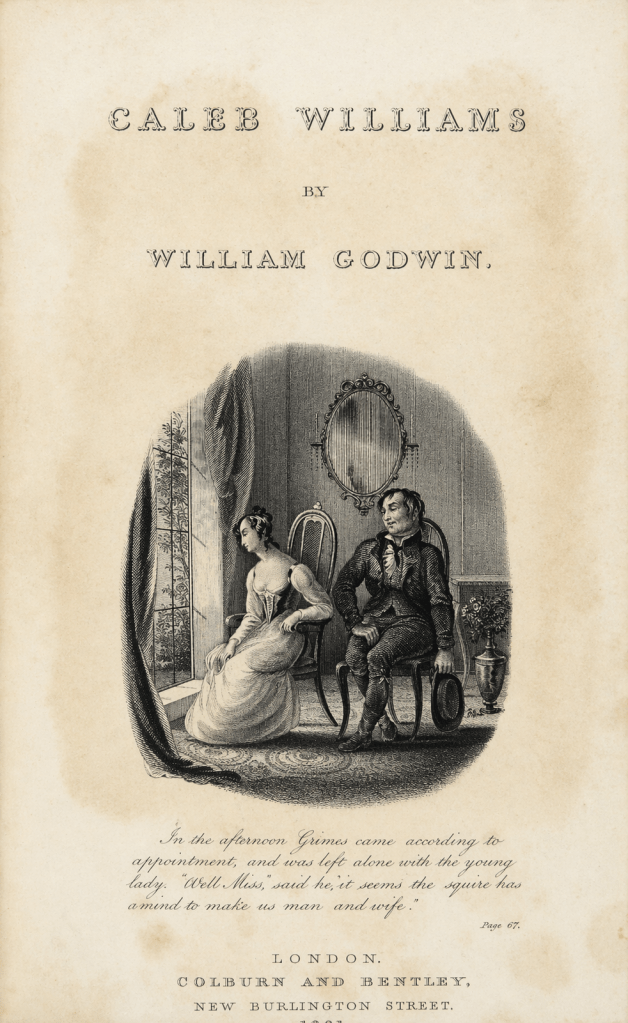
Technically a political novel. Functionally: a horror novel about being hunted across Britain by a rich man whose reputation you accidentally threatened and who will now destroy your entire life to keep you quiet. Godwin wrote it backwards, plotted the ending first, then reverse-engineered the chase. Nothing supernatural in it. Godwin didn’t need any. The machinery of class and reputation was already monstrous enough, and he’s showing his work. First sustained Gothic of pure pursuit. Every stalker novel you’ve ever read, every Javert sequence, every Highsmith creep, all downstream of Caleb.
13. Ann Radcliffe’s The Mysteries of Udolpho (1794, England)
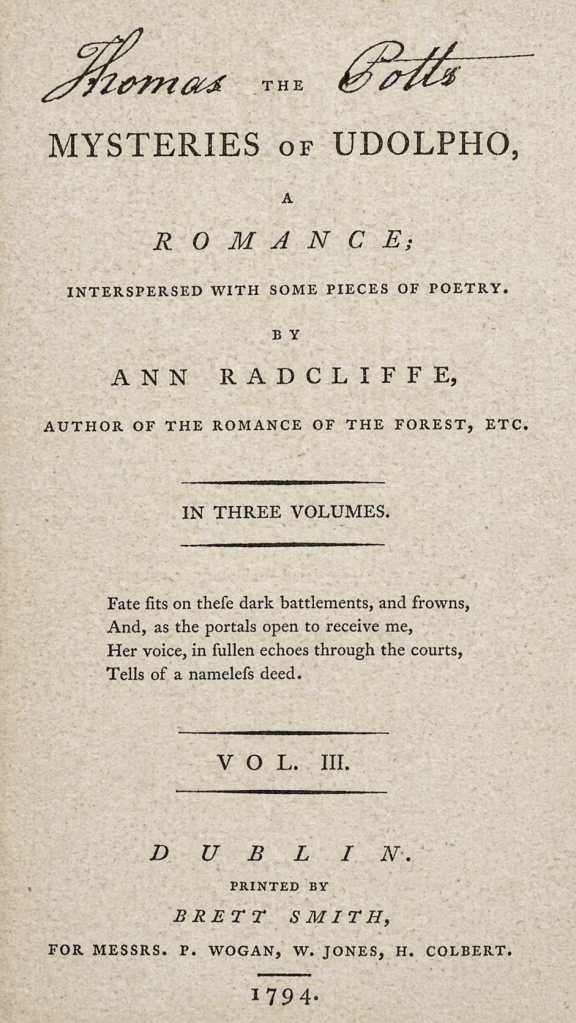
The blockbuster. Radcliffe got paid £500 for this, which in 1794 money was absolutely obscene for a novel, and the paperback Gothic boom is her direct fault. Seven hundred pages. Emily St. Aubert is orphaned, shipped off to a crumbling Italian castle by her aunt’s new husband, who is exactly as bad as he seems and also a little worse. The book is enormous and slow and spends twenty pages describing the Pyrenees before anything scary happens, and I am telling you: lean into it. Let the Pyrenees happen to you. Udolpho isn’t a plot, it’s an atmosphere that needs all seven hundred pages to generate, and once it’s in your head it doesn’t leave. The haunted castle as a living mode in horror literature exists because of this book. Every haunted-house novel ever written is a descendant of Udolpho, most of them without knowing it.
14. Matthew Lewis’s The Monk (1796, England)
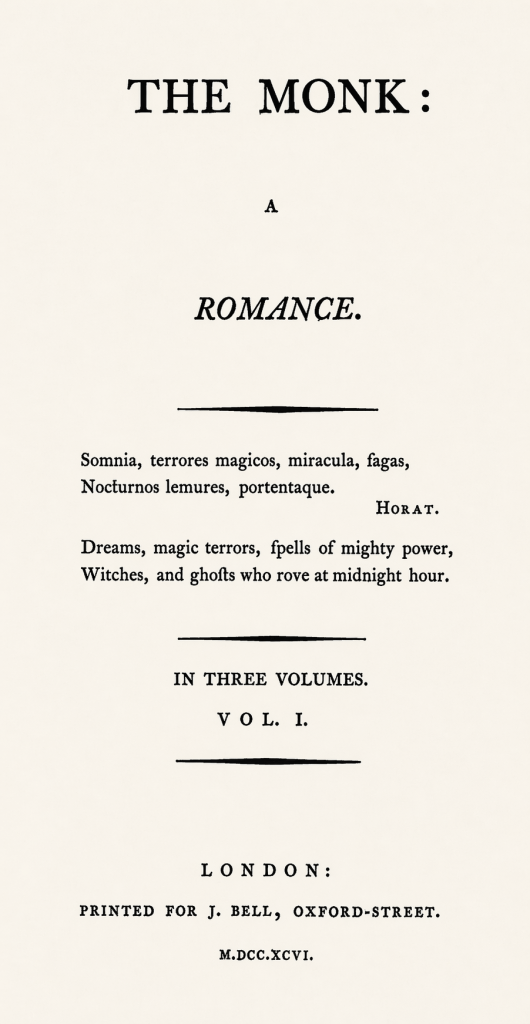
He wrote it in ten weeks. He was nineteen. He was serving as a British diplomat in The Hague at the time. He gave the first copy to his mother. Stop and picture that. A nineteen-year-old fresh out of Oxford writes a novel containing demonic seduction, incestuous rape, the live burial of a pregnant nun, and a deal with the Devil so cruel it ends with the Devil mocking the protagonist on the way to hell. And he hands it to his mom. The Hague chapter of Matthew Lewis’s biography is unhinged. The Monk is the Gothic novel that broke the Gothic novel. Radcliffe’s explained-supernatural could not survive a book where the Devil actually shows up and is worse than you were afraid of. The prose is often bad. The timing is not. The final sequence, where the Devil drops Ambrosio in the Sierra Morena and leaves him to die over seven days, is still legitimately shocking, and was designed to be. Horror as a distinct mode, not terror, not dread, but the shriek itself, starts here.
15. Karl Grosse’s Horrid Mysteries (Der Genius) (1796, German states, trans. Peter Will)
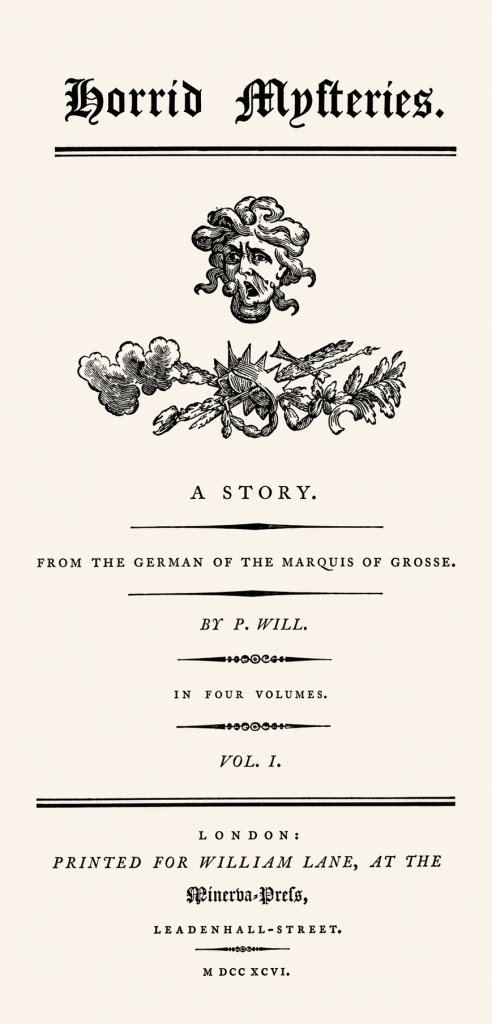
One of the worst novels ever recommended to anyone, and I mean that affectionately. It’s about Illuminati. It’s also about Illuminati. There’s some more Illuminati. It is approximately nine hundred pages of Illuminati. Joshi calls it “nearly unreadable, interminable, and preposterous.” But it was a monster hit in the 1790s and is cited by name in Northanger Abbey, so it’s included here as the representative slice of the German Schauerroman tradition, which pioneered the whole conspiracy-horror architecture that still rules. Read fifty pages. Get the vibe. Put it down. No one will know.
16. Ann Radcliffe’s The Italian (1797, England)
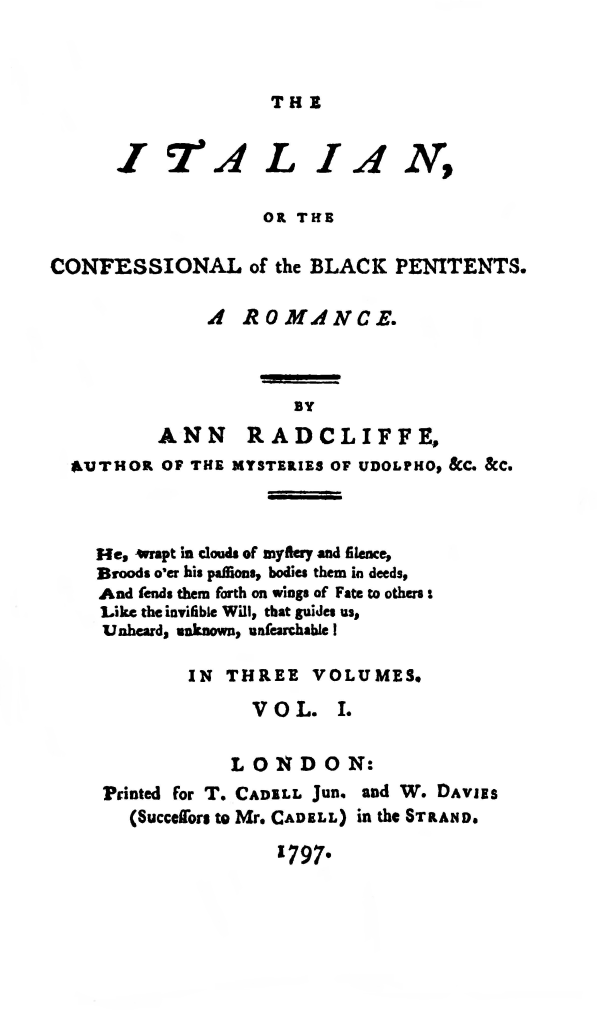
Radcliffe’s response to The Monk is this book, and what she does with that rage is deeply satisfying. After Lewis ran her explained-supernatural method off the road, she comes back leaner, darker, with a terrifying villain in the monk Schedoni, who has a real past and menace and none of Lewis’s Grand Guignol. The Inquisition scenes in The Italian are the best sustained dread sequence of the whole eighteenth century. This is the Radcliffe pick that ages the hardest. Her last novel published while she was alive. She walked away at the top of her game and never came back, and while the conventional reading is that Lewis drove her into retirement, I think she’d just said what she came to say and got bored. Legend behavior.

INTERLUDE: Why the Gothic Needed Catholicism
Something you start noticing once you read the Gothic in order: the books are all set in Italy. Or Spain. Or the Pyrenees, or some vaguely rendered continental Catholic nowhere half-remembered from a childhood atlas. They are full of priests. Monks. Nuns. Confessionals. Inquisitions. Saints’ bones. Buried chambers under abbeys. The occasional literal Satan in a hood. The protagonist is almost always Protestant or Protestant-coded (English, often) and the horror is almost always something the Catholic Church either is, hides, or permits.
Modern readers tend to flatten this into “the Gothic used creepy Catholic imagery for atmosphere,” which is not wrong but also not the whole thing. The whole thing is much stranger, and you need to back up about two hundred years to see it clearly.
The Gothic was born in 1764. This is 230 years after Henry VIII took his ball and left Rome. Between the English Reformation and Horace Walpole having his helmet dream, English Protestantism had spent the better part of a quarter-millennium building an entire cultural self-concept around not being Catholic. Catholicism was the Whore of Babylon in Protestant polemic. Catholicism was also, simultaneously and incoherently, the memory of what England had been before the break with Rome. The monasteries Henry dissolved were still ruined on the English landscape in 1764. Every Gothic novelist writing in the 1790s had grown up looking at actual Catholic ruins dotting the countryside, functioning at the same time as picturesque tourist attractions and as visible reminders of a world that had been violently suppressed to make the Protestant present possible.
So. The Gothic novel is doing something psychologically specific that we don’t have a great name for, and here’s my attempt. It takes the thing Protestant England had spent two centuries defining itself against, medieval Catholicism with its incense and its confessionals and its unbroken tradition of the operative supernatural, and it imports that thing back in as the setting for its nightmares. The foreign Catholic priest is scary because he represents a worldview England theoretically rejected but never stopped being haunted by. His sacramental relationship to the material world, where this bread is actually flesh and these relics actually work, was exactly the worldview Protestant rationalism had renounced. And the Gothic keeps quietly suggesting, over and over, that the renunciation didn’t take. That the supernatural is still operative over there, just outside the Reformation’s reach, and if you cross the Alps you might find out the hard way.
This is why the Gothic heroine is always English or Protestant-coded and always menaced by a Catholic villain in a foreign castle. The novel is staging, again and again, a Protestant rationalist tourist getting ambushed by the realization that the world she thought had been disenchanted is still full of gods, and they are specifically pissed at her. Radcliffe’s explained-supernatural is the Reformation reasserting control at the end of the book: see, honey, it was just a draft, the castle wasn’t actually haunted, go home. Lewis in The Monk is what happens when a Protestant writer stops lying to himself about this. The supernatural is real. Satan is real. He’s in the Sierra Morena, and you were a fool to think Martin Luther fixed anything.
Then the second wave, roughly 1815 through 1824, turns the screws inward. Maturin, an Irish Anglican minister of all things, writes Melmoth the Wanderer as a full-scale indictment of both Catholic tyranny and Protestant self-righteousness. Hogg gives us a Scottish Calvinist serial killer convinced his murders are divinely sanctioned because of his predestined election. The Gothic discovers that Protestantism has its own monsters, and Catholicism is no longer the only rot under the floorboards.
Why does any of this matter in 2026? Because the Gothic’s religious anxiety never went anywhere. It migrated. Contemporary folk horror is the exact same mechanism wearing a rural mask, with ancient pre-Christian forces the rational modern visitor insists don’t exist until they do. Cult horror is the mechanism inside-out, where the pious community is the monster. Hereditary is Gothic Catholicism with the serial numbers filed off. The VVitch is the Protestant version eating itself. Midsommar is Sophia Lee’s Recess as a day trip.
The Gothic needed Catholicism because the Gothic needed an outside, a still-enchanted elsewhere whose existence exposed modern rationality as a consensus hallucination. Once you see that move, the whole foreign-castle cliché starts looking like the genre’s permanent diagnostic of a civilization that talks a big game about reason and lives, mostly, in terror. Every book on this list will in some way be renegotiating this original contract. Even the space ones. Especially the space ones.
Okay. Back to the list.
17. Ludwig Tieck’s Der blonde Eckbert (Fair Eckbert) (1797, German states)

Short. Under thirty pages. And one of the first modern horror fictions in any language. A knight’s wife tells her childhood story to his friend, and the telling unravels reality. Identities slip. Time folds. The knight may be the friend. The friend may be the wife. The forest was never real and also never stopped being real. Tieck is doing things with narrative instability in 1797 that nobody else will touch until the twentieth century. Kafka read this. Ligotti has basically been rewriting it for forty years. Read it in one sitting.
18. Charles Brockden Brown’s Wieland; or, The Transformation (1798, America)
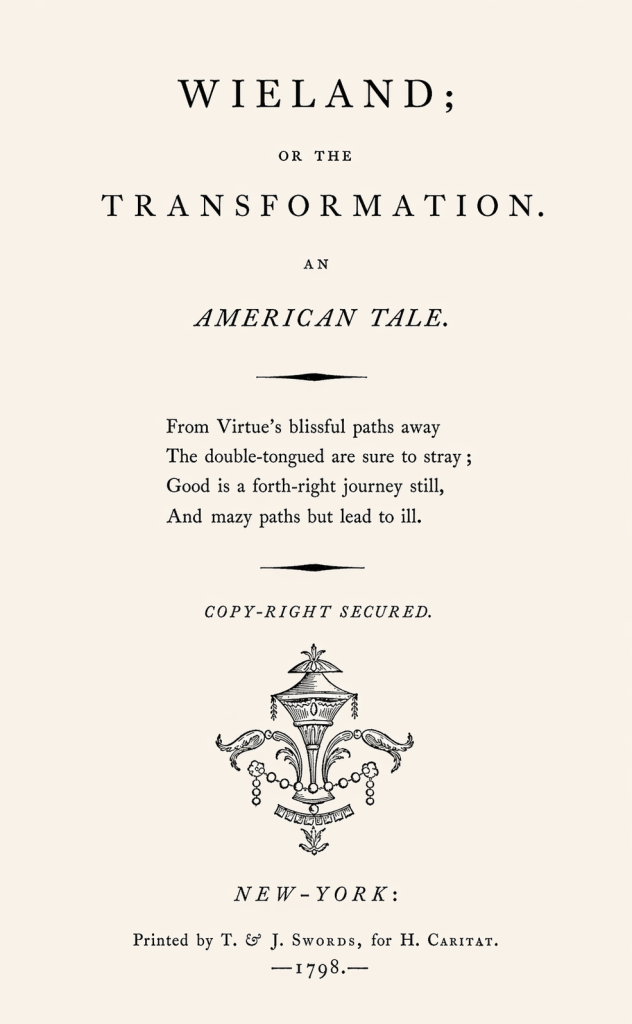
First serious American Gothic, written by a Philadelphia Quaker. A pious German immigrant family in rural Pennsylvania starts hearing disembodied voices that command atrocities. Brown eventually gives you a mundane explanation, that the voices are being thrown by a ventriloquist with his own agenda, and the explanation doesn’t dissolve the horror, it makes it worse. Because Wieland’s father has already been spontaneously combusted by God on the previous homestead, and the son Theodore will hear the voices and murder his entire family, convinced it’s divine command. American horror shows up already obsessed with religious mania, mass delusion, and the specifically Protestant question of how do you know the voice in your head is God. That’s still the American question. We just swap out the farmhouse for a megachurch.
19. Charles Brockden Brown’s Edgar Huntly (1799, America)
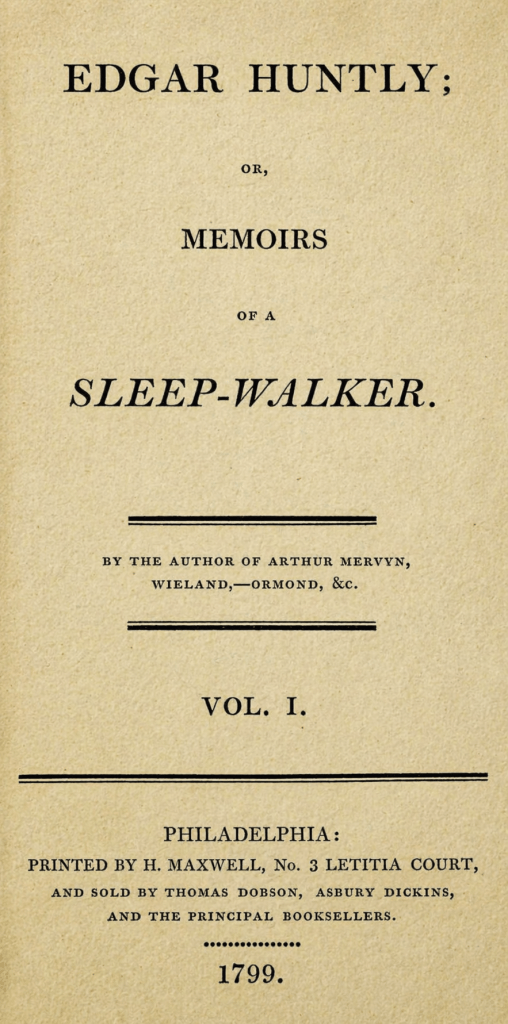
Brown’s frontier novel, and his last great one. A young man investigates a murder, starts sleepwalking through caves, gets lost deep in Pennsylvania wilderness among Lenape warriors who have excellent reasons to kill him, and discovers he cannot reliably distinguish his conscious acts from his unconscious ones. Where Wieland was domestic and claustrophobic, Huntly is vertical and topographic. First American novel to put the frontier itself at the center of the horror. Wild, unmappable, populated by people the settlers had wronged. Brown cranked out four Gothic novels in three years and then walked away for journalism and died of tuberculosis at thirty-nine.
20. Jan Potocki’s Manuscript Found in Saragossa (Rękopis znaleziony w Saragossie) (first fragments 1805, Poland, written in French)
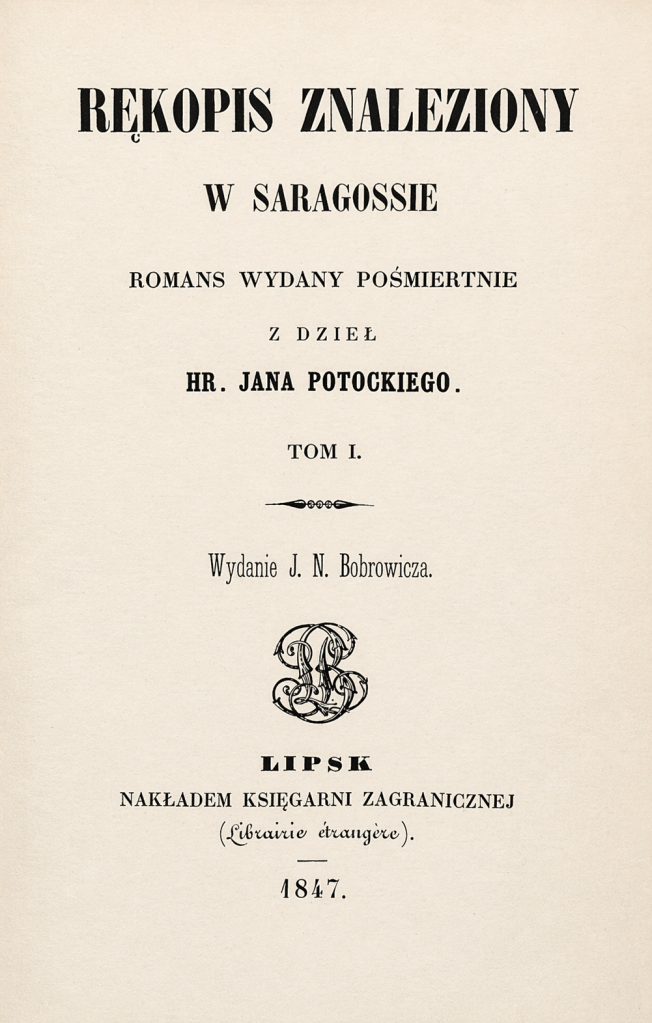
Okay so here’s the story. A Polish count writes a French-language Gothic novel consisting of sixty-six days of nested stories inside stories inside stories, most of them containing ghosts, demons, possessions, cabbalistic operations, or some combination, eventually implicating its own narrator. He publishes fragments in Saint Petersburg in 1805, more fragments in Paris a few years later, and never manages to get the complete text into print in his lifetime. Because he’s busy convincing himself he’s a fucking werewolf. In 1815 he takes the silver knob off the lid of a sugar bowl that had belonged to his mother, files it down, has it blessed by the parish priest, and shoots himself with it. The full novel isn’t properly assembled until the late twentieth century. If you read one book from the back half of this post, read this one. Everything about it is insane.
21. Lallu Lal’s Baital Pachisi (Twenty-Five Tales of the Vetala) (1805, India)
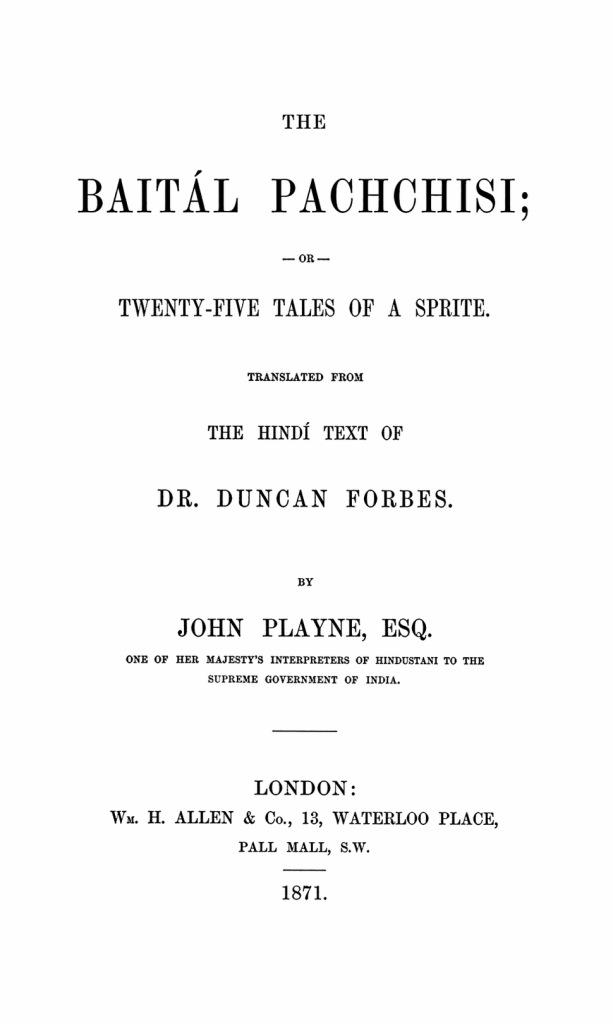
Same year as the first Potocki fragments, on the other side of the world, an entirely different horror artifact is coming out of Fort William College in Calcutta. Lallu Lal’s Baital Pachisi is the first modernized vernacular Hindi version of an ancient Sanskrit story cycle going back to Somadeva’s eleventh-century Kathāsaritsāgara, which itself was drawing on the lost Brihatkatha from centuries before that. The frame is perfect horror architecture and every writer in this post should envy it. King Vikramaditya is commanded by a sorcerer to retrieve a vetala, a demonic spirit that inhabits corpses hanging from a tree in a charnel ground, and carry the thing back silently through the night. The vetala immediately starts telling the king puzzle-stories, asks him a moral question at the end of each, and if the king can answer but fails to stay silent, the vetala escapes and flies back to its tree and the king has to go get it again. Twenty-five tales. The king is on the hook to not speak, the vetala is provoking him to speak, and the reader is in the middle of the best possible frame narrative ever constructed. The vetala itself is a corpse-possessing spirit that predates every European vampire archetype by a thousand years. Richard Burton later adapted the whole cycle into Vikram and the Vampire (1870) and gave the West its first real exposure. Read it as the founding document of South Asian horror fiction in print. Also read it because the frame is genuinely better engineered than most contemporary horror novels.
22. Charlotte Dacre’s Zofloya; or, The Moor (1806, England)
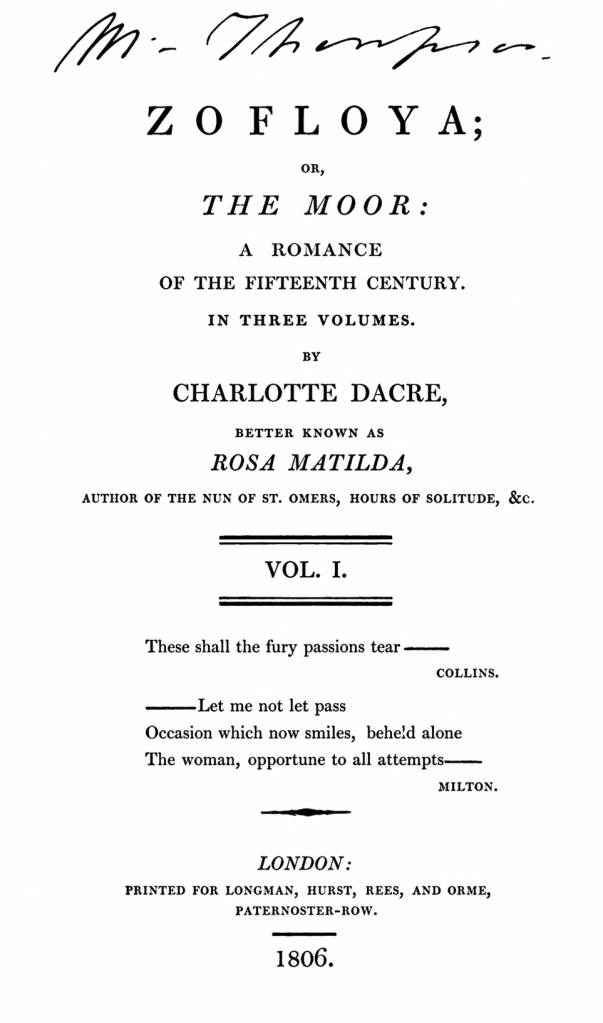
This is The Monk from the villain’s POV if the villain were a woman and the Devil were a Moorish servant. Written by the daughter of a Jewish moneylender under a male pseudonym. It is racist in ways that matter and can’t be hand-waved, and it is also a genuinely astonishing document: a female novelist in 1806 writing a protagonist who fucks and kills her way through the book with zero redemption arc and no apology. Teenage Percy Shelley wrote two imitations. The nineteenth century tried very hard to forget this book existed. It refused.
INTERLUDE 2: Ghosts Without the Gothic
Four books in this post are doing something different from everything else, and the difference is worth sitting with. Pu Songling in China at entry 2. Akinari in Japan at entry 3. Yuan Mei again in China at entry 8. And now Lallu Lal in India at entry 21. Together they’re running in parallel to the European Gothic across the same eighty-year window, and they are not the European Gothic. They are doing different work, and understanding the difference is useful, because once you see what they’re not doing you understand what the Gothic specifically is.
The Gothic, as we established in the last interlude, needs the supernatural to be a disruption. A Protestant rationalist modernity gets ambushed by an older sacred worldview that was supposedly renounced. The castle is Italian. The priest is Catholic. The ghost is what the rational observer has to pretend doesn’t exist and then confront anyway when it turns out to exist. The whole machinery is built on a tension between the world as disenchanted and the world as secretly still full of gods.
None of this is operative in the Chinese strange-tale tradition. None of it is operative in Japanese kaidan. None of it is operative in South Asian vetala cycles. Because those traditions never got disenchanted. They never had a Reformation to recover from. Nobody in Pu Songling’s Shandong province in 1690 thought fox spirits were a metaphor, or a superstition to be scientifically debunked, or a relic of a backwards age to be transcended. Fox spirits were a feature of the cosmos. Like civil servants. Or weather. The stories don’t stage an encounter between a skeptic and the supernatural because the supernatural was not on trial.
What those traditions are doing instead is taxonomic and procedural. They catalog. They populate. They tell you about the creatures and forces already present in the world and the protocols for dealing with them. A fox spirit will try to seduce you, so here is what to do. A hungry ghost needs to be fed at the seventh-month festival, so here is how. A vetala is a corpse-possessing demon who will tell you stories with moral puzzles embedded in them, and if you speak, it escapes back to its tree, so shut up and listen. The horror isn’t are ghosts real. The horror is the ghosts are real and you’re going to interact with them and you had better know the rules.
This produces a different shape of fear. Gothic dread is the dread of ontological collapse: the world you thought you lived in turns out to have no floor. Zhiguai and kaidan dread is the dread of procedural catastrophe: the world is fine, the rules are fine, but you are about to break one and the consequence will last either this lifetime or several. “The Reed-Choked House” is terrifying because the husband has violated a pact of time and fidelity with the dead, not because the wife’s ghost represents the return of some repressed supernatural. “The Painted Skin” is terrifying because the scholar fucks up by letting a beautiful stranger into his house without the appropriate protocol, and what she removes from a hook in her room and puts on every morning to visit him is, in fact, a human skin. These aren’t stories about what’s hiding under the floor of rationality. They’re stories about the price of inattention to the ordinary weird fabric of the world.
The morality is different too. The Gothic runs on Christian sin and damnation. Ambrosio sells his soul. Melmoth has a hundred-fifty-year contract with the Devil. Every Faustian bargain is an individual ruin worked out across the ledger of eternity. The Chinese tradition, and much of the Japanese, runs on karma instead. Nobody in Liaozhai goes to Christian hell. People get what they deserve, but they get it through cause-and-effect mechanisms that cross lifetimes. The filial daughter-in-law is rewarded. The cruel merchant comes back as a pig. The woman who seduces a monk turns out to have been his wife in a previous incarnation and the cycle resolves itself. This is a moral universe. It’s just not a dramatic one in the Christian sense. There is no final scene. No deathbed conversion. No eternal damnation. There is accounting, across time, impersonally applied. This makes the horror colder and in some ways worse, because you can’t repent your way out of it. You can only not make the same mistake next time, which is harder than it sounds when the universe is in charge of grading.
And the ghost itself is different. In European Gothic the ghost is an anomaly, an interruption, something that shouldn’t be there. In the East Asian and South Asian traditions, the ghost is a relative. A neighbor. An ancestor. The dead are continuous with the living, separated by a thin membrane, visiting regularly, needing to be fed and tended and spoken to politely. The horror isn’t that the ghost exists. The horror is that the ghost is legitimately angry at you, and you have caused or inherited the problem, and now you have to figure out how to settle the debt. The vetala in Lallu Lal is not a disruption. It is a test. It is going to quiz you until you get the answer right. This is closer to the spirit’s view of horror than to the protagonist’s.
Why does any of this matter for a horror list in 2026? Because the last twenty-five years of horror have been the period where these traditions have been muscling back into English-language genre consciousness, and they are changing what horror is. Nakata’s Ringu is a yūrei story and its logic is Japanese, not European: Sadako is not an inversion of goodness, she is an unpaid debt. Bong Joon-ho uses Korean supernatural grammar throughout his career. Silvia Moreno-Garcia grafts Mexican folk horror onto European Gothic structure in Mexican Gothic and the tension between the two traditions is the actual engine of the book. Mariana Enríquez draws on Argentine ghosts who have their own rules about who they haunt and why, and their logic is not Catholic even when their surfaces are. Stephen Graham Jones writes Indigenous North American horror whose supernatural is continuous with the living world in exactly the way the European Gothic’s isn’t. A lot of what contemporary horror readers experience as new is actually old traditions that English-language horror has finally stopped ignoring.
So read Pu Songling. Read Akinari. Read Yuan Mei. Read Lallu Lal’s vetala cycle. Not as exotic curiosities but as equal-standing founding documents. The European Gothic is not the whole of horror. The European Gothic is the specific thing the European Reformation made necessary, and most of the world didn’t need that particular invention because most of the world didn’t have that particular problem.
Okay. Back to the list. Hoffmann is next, and Hoffmann is where Europe starts catching up to what the rest of the world already knew.
23. E. T. A. Hoffmann. Die Elixiere des Teufels (The Devil’s Elixirs) (1815–1816, German states)
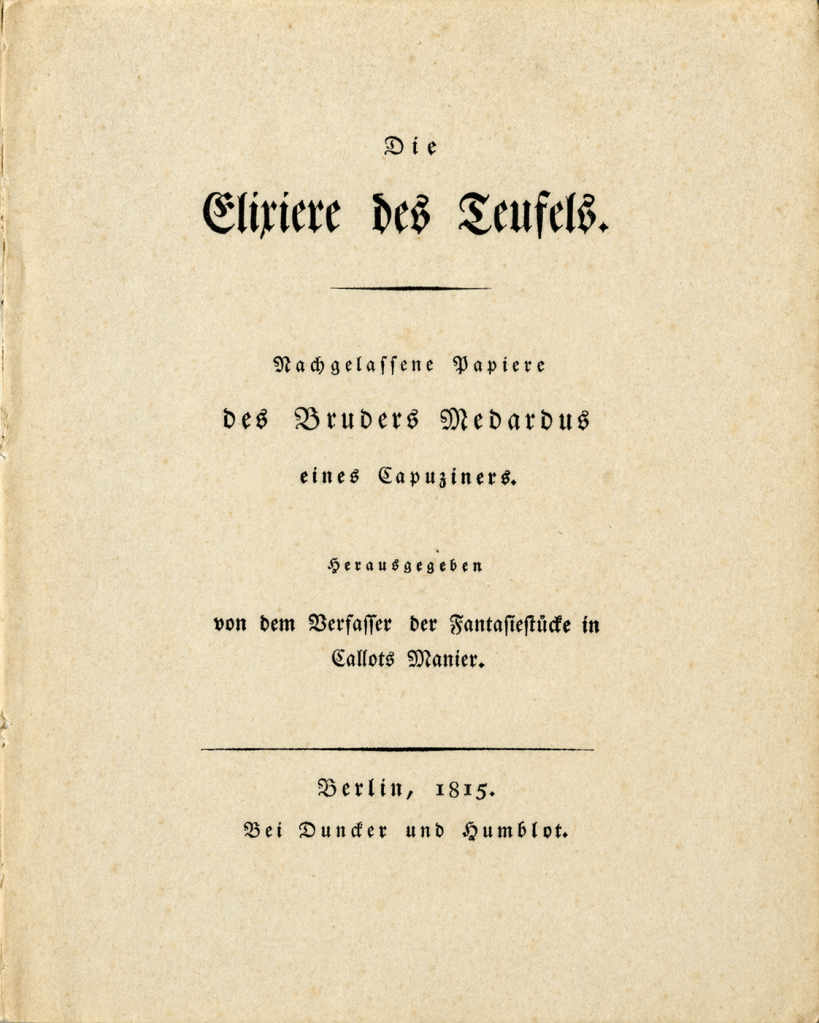
A monk drinks an elixir from the relics of Saint Anthony and starts splitting. He finds his double everywhere, in strangers, in family members, in himself, and he cannot figure out which of them is committing the escalating murders that follow him across Europe. Hoffmann absorbs everything the British Gothic has done and pushes it into something stranger, where the horror is no longer the Catholic foreign elsewhere but the instability of the self. Dostoevsky read this. Freud read this. The whole nineteenth-century doppelganger tradition, Poe and Stevenson and Dostoevsky’s The Double and Hogg’s book six entries below, is in direct conversation with what Hoffmann did here.
24. E. T. A. Hoffmann. Nachtstücke (Night Pieces) (1816–1817, German states)
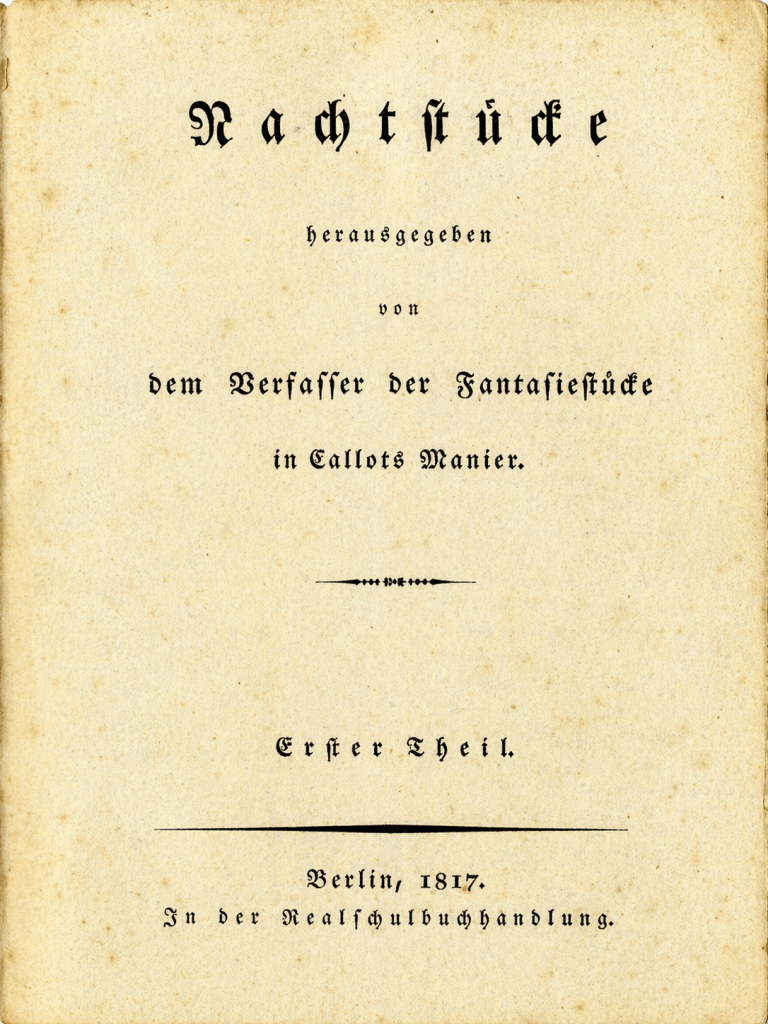
Collection containing “Der Sandmann,” “The Sandman,” which is, no hedging, one of the most perfect horror stories ever written in any language. A young man becomes convinced that the Sandman of his childhood stories is an actual figure operating in his adult life, and Hoffmann never lets you decide whether he’s right or catastrophically ill. Freud built the entire concept of das Unheimliche, the uncanny, out of this story. If you’ve ever been unsettled by a doll that looks like it’s looking at you, or a person who doesn’t move quite right, or a repetition that shouldn’t be possible, you’ve been having a Hoffmann experience.
25. Mary Shelley. Frankenstein; or, The Modern Prometheus (1818, England)
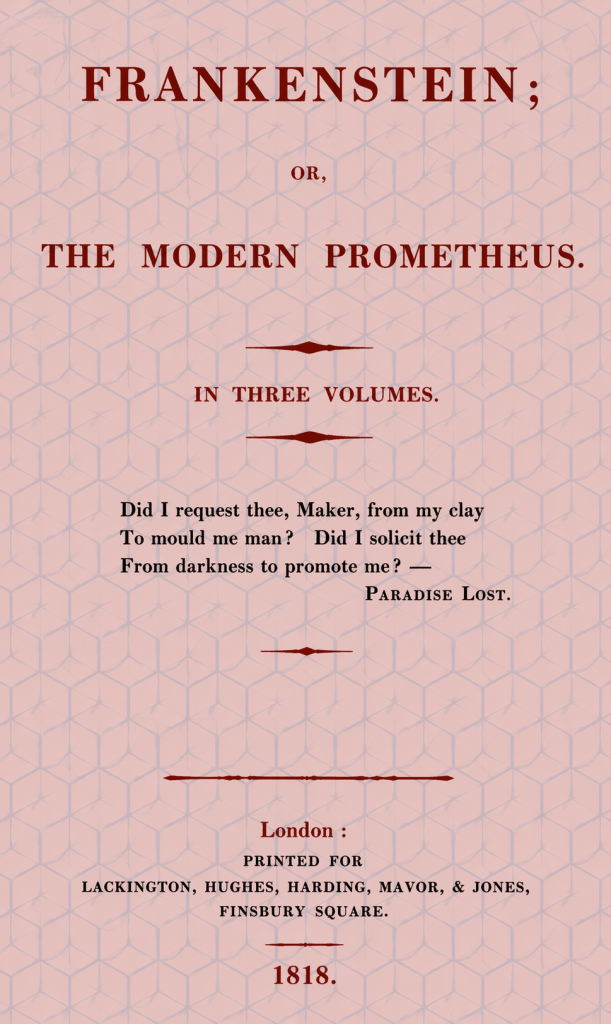
Started at eighteen on the shore of Lake Geneva during the ghost-story competition at the Villa Diodati in the famously shitty summer of 1816, when the Tambora eruption had blotted out the sun across Europe and a bunch of Romantics were stuck indoors getting fucking weird. Finished and published at twenty. The originating document of science fiction and a late-arriving masterpiece of the Gothic, and one of the rare cases where “most important book in a genre” and “actually genuinely great” line up without argument. The horror isn’t the creature. The horror is Victor refusing to look at what he made, and the creature’s slow education into the fact that the world has no place for him. Read the 1818 original, not the 1831 revision Shelley published after Percy drowned. The original is leaner and angrier and doesn’t apologize. Every horror writer working with creation, responsibility, the abandoned thing, the made thing that exceeds the maker, is still writing Frankenstein variants whether they know it or not. She wrote it at eighteen. Think about that and try to feel good about your own twenties.
26. Washington Irving. The Sketch Book of Geoffrey Crayon, Gent. (1819–1820, America)
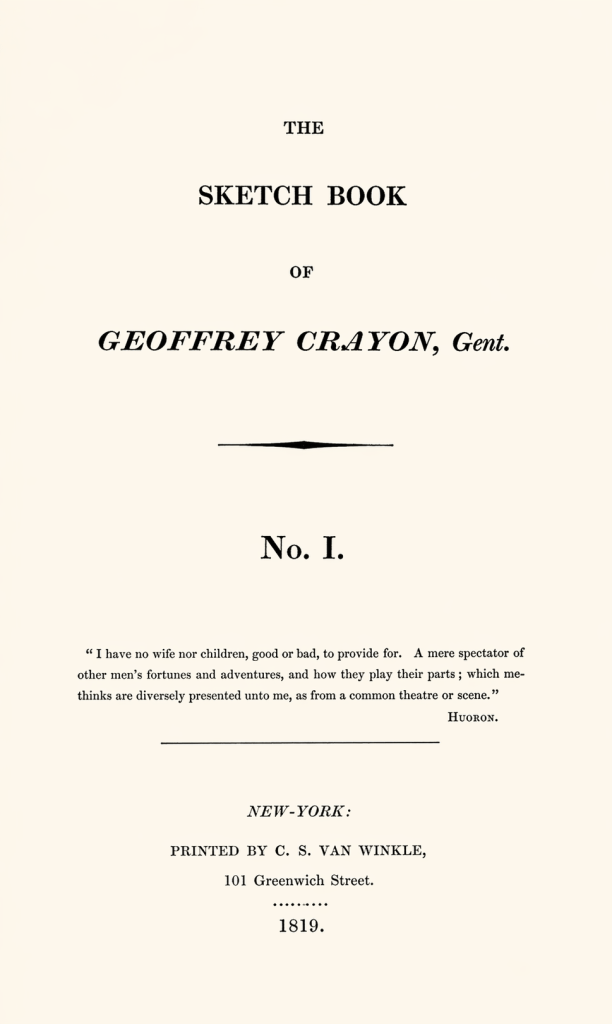
Collects the two stories that gave America its first native ghost-story tradition, “Rip Van Winkle” and “The Legend of Sleepy Hollow,” buried inside a lot of sketches of comfortable British nostalgia that nobody reads anymore. Irving’s move is specifically American: grafting European folklore onto New World landscape and getting ghosts that are continuous with a settler mythology still actively being invented. Ichabod Crane getting chased through the hollow by a headless Hessian mercenary is the template for two hundred years of American regional horror. Brief. Strange. Still works. Anyone who tells you Sleepy Hollow is just a kids’ story has not actually read it.
27. John Polidori’s The Vampyre (1819, England)
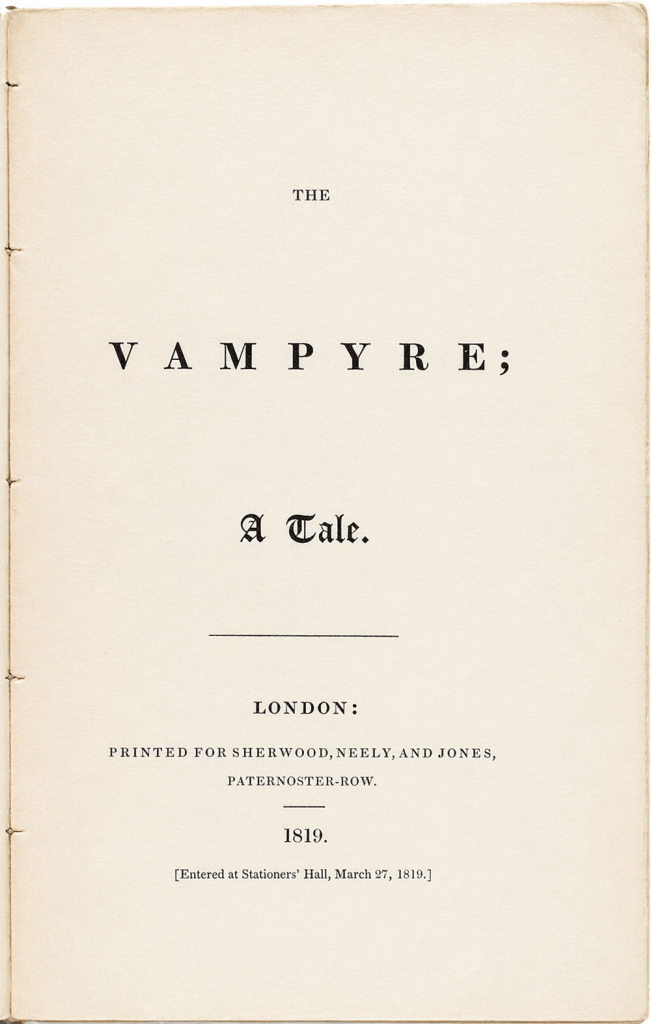
Polidori was Byron’s personal physician, and he wrote this at the same ghost-story contest that produced Frankenstein, which is one of the most productive weekends in the history of Western literature. Published three years later, probably without his full consent, and initially attributed to Byron, which sold a lot of copies and drove Polidori into the ground. Lord Ruthven, the first literary vampire in the modern sense, is a full hatchet-job portrait of Byron: beautiful, bored, preying on society’s women, impossible to kill. Every subsequent vampire in English literature, Carmilla and Dracula and everything downstream of them, is responding to Lord Ruthven. Polidori killed himself at twenty-five. He got one book. It mattered more than most writers’ entire careers.
28. Charles Maturin’s Melmoth the Wanderer (1820, Ireland)
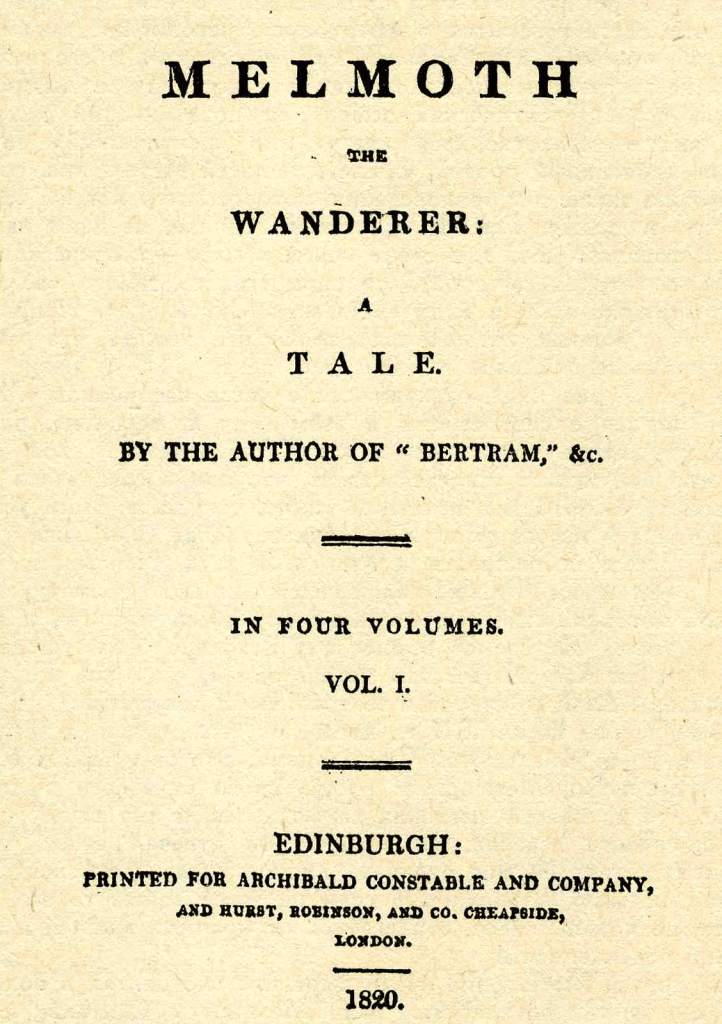
The last great Gothic novel and arguably the best one. Maturin was an Irish Anglican minister in Dublin with a gambling problem and a book problem, and what he produces is a novel about a scholar who sold his soul for a hundred and fifty extra years of life and is now wandering Europe trying to find someone desperate enough to take the contract off his hands. Structured as a Russian nesting doll: stories inside manuscripts inside shipwrecks inside letters. The sequence in the Tale of the Spaniard, where a prisoner of the Inquisition describes the incremental cruelties of a religious dungeon, is some of the best sustained horror writing of the nineteenth century, full stop. Lovecraft called Maturin “the greatest as well as the last of the Goths.” He was both. Balzac basically wrote fan fiction of this book twenty years later. I’m being serious. Look up Melmoth Reconciled.
29. James Hogg’s The Private Memoirs and Confessions of a Justified Sinner (1824, Scotland)
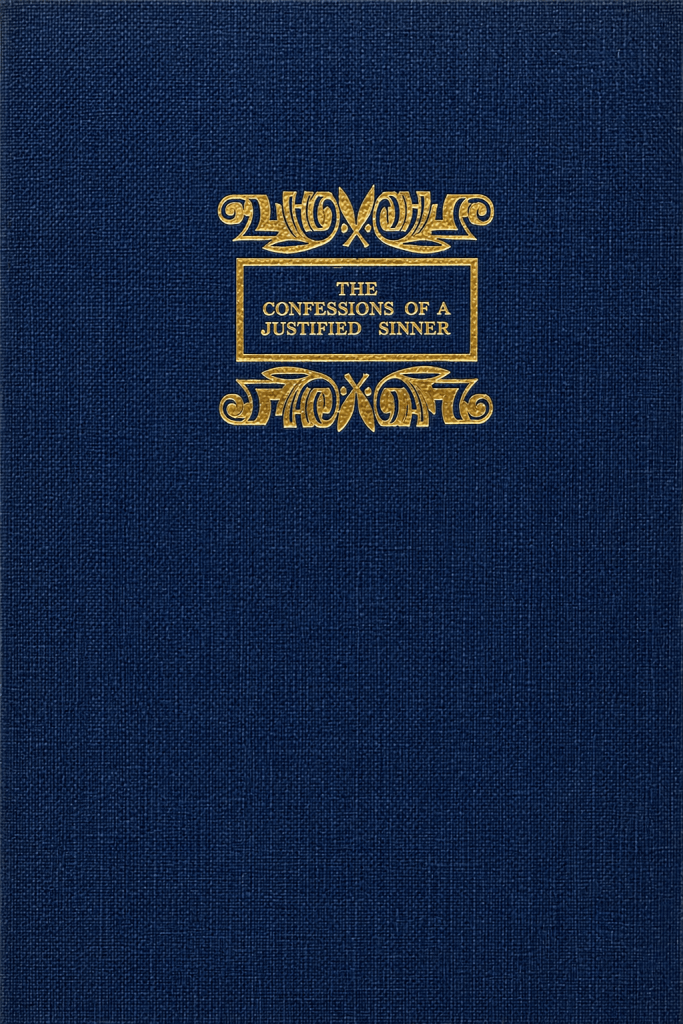
The capstone of the whole Gothic birth canal, and the book pointing directly at what horror is about to become. Young Scottish Calvinist, convinced by his upbringing that he’s among the divinely Elect and therefore cannot sin regardless of what he does, meets a mysterious double named Gil-Martin who encourages him toward a series of escalating murders in the name of God. Hogg refuses to tell you whether Gil-Martin is the Devil, a hallucination, or the protagonist’s fractured psyche, and the novel’s hard commitment to that ambiguity is its whole genius. First Gothic novel that fully understands the horror is not knowing. Out of print for most of the nineteenth century because nobody in 1824 was ready for it. Rediscovered in the 1940s. Ready now.
What this post was
Twenty-nine books, sixty years, the shape of what the modern horror novel was doing before it splintered into everything else.
The founding document is a dream. The commercial peak is seven-hundred-page terror as atmosphere. The transgressive counter-stroke is the supernatural refusing to be explained. The late syntheses understand that Protestant self-regard is the next horror to confront, which will keep horror writers busy for another two hundred years. And running in parallel across the entire period, on three different continents, are older traditions with solved supernatural problems going back a thousand years. One of them gave us the first great Chinese strange-tale collection. One of them gave us nine of the best ghost stories ever written. One of them gave us a vampire cycle a thousand years older than Dracula.
What these books build, together, is not a canon of scary novels but a grammar of what supernatural fiction can be. The haunted building. The buried past. The double. The pursuer. The contract with something worse. The frame narrative that implicates the reader in the telling. The foreign elsewhere where modernity doesn’t reach. The vengeful dead who remember exactly what you did. The fox spirit who needs only that you open the door. The vetala who will quiz you until the sun comes up. Every move is still operative in horror novels published this year. Open any good one and you can point to the ancestor in this post.
Post 2: Romantic Horror and the Short Form’s Rise (1825–1865)
Next month: Poe arrives and breaks everything. Le Fanu invents the modern ghost story. Hoffmann gets his third slot. Hawthorne does something specifically American with Puritan guilt. Gogol gives us “Viy” and “The Nose.” The novel cedes ground to the short form because dread turns out to have a shelf life, and the magazine is the delivery mechanism that fits it perfectly. We also leave the European Gothic’s exclusive focus on itself and start picking up the Brazilian, Spanish, and Russian branches of what was already happening all over the world.
Forty entries (I think). One essay: Why the short story became horror’s native form.
Thirty days. Stay out of the dirt.


 The Blog Without a Face
Leave a comment