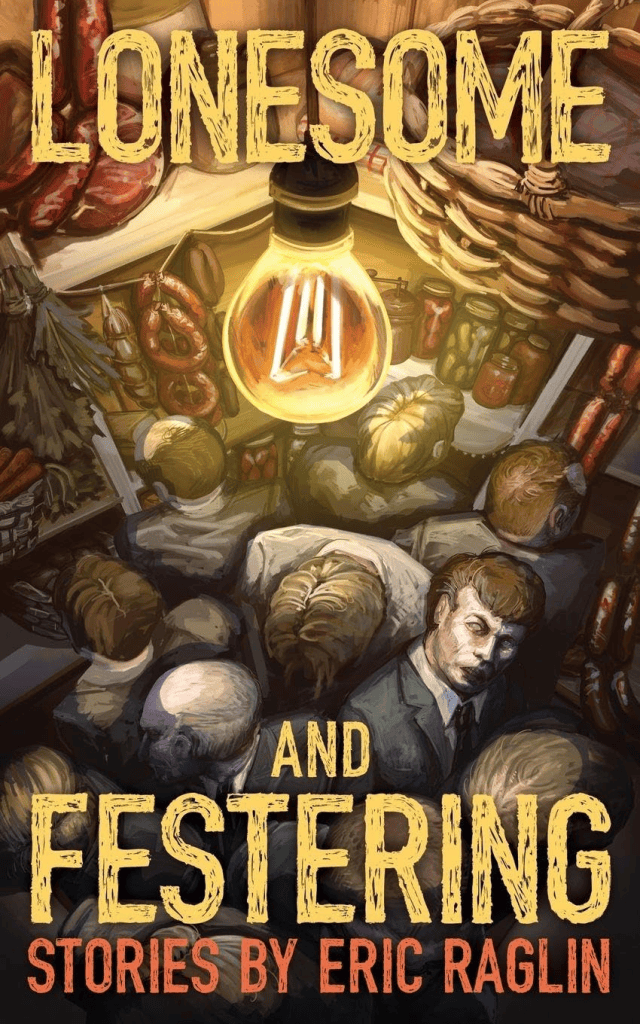
TL;DR: Every lonely person here grows something hideous, and the hideous thing is the only one who calls back. Twenty-one stories from the guy who owns Cursed Morsels, and the best of them are the real fucking thing: a ghost reef, a pantry that makes lonely men phone each other, a cave that screams at poison, a town monster that licks everyone and spits out one guy. Some run on frames you’ll know on sight, and the running order saves its repeats for the end, but the good third carries the book.




Cursed Morsels is one guy. Eric Raglin owns it, edits its anthologies, and on this book’s copyright page he is credited with the interior formatting too, which means the chain of people who could have told the author no was, start to finish, the author. I want that on the table before anything else, ’cause this blog roots for the fucking house. Antifa Splatterpunk, Bitter Apples, Under a Malevolent Eye, No Trouble at All: Raglin’s anthologies are where I go to find other people’s weird, and a press this small putting out a book this wet gets my full attention. It does not get the benefit of the doubt.
Twenty-one stories, fourteen of them reprints (two from anthologies Raglin edited himself, which is a perk of ownership) and seven new. No frame, no introduction. The title is the thesis and the book sticks with it. Story after story, the loneliness is a thing you can see. A hole above the heart. An ingrown hair with no end. A wart for every toad killed on the highway. Roaches in a man’s intestines that he pays an exterminator to fumigate through his ass, and I’m sorry, I didn’t write this shit, I just read it. The lonely person grows something, and the something is the only company that ever says yes.
Credit first, and it’s long. “The Coral Tombs” puts a widower at the wheel of a tour boat, ferrying sunburned Americans out to a dead reef where the drowned glow green and his husband’s ghost drifts beside the anemones and does not notice him. What it does with the tourists before the hurricane made me sit the fuck up. “No Such Thing as a Lonely Sardine” is eight hundred and fifty words (more or less) about an abandoned pantry with that sentence spray-painted on the wall, and the lonely men who stand in it start calling other lonely men, and it closes on a document so flat and so right that I laughed out loud and then didn’t feel great about it. “The Chalk Martyrs” has teachers at a gutted public school feeding body parts to a chasm under the old bomb shelter in exchange for standing desks and a short-throw projector, and the new hire wants the projector without the toe.
“The Debtor’s Sandwich” is lunch debt, and the scariest fucking prop in the book is a walkie-talkie. A brown kid at a rich white school can’t cover lunch, gets handed the sandwich with the jiggling yellow filling, gets moved to the table in the corner, gets walked out of the cafeteria by a bald administrator with that walkie-talkie on his belt, and gets offered a way to work the debt off that involves a keypad, a staircase that goes down a lot longer than a school basement should, night-vision goggles, and a bucket.
“The Devouring Hole” gives two starving siblings a cave their dead mother promised can tell food from poison, and it can, by screaming like a thousand pinned hares every time you feed it something that would have killed you. The boy has to decide whether to make it scream again. I would put it against anything Raglin has published by anyone else. Then “The Licker,” a town where a spindly thing taller than a doorway sneaks up and licks you once and goes mmmmmm, and one man it licks and spits out. The story rides that idea to a last page that is a list of flavors.

Now the column I don’t enjoy. About a third of the book runs on frames a horror reader can probably name pretty quickly. The opener, “Macramé Flames,” is queer Satanist bikers reuniting to torch the 666th Hobby Lobby after the first count came up one short, which is Satan as liberator in the exact mode of the Antifa Splatterpunk anthology, a wish with a Gimli beard on it. “The Spark” is a Black Mirror episode, an earpiece that announces when a woman wants you and keeps announcing it in the alley behind the bar after close. “The Birthday Hole” is a body opening a door for a lover, which is the slot in James Woods’s stomach in Videodrome and the last ten minutes of Society, where the rich melt into each other. The calendar story is “The Mezzotint,” M.R. James’s 1904 picture that changes every time you look at it, with firefighters’ abs and a puppy missing its lower jaw.
Lonely, somewhere between twenty-five and thirty-five, a shift job (grocery, Pizza Hut, pest control, the Burger Bear), one rejection away from the floor. That’s every narrator in the book. The villains are cartoons. A TV director who says “freak of the week.” A landlady with a Clean Living Clause and twin adult sons who call her Mother. A recruiter whose business card leaves a dot of ink that won’t wash off. Cops who exist to be pulled into a hole. Cartoons are fine for a joke, but only about one story in three puts two people who want different things in the same room and lets that decide what happens, and those are the ones with real fucking teeth. The widower and the man who paid for the tour, the boy at the cruising ground who wants to die and the boyfriend who wants to be a hero.
Half these stories end on a punchline or a hug. Hell as a queer paradise. An arson that reads as therapy. “The Licker” gets to its tasting menu and then adds one line of consolation I’d have cut with a box knife. “Cave In” is the one that gets it right: a woman whose best friend’s skull keeps caving in, which she fixes with a plunger, and it’s a sitcom premise until it really fucking isn’t, and it ends on an object that is a gag and a wound in the same breath. I can’t put it down.
I still don’t know what “A Pain All My Own” is. A stalker eats an MMA fighter’s hair and takes her pain away, and she wants it back, and the last page reads as a win if you squint and as something much worse if you don’t. Three reads, and I’ve argued it from perspectives.

The last four stories play the book’s two major moves back to back: a lonely body learns to love what it grew, twice in a row right after the TLC story already did it. Then a grave-robber who delivers dead killers to the women who write to them, and what he decides about company; then a landlady confiscating a couple’s sex toys into a pit under the building with something living in it, which the teachers and the lunch ladies already did better eighty pages earlier. The closer ends warm, which is the last goddamn thing a book with this title should do. “Warts,” which is the right last story (a seventy-year-old woman who feels every toad die on the highway outside her fence, and the toads are endangered, and nobody is coming), sits third from the end. I read it on the porch with trucks going by and went inside.
Amherst, Massachusetts dug two tunnels under Henry Street in 1987 so spotted salamanders could cross on the first warm rain of spring without getting flattened, and on the right night volunteers still stand out there with flashlights, walking the slow ones across by hand. You get the date by email. I’ve been on that list for three years. I keep meaning to go.
Add it up. Three stories I’d hand to anyone, half a dozen more built on an idea nobody lent him, a third I have read under other names, and a last stretch that repeats itself. That is a good book with a soft back half, and it lands at its score mostly on the strength of “The Devouring Hole.” None of that counts the back pages, which are a catalog of the press’s other books, and the catalog is other people. Cynthia Gómez’s Oakland. Briar Ripley Page’s werewolves. D. Matthew Urban’s burned-out professor taking up the art of annihilation. Samir Sirk Morató’s housewife who finds out she is made of ticks. That is where Raglin’s attention goes when he isn’t formatting his own interior, and it’s the reason a one-man press gets this much of mine. Buy this one straight from the press. “The Devouring Hole” alone covers the shipping, and the catalog behind it is why I keep the tab open.