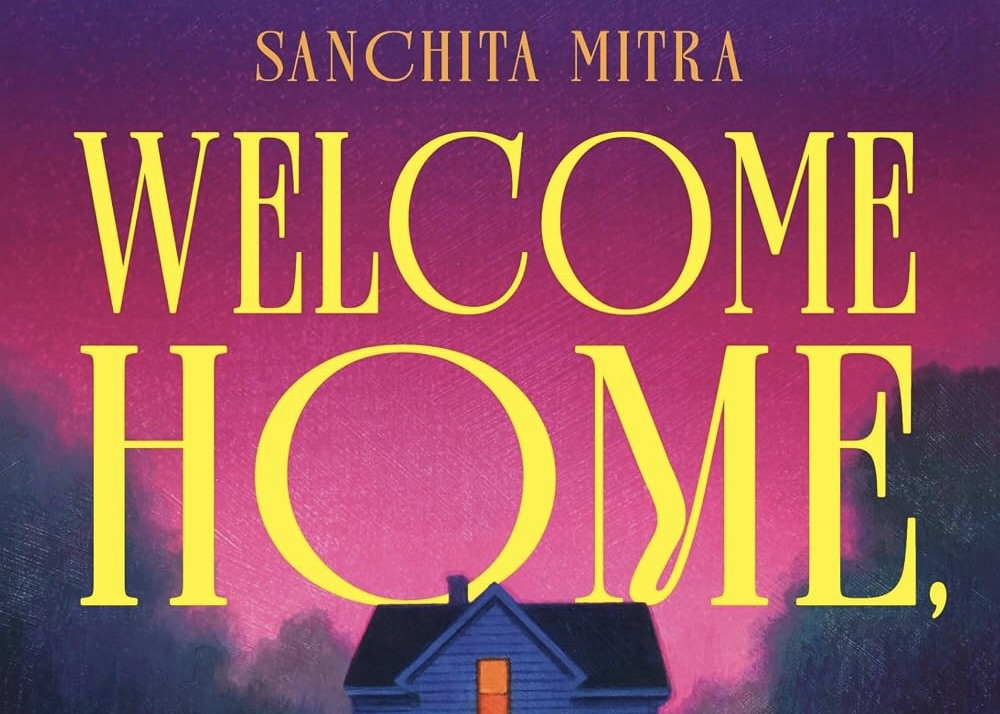
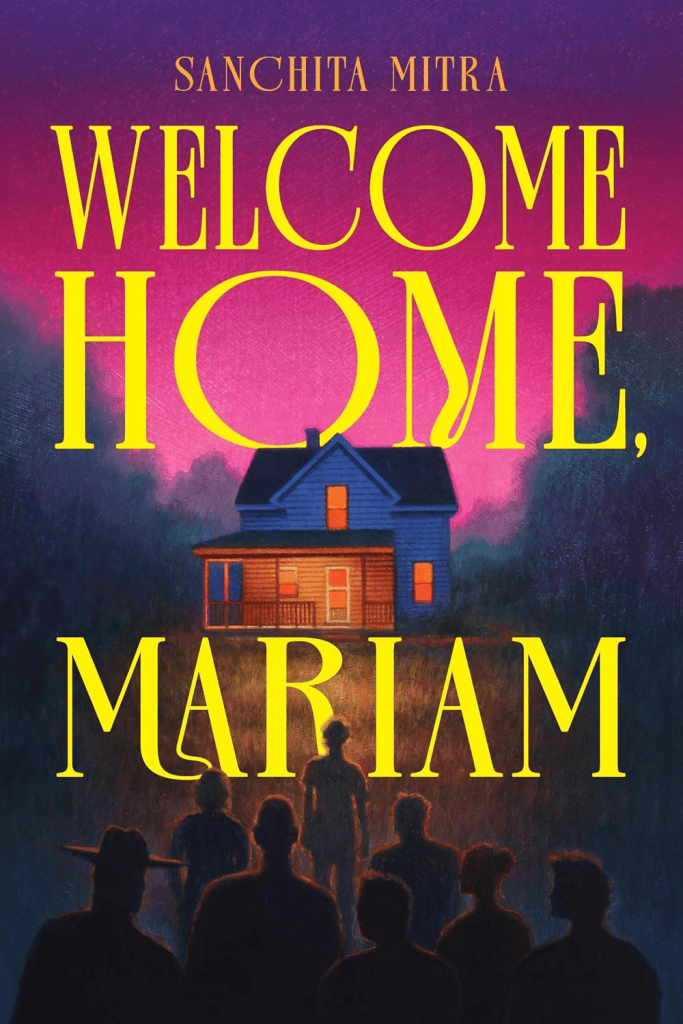
TL;DR: An amnesiac is brought home to a farmhouse by parents who say they love her and a town that sends flowers and stands on the road to cry. For half the book it’s a gaslighting thriller, a good one. Then the house turns out to be the thing everyone’s praying to, and Mitra’s one original rule, that the house gives back whatever is done to it, buys three scenes worth the cover price. Everything around them is a story horror has told for seventy years, and you’ll know where you are. The ending lets you out. Recommended, with caveats.




Who sends flowers to a house they won’t walk up to?
Night one, on the couch.
Mariam is twenty-four and has just been found by two cops in a wrecked studio apartment, holding a floor lamp like a bat, with nothing in her head past her own name. Her parents drive six hours to collect her, their hometown sheriff along for the ride, and take her back to a white farmhouse on a hill above a town that is visibly dying, a crack down the main road and houses collapsed into themselves. She calls them Mother and Father because the photographs say she should. Her bedroom has bird wallpaper and bars on the window. Something taps in the attic. Flowers arrive from people who never visit, every card reading Welcome Home, Mariam, and her birthday is a month off, and everybody in town seems to know the date.
There’s a raccoon in the attic in chapter five, and Father goes up after it with a broom and a flashlight in his teeth, and it comes down the ladder at speed and gets chased out the front door with the broom. It’s the only time anybody in this house laughs.
I liked the raccoon.
Then the porch scene, and I sit up. Mariam trips on the top step coming home from town, bends down for a dropped bag of caramels, and straightens up into night. The rain has stopped, the moon is up, she’s wearing her father’s jacket, and the porch is covered in bouquets she never saw arrive. Her parents say she’s been standing there an hour. Two pages later she finishes the family grace before her parents do, the words arriving in her head ahead of their mouths, and the grace thanks something that lives in the walls.
Never finish a prayer ahead of the people who taught it to you.
By the quarter mark I’ve decided what I’m reading anyway: a gaslighting thriller, a pretty fucking good one, and it’s Before I Go to Sleep with a farmhouse. S. J. Watson’s 2011 novel is about an amnesiac woman who wakes every morning beside a husband who tells her a story about her life, and a doctor who helps her in secret and tells her not to mention him. Mitra has the caretakers who lie and the town doctor who slips Mariam a blister pack with instructions not to tell her parents. Watson’s journal hidden in a wardrobe is a schoolbook hidden in a closet here, with a second name scrawled in it. Add Run, the 2020 film where a mother keeps her daughter sick on pills, and that’s the first half.
Night two. I fell asleep the first night about a third of the way in with the book on my chest, which is what books about captives do to you. They sedate you right along with the heroine. Now the town has started standing on the road to look at the house. Underneath a home video of a seventh birthday party there’s a second birthday party, recorded over. About two-fifths in, Mariam’s parents come home to a mess, and instead of dealing with it they go down on their knees in the gravel of the driveway, foreheads to the ground, apologizing.
Not to her.
That’s the scene where the book stops pretending and turns into what her agents called it when they sold it: “Sarah Gailey meets Midsommar.” The Midsommar half is the one that shows up. Ari Aster’s 2019 film is flower crowns, smiling villagers, a chosen woman, a congregation that weeps for her on cue. The town here weeps on cue, in a line, on the shoulder of the road, and it’s a good image every time it comes back.

Here’s what else the book is built from. Shirley Jackson’s “The Lottery” (1948) is a village stoning one of its own every June so the corn comes in. Ursula K. Le Guin’s “The Ones Who Walk Away from Omelas” (1973) is a city whose happiness depends on one child kept in a basement, and the only refusal on offer is to leave. The Wicker Man (1973) is an island burning an outsider for the harvest. Robert Marasco’s Burnt Offerings (1973) is a house that repairs itself on what it consumes, and the town here, which has been in drought and disrepair, repaints its storefronts and gets its first rain in months the week Mariam’s home. Mitra has read all of it and fitted it together competently.
Two things in particular are uniquely hers.
Two characters sit Mariam down, one in a clinic and one in a hardware store aisle, and explain what the house is and what the town wants from her. It’s the worst stretch in the book, the rules of the world read out loud in dialogue, which is a shitty way to hand a reader the one idea you actually own. The idea is in there anyway: whatever is done to the house, the house does back to you. For a hundred pages after that it’s just a line somebody said. Then, on a road at night, the book shows you what the line means, in a sequence that is the best goddamn thing here by a mile.
The second thing is the reason I’m recommending it at all. Very late, the book finally says what it thinks the house is, as opposed to what the town has been telling itself for generations, and Mariam acts on that answer. For most of its length, though, this is a book that’s serious about a family, not about a god: a love that is sincere and is also trying to kill her, parents who kiss your forehead and hold the belt. That’s real and it’s done well.
So, buy it, for the porch and the road, and go in knowing the middle will explain itself to you.
One chapter in five ends on a comfort. The other four end with the scare. The prose is plain commercial stuff, heavy on skin prickling, hearts hammering, acid in the throat, and counting back from ten; I stopped counting the counting-down at nine. It isn’t hurting anything, and it isn’t doing anything either.
Mitra is from the Toronto area in the way, she says, that everyone from Southern Ontario is from Toronto. This is her first book. Page Street Publishing is in Salem, Massachusetts, which is where you’d put a horror line if you were naming it on purpose, in a town that has been selling 1692 to tourists since before anyone in this book was born; the publisher was built on cookbooks and picture books and printed its first adult fiction only last year, Hester Steel’s The Faceless Thing We Adore and Robert Brockway’s I Will Kill Your Imaginary Friend for $200. Alexandra Murphy acquired this one and edited it. Macmillan drives the delivery truck and doesn’t own the company.