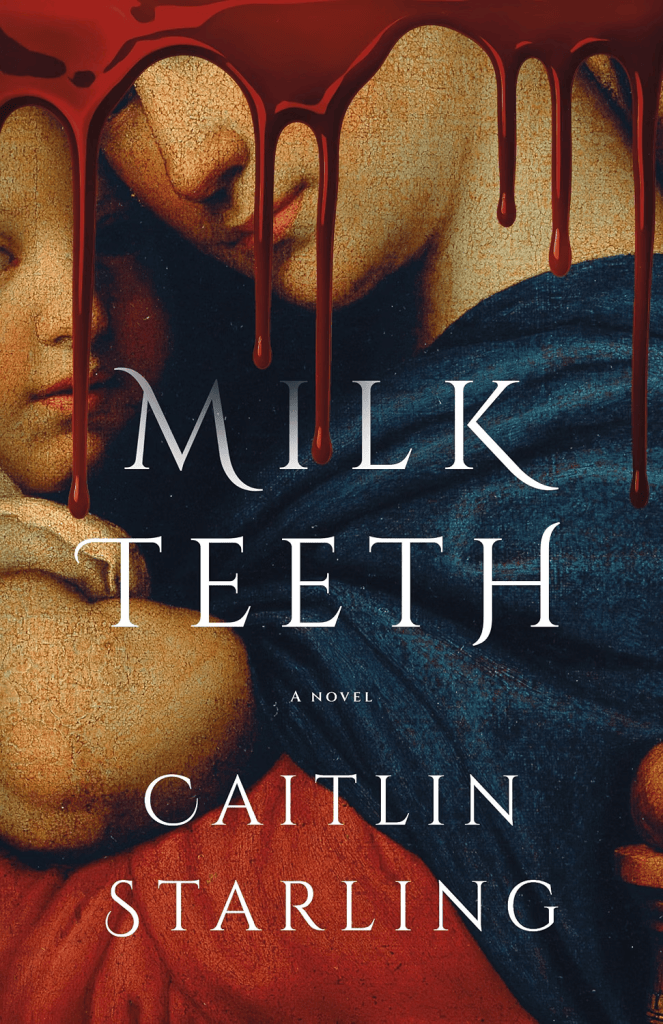
TL;DR: Somebody has to breastfeed the baby vampires. They can’t keep human blood down for three years, so one of them does it for the whole city, from her neck, in a basement of abandoned conference rooms under a skyscraper. She hasn’t had a night off in fifty years. There is no union. Her boss drops off a third baby, one that chews, and she starts craving liver and goes to find an OB-GYN. It’s disgusting and the nursing scenes are fucking great. The vampire politics upstairs are boring and the middle repeats. Read it, and don’t let her hold you.





Milkteeth is a vampire novel about breastfeeding, and it is much better at the breastfeeding than the vampires.
Start in the second chapter. Six in the evening, fourth floor of a hospital, recliners in a circle, a rack of swaddles for sale. A woman whose sticker says BEATRICE is trying to get a newborn to latch while a nurse named Tiffany, who is pregnant and has seen worse, crouches beside her and fixes the hold. The nipple is cracked and scabbed over. Tiffany asks whether she’s tried Silverettes, which are little cups of actual silver that nursing mothers wear, and Caitlin Starling lets that go by without a wink, because Beatrice is a vampire, the baby isn’t hers, and what he swallows when the scabs give way is blood. “Can you hear his swallows?” Tiffany says. “That’s what you want.” The sentences stay as calm as the pamphlets by the door, and it’s the creepiest shit in the book.
Just before that, the woman at the desk asks if it’s her first time, and Beatrice lets her assume nerves. Then, on a line by itself: “Really, it was just nice to get out of the house.” Ten words. It’s what every mother in that circle would tell you if you got her alone, and the only false word in it is “house.” The house is a fucking basement. Everything that goes wrong afterwards goes wrong because she wants out of it again.
The basement is two floors of office space dug in secret under a downtown tower. Budget carpet, conference rooms, whiteboards, a commuter shower, all of it stained. In Starling’s rules a newly made vampire can’t digest human blood. It has to nurse from an older vampire for about three years, several bites a night, and it spends those years as a howling toddler in an adult body with no memory of who it was. The vampires who make them mostly can’t stand it. So the city’s ruler, an elegant landlord named Manon, keeps Beatrice downstairs to nurse everyone’s, and sends people for her to drink by freight elevator. The word for what she is is broodmother. She has two charges when the book opens. Gorgeous, whose change went wrong and took his nose, and who has waited three years for the lover who made him. And Fortunata, Manon’s own, small and golden-eyed, at the age where she has to stop and count things. (Folklore says a vampire must count spilled seeds. Starling files that under developmental milestones, which makes the Count from Sesame Street somebody’s very advanced three-year-old. There’s a box of Count Chocula in my cupboard from October. I turned it to face the wall.) Then Manon delivers a third in silver chains, a newborn named Lu whose maker let her eat human flesh, which in this biology is how you raise a ghoul, a mindless thing that eats the dead. Beatrice says yes. Her own body starts wanting meat. She goes and finds an OB-GYN.
Starling took her vocabulary straight off the clinic wall. Latch, supply, tandem nursing, weaning, failure to thrive: each term a new mother gets handed is applied to the undead with a straight face, and what that buys is a picture of care I haven’t seen a horror novel draw. Care here is being eaten. Beatrice’s throat and wrists are ridges of scar, she wakes glued to the floor by her own dried blood, and the children she raises grow up and can’t look at her. The question underneath is whether she is this by nature or by assignment. She says nature (“It is innate, I think”), and everyone upstairs agrees with her, which ought to make you suspicious, since it’s a convenient fucking thing for them to believe. Aristotle thought you find out what’s good for a thing by asking what work belongs to it alone: the flute player plays, the shoemaker makes shoes, and a good one is one who does the job well. Manon’s court is Aristotelian about Beatrice. She is for feeding, the way a knife is for cutting. (His examples, for the record, were a flute player, a sculptor, a carpenter and a shoemaker: four jobs you can do with the door shut while somebody else minds the baby.) The rest of the novel is a test of that word “innate,” run on her own body with a doctor’s help. The book also carries a second, nastier idea, that feeding and eating are one act seen from opposite ends, and that one it never says and proves completely. Late on, Starling parks Beatrice in a hospital chapel to say it out loud: this is bodily work that everyone needs and no one honors. The dedication page had already said so. By then a grown nursling has come back to tour his old nursery and tried not to gag, and that scene made the case.

She is telling all this to somebody. There’s a “you,” a later nursling, in her arms while she talks, who interrupts (“Hm? What’s that?”) and gets called my love and my darling. Early on she is told, flatly, that she will never hear who she used to be. A monster narrating her own book has a problem, which is that fear mostly lives in what the teller can’t see coming, and Beatrice is the thing coming. Starling gets around it two ways. The hunts are told from inside the prey, close up, until the narrator steps into the last sentence and you find out who has been doing the voices. And the listener is held back. The last chapter says who “you” is. I’m not telling you. Every endearment before it reads differently afterwards. Beatrice also keeps insisting she didn’t love the three in the basement, and I’ve read her as lying and I’ve read her as honest. I might have to revist this…
The children are built from one want and one habit apiece. Lu wants to chew. Fortunata draws Beatrice’s throat on the whiteboards with her fingers. Gorgeous has a name that used to fit and a skin-care routine. His maker hasn’t come downstairs in three years, but the creams arrive every month (I’ve had a razor subscription since 2021 that I have never managed to cancel. The blades come whether I shave or not).What the kids want is her, in the building, and what she wants is out, and those can’t both be had. This gets staged again and again. She slips out, something happens to the children, she comes home to it. Around the fourth trip I wanted to hide her fucking shoes. It’s the one stretch where the book goes slack, because each trip teaches her what the last one did.
Upstairs is furniture. A city under one ruling vampire, permission needed to make a new one, old blood that binds whoever drinks it, a secret kept from the living: that’s Vampire: The Masquerade, the 1991 tabletop game of court politics with fangs, and Starling changes little. A vampire telling a life story to a listener is Anne Rice’s Interview with the Vampire (1976), down to the makers who get bored of what they’ve made. The clinic is a unique angle. Saliva that tells the nurse’s body what the child needs, and a feeding disorder that grows its own teeth. Every good scene here comes out of that, and every flat one is a fucking meeting. The nursery is the best in print.

What the book does to its mother is where the jokes stop. Beatrice is right about her employers. She is kept underground and despised by people who couldn’t exist without her, and when her body starts to change they answer with locks. You want her out. Starling makes sure of it, and then shows you what a mother who wants out does to the children in the way. There is a week involving a kitchen cabinet. There is a morning when she stands over each of them asleep and does arithmetic. And near the end there is a feeding, written like every feeding before it, the child drinking and the nurse murmuring, between Beatrice and the one who has loved her longest, in which she takes what she has learned about mending a child and uses it the other way round, on purpose, and then describes the result to her listener in the same lullaby voice she has used all book.
So that’s in my head now.
The jacket calls what happens to Beatrice a monstrous descent. The book isn’t sure it’s a descent, and by the last chapter Beatrice is certain it isn’t. That chapter is told from somewhere very comfortable. It’s a summary. Two of the largest things that happen in this novel happen there inside single sentences. They deserved scenes, for fuck’s sake. The last line nearly pays for it. It is three words long, a question, put to the listener in her arms. All the comfort in that chapter is Beatrice’s, and she would like to know how you’re taking it.
This is Starling’s eighth book, from St. Martin’s Press, after The Luminous Dead (2019), a cave novel with a Stoker nomination, and two last year, The Starving Saints and The Graceview Patient. Her bio says she works in narrative design and “has been paid to invent body parts.” The acknowledgments say the idea hit her like a freight train and jumped the queue ahead of whatever she was supposed to be writing. It reads that way: one idea at full speed, with a court’s worth of furniture on the tracks. Beatrice eats by freight elevator and the book arrived by freight train. I don’t have a second half for that.