TL;DR: Six horror stories from Japan, each a found document: a letter about a rooftop amusement park gone wrong, a dead writer’s drafts, a tape from a car hunting a pirate radio signal, a cult’s recruiting manual, a farewell letter about a boy only a dying woman could see, and a man in an elevator that won’t let him off. All six are about what’s waiting after you die, and the answer is nothing good, heaven included. The last story stops to explain that, and it didn’t need to. The other five made you fucking feel it. Read it in order.



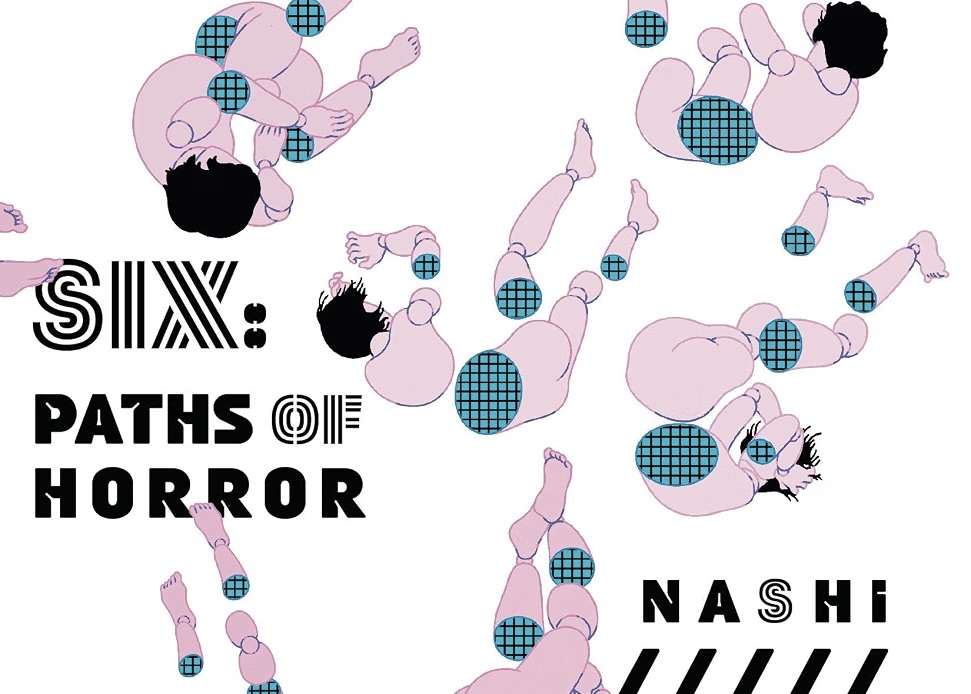
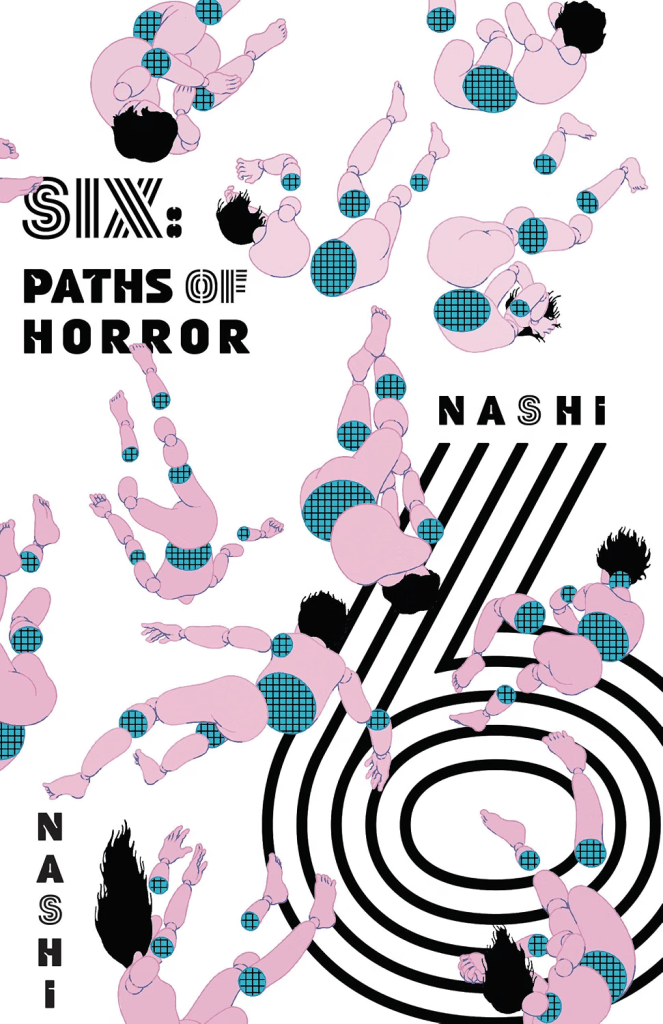
A dozen pink dolls fall down the cover. Ball-jointed, the pencil-eraser pink of the ones art students buy and never draw, the joints picked out in blue graph paper, black hair flying up the way hair does when the body under it is going down, and behind them a black spiral that reads as a six from across the room and a drain from closer. The jacket is credited to Aracelli Ejarque Villegas and it is the most honest fucking jacket of the year, because the dolls are in the book and so is the falling. I own one of those dolls. Wooden, eight inches tall, and it has held my keys on the hall table in the same pose since 2019, which I’d describe as surrender.
Here is what you’re buying, as the jacket would put it. Six stories, Japanese, translated by Stephanie Liu, published by Tokyopop, the company that sold America Sailor Moon and Fruits Basket and would now like to sell it hell. A woman writes to a magazine’s nostalgia feature about the amusement park on the roof of a department store and what she found there when she came out of the washroom. The colleagues of a missing writer go through three of his pieces, one of them about a gravestone on a mountain pass with a radio antenna stuck in it. A tape, transcribed by timestamp, of two students driving a mountain road at night hunting a pirate radio signal. A training manual for recruiters in a cult of something called the Great Animal, with footnotes. A farewell letter from the last resident of a district to the developer knocking it down, about the boy her great-grandmother used to see in the courtyard. A man coming home from overtime at dawn, in an elevator that is taking too long. The jacket calls it a must for fans of Uketsu and Sesuji, and what it isn’t telling you is in the title. The Paths in Paths of Horror are the Six Paths, the six realms a soul is reborn through in Buddhist cosmology, heaven at the top and hell at the bottom. The stories are the realms, counting down (the titles are ROOFy, FIVE by five, FOURierists, THREE times three, TWOnk and ONE), and the book does not tell you so until the last one.
The question the book is built on gets asked out loud in the second story, by something that isn’t a person, to a man sitting in his car with the window down a few centimeters: suppose the dead came back and proved there was no good afterlife anywhere, no matter how hard you looked. The writer, answering as a human, says it would be terrifying. The book’s answer takes six stories and agrees with him, then goes on past him to the part he didn’t ask about, which is what the dead do next.
In the cosmology the book borrows, you die and are reborn into one of six realms according to what you did, gods at the top, then humans, then the shura, who fight, then animals, then the hungry ghosts, then hell, and you go round until you get out. Getting out is the goal of the arrangement; the wheel exists so that you can leave it. Nashi keeps the six and takes the door off. The afterlife is real, there is no nothing waiting, and there is no paradise on any floor. Heaven is a rooftop amusement park, which in the first story turns out to sweat and excrete like anything else alive, while a flat voice over the hero-show speakers recites the five signs by which a god knows it is dying. Every attempt to get off the wheel makes the wheel worse. A cult calls up a god and gets something else. Men who’ve worked out that the gods won’t answer prayer start desecrating graves to make the gods at least angry, because anger is contact. Schopenhauer, who read what Europe had of the Buddhists in the 1810s and 20s and decided they’d had it right all along, held that existing is wanting and wanting hurts, and that suicide is no exit, because the wanting carries on without you. The only door out, in his book, is to stop wanting at all. Nashi signs off on the first two and deletes the third. There is nothing you can fucking stop doing. Schopenhauer also once shoved a seamstress out of his anteroom in Berlin, down the stairs by her account, and the court made him pay her a pension for the next twenty years, so he had his own position on vertical movement. The book is serious rather than a lecture because for five stories nobody argues any of this. Each is a document from inside a realm, written by someone who doesn’t know which realm they’re in, and the reader doesn’t know either, so the cosmology arrives by feel: you can tell the park is wrong before anyone has a word for it. Then the sixth story supplies the words, floor by floor, in a flat female voice from the elevator ceiling that tells the man inside what realm he’s looking at and what its residents did to end up there, the way a docent does a room. A book this sure of its own hell didn’t need the fucking audio tour, and for me that’s its greatest flaw.
The structure is the book’s most compelling idea. Five of the six stories are documents with a receiver attached: an editor’s note on why the letter ran, colleagues annotating a dead man’s edits, a transcriber’s timestamps, a developer’s bullet-point site report. The receivers, every one of them, can do nothing with what they’ve been handed except pass it on, which is where the fear lives in this book, in the hands of whoever is reading after the fact. The manual is the exception. No receiver at all, until after its last paragraph, where somebody has written six words in red in their own hand, reporting back on how the program went. And then the sixth story has no document, just a man telling it straight in the first person, which in a book built like this is the loudest possible signal that something is wrong with the man. You only learn which realm you’re in from outside it, and the only outside is death. David Mitchell’s Cloud Atlas (2004) already did six stories in six document forms with one soul reincarnating through them so that the sequence carries the metaphysics (and became a lame movie). Nashi’s version hides the link until a closing story reads the book back to you, which is better horror.
Read one sentence, because you can check it in the shop. A child in a rooftop washroom, in the first story, has just spent a paragraph on toilet paper: “I tugged at the toilet paper, reduced to only twenty percent of its original size (where’s the tear strip? I can’t find it (the moment I messily tore into the roll and ripped myself a square, I noticed the perforated line, but it was already too late)) and rubbed it against my dirty and wet skin.” A parenthesis inside a parenthesis, in a toilet stall, mid-shit, from a child who reckons toilet paper in percentages, and that’s the texture of Liu’s English for the whole book: a mind that can’t report a thing without correcting the report, the brackets stacking up like a stammer. Then she opens the stall door, and the next sentence is five words. “All sound disappeared from the world.” The verb sits in the middle and the world at the end, with no bracket anywhere. It’s the one sentence in the story nobody corrects, for exactly one beat, because the sentence after it begins “No, to be more precise,” and the correction is worse than the claim: she can still hear the squeak of the door she just opened and her Velcro shoes on the grit. The world didn’t go silent. It left, and she’s still audible in it. Nothing in this prose is lyric, and the horror turns up as the one line that doesn’t get corrected in time.
In Japan the found-document horror story is a genre, from Noroi: The Curse (2005), a mockumentary built from a missing occult journalist’s tapes, to Uketsu’s Strange Pictures (2022), which reads documents for what their edits hide, and Nashi works inside it rather than inventing it. What’s new is inside the documents: an amusement park that turns out to be a body, antennas planted in graves to pick up the other side, a recruiting manual that works on whoever reads it, the corpse of a ghost.
“Guidelines For Seedling Production” runs from Sowing Seeds through Planting to a seven-day retreat called the Caravanserai, and it is addressed to you, the recruiter, in a managerial second person that tells you how to pay your friend’s fee so they’ll feel they owe you, which games to run at the first session (ones where everybody has to talk, so UNO, so Telephone; a cult that opens with UNO is one I’d sit through the orientation of, and I’ve sat through worse), when to cut the food, when to cut the sleep, and how to keep asking a starving person why until they confess to something they didn’t do, so that by the seventh day they can believe anything they’re told they experienced. It has no people in it, and it’s the best thing in the book. The vocabulary is Charles Fourier‘s, the French utopian whose phalanstères and New Amorous World the cult has borrowed wholesale and who believed the oceans would one day turn to lemonade. The sacrament is Kokkuri-san, Japan’s Ouija, a ten-yen coin on a sheet of the syllabary under a drawn shrine gate, moved by whatever answers, and the manual’s one supernatural claim is that on the seventh day the coin moves. Everything else in it is just how you make a fucking person. Nobody in Six wants two things, and nobody’s want runs into anybody else’s. The child wants the rooftop to stay a different world; the writer wants to go back to the pass; a student in a cold car wants a hot can of coffee; the initiates want a home; a girl wants a younger brother; an editor wants to sleep. The best-made person in the book is the manual’s “you,” and that’s you. Everyone else gets one want, and then the realm takes over, and from there on they are witnesses, and a witness’s job is to hold still.
Follow the laugh. On the rooftop stage in the first story stands a doll in mourning clothes with a dead man’s head on it, and the head laughs, badly, “like someone trying to laugh while crying,” and the child knows the laugh because it’s hers after a scolding, the one you do to make the thing that just happened smaller than it was. In the interview that follows the tape, a quiet member of the radio circle who went up the mountain alone comes back telling jokes about dead dogs, a lost-dog poster on a pole and whether the owner would be upset enough to say life is shit (it isn’t funny in English and I’d bet the yen it wasn’t in Japanese. He isn’t telling a joke, he’s presenting a symptom). And the last word of the book is a laugh, heard from another room. That is the part of the question the writer in the car didn’t ask. What the dead do next is get funny. In Six, joking about death is what people do once they’ve seen the other side and understood that there isn’t one, and it’s a symptom, and it’s contagious. My jokes are better than that man’s. I’d like that to be the difference, and the book’s position is that it fucking isn’t.
“The sounds echoing through an elevator,” says the jacket, and that’s the last story, told straight: a magazine editor, a week after the writer at the next desk vanished, comes home at daybreak after overtime, gets in the elevator, presses five, and the floors go by too slowly, and then the building is taller than the building. From there it is the book read back to itself, and it’s the one story of the six where the explanation comes before the events, which is the right order for a key and the wrong order for a story. The ground floor is where the book’s one argument stops being a creed and becomes a place, with a sound in it at intervals that you will be hearing for a while; the narrator goes back up; and the last movement is a man choosing the thing the five stories before his have proved is no way out, knowing it, choosing it anyway, with the morning coming in, and the book does not step in. Nothing is given back.
What Six takes off you is the hope that death is rest. Suicide runs through it the way the whale runs through Moby-Dick, mostly offstage and always the subject: a pass where travellers keep dying in the same spot, a room nobody can clear, a ghost’s attempt to be finished, a lobby. The book’s position on it is the least romantic one on the market. Death here is a floor change. Whatever hurt on the last floor comes with you and the new floor has its own. The one soul in the book who tried hardest to be done is the one the book can’t stop looking at. That is the answer to the question in the car. If you came to horror for the thin consolation that whatever is over there at least ends it, this book takes that away from inside the act that hopes so, and it holds the first person steady while it does it.
All right. Point made.
Stephanie Liu’s translation keeps the recursion, which is the hard part. The copy is Tokyopop’s, and it’s rough as shit: about a dozen errors in forty-eight thousand words, “the aufhebun” for Hegel’s word in the cult’s manual (I’d have let that stand as the cult’s own spelling if “reverence” hadn’t come out as “reference” a few pages on), “an sickening premonition,” “who they raised them.” None of it is Nashi’s, and the press should fix it for the fucking paperback. One thing I’d have footnoted and the book doesn’t: behind the dead woman’s voice on the radio there’s an orchestral “Auld Lang Syne,” and in Japan that tune, under the name “Hotaru no Hikari,” is what a shop plays over the speakers when it would like you to leave. A Japanese reader hears a station closing. Nashi, for the record, is a pen name. The writer behind it began online, has been on staff at the web outlet Omocoro since 2021 (a comedy site, which after the paragraph about the laugh I find I have no joke for), co-planned touring exhibitions called, roughly, Have You Read That Strange Document? and The Missing Persons Exhibition, has two other books in Japan, and this is the first of it in English. Genkosha, an independent house in Tokyo, put the original out in June 2023; a manga adaptation followed a year later, Tokyopop has that too, and you want the one with the parentheses. Nobody in English has reviewed it that I can find.
The manual is the best story in the book. So is the tape. That’s two bests out of six, and I’ve counted twice and got two both times, so I’m leaving the arithmetic in. What I’m sure of is that Six is the most serious thing on my table this month, and the first book in a long while whose structure I’d defend over a drink against the people who’ll call it a fucking gimmick, because the countdown is the belief and so are the forms, and the belief is one no horror reader wants and every one of them came for.