




TL;DR: Our Lady of Holy Slaughter is the finest medieval horror since Between Two Fires, at a third the length, mud still on it. Shank strands six crusaders in a Livonian bog with one waterskin, a snake that asks questions, and a veiled woman the knights swear is Mary. Lips like bark, flies for halos, not one wasted sentence.

The wisest man in this book commands about twenty words of German and the one he uses is no. Sir Pandolfo is an emissary of the Pope, an Italian knight under no monastic vow who squints at the swamp and at his companions like a man sizing timber, and when the Livonian Brothers of the Sword hear a trumpet from deeper in the fen and conclude that duty commands them toward it he points the other way and says No go. No water. The Germans do not hear him. They have a habit of not hearing him. He spends that first evening alone on a spit of mud squeezing his spent waterskin as though by working it he could make it plump, and he is the only man on the island who understands where they are.
Where they are is Terra Mariana, the land of Mary, which is what the crusaders named Livonia when they came up the Daugava to baptize it at the edge of a sword, and the year is one the book never states and the jacket does. It is 1236. The Sword Brothers have marched south out of Riga in a host of thousands swollen with guest knights up from Germany for the season, on the feast of Saint Maurice, on a day the old hands said was too early and the ground too soft, and the Samogitians and the Semigallians have come at them out of the marsh from every side and broken them. Six men are left in the reeds. Three brothers of the order in rusting hauberks with the cross and sword still painted on their shields. The papal Italian. And two native infantrymen, converts, Ilo and Gaidis, whose spears are sharpened sticks and whose blood is the blood of the men hooting at them in broken German, promising the rope, the ax, the fire. Ilo has a stain on his jacket that he says is a pagan’s and is not. Gaidis polishes the knights’ mail by the last light and finds a single blonde hair wound through the links like thread on a loom, and a snake with a yellow ring about its neck comes up out of the water and regards him the way a judge regards the accused, and opens its mouth, and asks him who his mother is.
That night the frogs quit. The breeze settles so that no reed touches its neighbor, and in a silence beyond any swamp’s capacity a woman stands on the water of the next islet in a veil that gathers the moonlight, and she beckons, and the knights go down on their knees and say Mary. Gaidis has another name for a veiled woman who comes for men in the darkening season. His mother gave it to him in his crib. The book’s whole method of fear lives in that gap. One sign is set before two peoples and each reads it in its own tongue and the fen does not care which reading is true, and the brothers turn back from the drier ground they had nearly reached and wade toward her through thighdeep water with the delicacy of driven cattle, as certain of their deliverance as men have ever been of anything. What follows is a pursuit through water and mud and water again, hunted from behind and led from ahead, built as a passion in the old sense, a sequence of stations. A dead man in the trees stripped and headless with his arms folded so that he resembles a sword whose pommel has been lopped off. Flies circling the brothers’ heads like black halos as they crawl across a quaking meadow on their bellies. A swim through fog so thick there is neither shore nor sky, which the boy recognizes from a sermon on Purgatory, a place the priest could describe only by its want of definition. And the snakes. Everywhere the snakes, at the corner of the eye, wearing what the boy was taught is the Devil’s favorite skin.

The book runs on thirst. There is water to the horizon and none of it will go down, and by the second day the surviving skins are poured into one and hung from the senior brother’s belt, enough for a single man for a single day, and he doles it by the sip and holds opinions about who has earned one. Lips like bark. A tongue that catches on the palate like a burr. The boy sucking his own filthy knuckle for a bead of spit. Shank writes plain and close and keeps his archaism in the objects rather than the syntax, coif and hauberk and gambeson, a polishing cloth, a birch switch, and the sentences are not the show. The images are, islands scattered over the fen like mold on bread and knights stripped to wring out their hose so white they blend into the mist and a sky as hopeful as lampblack. Four chapters, under thirty thousand words, and the long second chapter could sag and does not, because every crossing costs something, a shield, a shirt, a spear, a mouthful of water, and the ledger is kept in plain sight. Past the halfway mark Gaidis lies hidden in a reed brake and hears his mother’s tongue for the first time in days, and it falls on him like water, and what the voices are saying is Fuck the Germans and fuck their horses. Shank does not remark on it.
The knights are drawn from the outside, as the boy sees them, and they are the book’s other horror. Marquart, twenty years in the country, who has seen a miracle and will drive his men into the mire on the strength of it. Lorenz of Lübeck, whose sneer beneath his mustache promises a beating and keeps the promise. Johannes, the youngest, who laughs in the Riga market and tries the local dialect and tells Gaidis that if a convert can be Christlike there is hope for everyone, even you. That even is the cruelest word in the book. The brothers preach a gospel of love with hatred in their hearts, and the book says so once, early, and lets them show it for a hundred pages. Gaidis, who once coveted the painted shields and now polishes the mail behind them, was raised under the bishop’s cathedral by a mother who whispered goddesses over three little figures and told her son they were the Trinity, and a father who put the figures in the fire. One of us, yes, but one of them too, as a man with an ax puts it to him later, and by then every snake in the swamp knows it.

Shank is Canadian, a self-described lover of dead languages and collapsed empires, and he publishes under his own Carthago Nova Press, named for the Punic colony in Spain that Scipio took in 209 BC, as clear a declaration of affection as a copyright page allows. His debut, Mountain Fast, in 2024, sent a messenger up to a fortress gone silent in the Hungary of 1468. The Knave of Graves, last year, gave a gravedigger a saint’s skull and three parties who wanted it. Nick Mamatas edited this book, and the acknowledgments thank the illustrator for breathing life into our lady, a phrase that reads differently once the reader has met her. The jacket pitches it at readers of Between Two Fires and Hellmouth and it belongs on that shelf, at the short end, where the knives are. It was published seven hundred and ninety years to the day after the Sword Brothers went into the marsh, and in a note at the back Shank says he wrote it as a sort of holiday between rewrites of other stories that needed a lot of fixing. This is what the man does on holiday.
Pull back from the reeds and the subject under the book is older than Livonia. It is the transaction by which a conquering faith takes the children of the conquered and teaches them a commandment and then sends them out with sharpened sticks to break it, and the book opens on exactly that, a convert grieving the pagan he ran through and a monk telling him to rejoice because killing heathens is holy work. Thou shalt not kill. The first page. The rest is a gloss written in mud, and the commandments keep surfacing as the snakes do, whenever a knight is about to do something he will later call necessity.
The faults are small and set down as small. The book gives the brothers no quarter, and a reader who wanted the argument harder on its author will notice how readily Lorenz earns his sneer. Marquart’s sermon on the desert, we wander the desert, Brothers, says aloud a thing the mud had already said better. A few small press slips survive on the page, a mug where a mud was meant. That is the whole bill, short for a book that does this much in an afternoon.
The last chapter is brief and it walks. It goes where the trail goes and the book stops where the trail ends, and it does not haunt so much as confirm, setting down what the reader has carried since the snake first spoke and giving nothing back for the weight. The title says Our Lady. The knights know which lady. So did the boy’s mother. Between those two certainties lies a swamp that takes no side. It takes men.
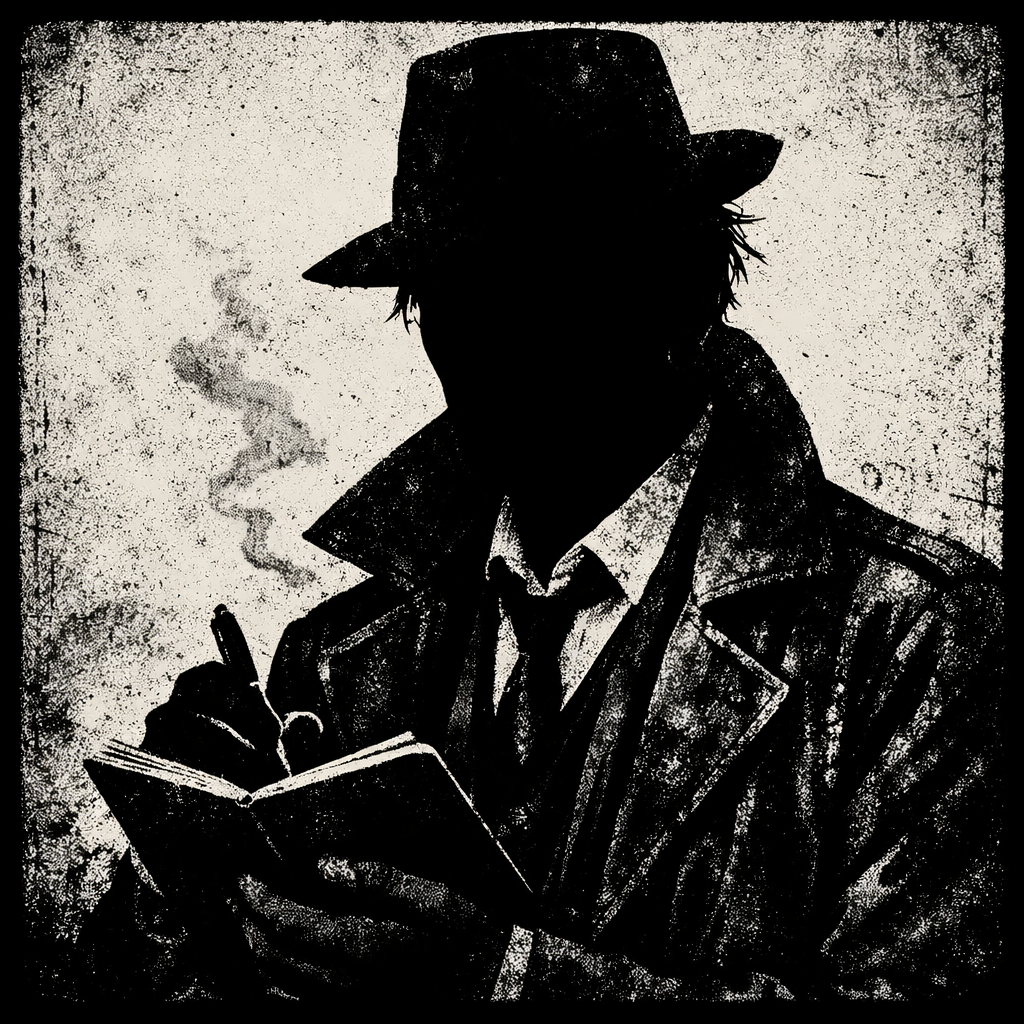
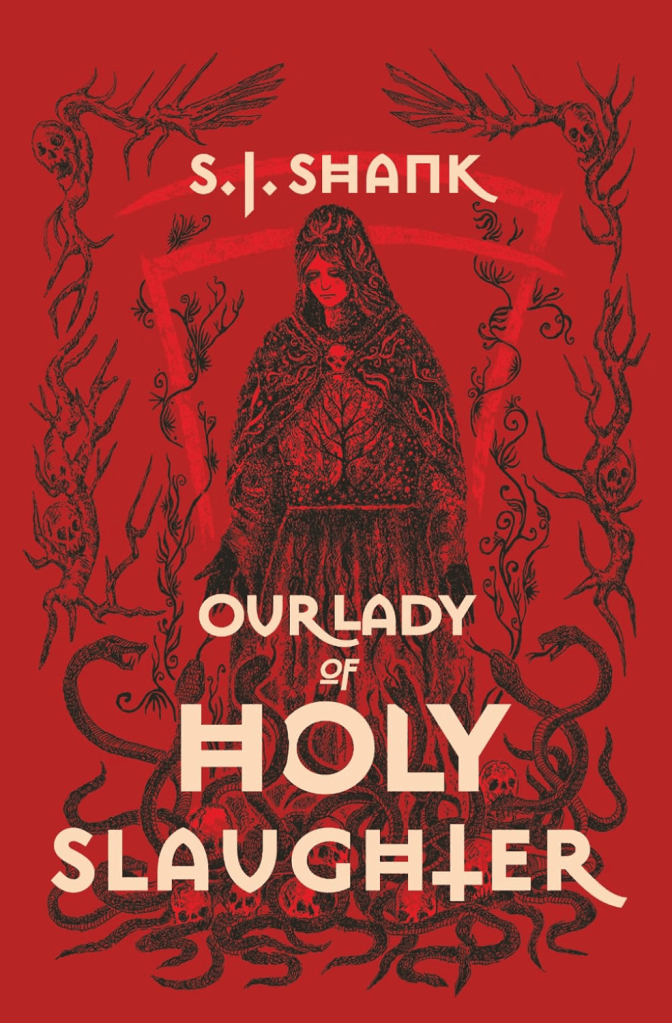
Our Lady of Holy Slaughter by S.J. Shank,
published September 22, 2026 by Carthago Nova.



Leave a comment