





TL;DR: Rosson has built the best drug in modern horror and the town that runs on it, and the book moves the way his sentences do, fast and cut on the beat. The back third stacks bodies faster than it can count them, but the grief underneath is exact and earned. Crime noir with wings, and a witch worth the wait.

The van is blue.
That’s the first sentence, and the second one takes it back, because the girl who thinks so has rain on her glasses and an optic nerve that never finished growing, and at night on Highway 101 the world is a pinhole full of smears. Hannah Lamp is fifteen. She has a red and white cane and a dead mother in a handful of Polaroids and a dad at home doing so much wire he’s gone paranoid, and she has Avery, who is the entire list of people in her corner, and three more miles to walk in January rain. She does an old-man voice when she’s scared. Oh, praise Jeebus, sweetie, we’re saved. The van pulls onto the shoulder. Avery won’t get in. Hannah does. Somebody puts a hand on her arm.
Then Rosson slams the door and drives off with her, and you get her back in pieces over three hundred pages, and I’m not telling you which.
Thirteen years later her father is fifty-two and works for the men who sell the drug that ate him. Chapter one is Eli Lamp knocking on a duplex door in a town called Cape’s Head, walking a wirehead named Derek to his knees in a cracked Wisconsin T-shirt and gray slippers, and before he breaks four of the man’s rotten fingers he asks him what he dreams about. What’s your favorite dream. The book tells you this is the most intimate thing you can ask a wirehead and it’s right, and I put it face down on my chest for a minute. That’s chapter one. Eli keeps five candles and five bullets on his nightstand, one for each man he killed the year Hannah went, his own little flagellation station, ha. He keeps her punk records on the shelf and can’t take one out of its sleeve. He grows the biker club’s crop on his own land, and every week he hands the sheriff a paper sack with AC/DC playing on the desktop speakers so nobody down the hall hears the count.
Wire is the best thing Rosson has ever built and the whole book runs on it. It’s a green thread with crystals on it and you put it under your nail. Toes until those go, then fingers, then nowhere, and the book says that flat, like weather. What it does is called the dreaming. It takes you back. Your mother’s lap, a sprinkler in Tampa in a neon orange one-piece, the record store in Portland with your best friend. Everybody in Salt Point is trying to get back to some year before the bad thing, and Rosson built a drug that takes them there and charges their hands for the ride. When Avery Bryant rolls into town on fumes with thirty-six thousand stolen dollars in a Bean There, Bun That sack, chasing a dream about Hannah she can’t explain, she does her last hank right there at the rest area with a little girl in the next car watching through the glass, and when the deputy finds her passed out and spots the baggie she says that’s what I keep my beads in. I’m a jeweler. I laughed and then I didn’t.
So here’s the engine. Trying Dave Novak, who runs the Crooked Wheel and most of the county, has his oldest boy turn up in Jesus Creek with an arm off and a finger curled in the mud like an apostrophe, and he wants Eli to be a detective again: no pictures, no coroner, no cops, find the man and we’re square forever. Same week a seer named Vicki Stubbs, who smokes thirty hand-rolleds a day and never once left a thing alone in her life, finds a human heart in the dunes below her house, wound in twine, speared with blackthorn, crusted in amaranth seed, and goes home to her books to find out what that’s for. And then something white with black wings comes out of the trees. That’s all you get from me.
Vicki is where I’d have stayed if the book had let me. She keeps a silver boom box from the nineties on her kitchen table and rolls the dial all the way down to 87.5 and says a name into the static, and what answers is a little boy with his front teeth out. Old sails, old bodies, old souls. Grasp the mast and fill the hole. He does voices. A lewd old man from a war, a woman who talks about herself in the third person and has dirt in her mouth, and all of them lie and salt it with enough truth to keep her coming back for forty years. I walk in the walls, he tells her. I got blood up to my balls in here, I swear to God. When one of Dave’s gunmen sits at that table and tells her she has the manners of a fucking street cat, she says that’s the kindest thing anyone’s said to her, and she means it. She’s the one character who knows exactly what kind of story she’s in.
The chapters run a few pages and cut on the beat, and Rosson is deadly at ground level. Pop songs on a truck radio, vicious as lemon-scented air. A man on his knees who figures this is it, dying in fucking sweatpants with a bleach spot on one knee. A sitcom Eli falls asleep to where a plate of glistening lasagna makes lewd suggestions to two women having tea. A bullfrog in the kitchen closet, once, the whole trailer torn apart looking for the noise. And the scares work because he shows you the fingers before he shows you the face. An arm through a windshield. Wings like oiled sheets with veins running through them. A hand pressed to the glass from the outside.

He can’t let a good image go home, though. Once he finds one he likes, a marionette, say, you’ll hear that string pulled half a dozen more times. Vibe as a verb, three times, and once is the limit. It’s a small thing that adds up, the way a drummer who loves one fill gets found out by the third song.
The bigger thing is the crowd. By the last hundred pages there are two motorcycle clubs, a sheriff with a hot tub, a deputy with a bookie, a knife man who eats your salmon while he decides about you, an ex-boyfriend and the sidekick who breaks pint glasses on his own forehead, and the book has to get to all of them, and somewhere in there the killing stops being horror and turns into payroll. A head goes down a hallway like an errant football. That is the sound of a writer who has stopped counting. Rosson also pulls over three times to back up, Eli’s marriage, Avery’s sophomore year, a deputy’s debts, and the deputy’s is the funniest forty pages in the book, a barstool parable about a sure thing and a man named Bob Robertson, middle name Richard, and fifty-six dollars pushed across a table, and it’s still forty pages in park on the way to a place you’ve already been shown. Late on, somebody sits down and lists the rules. I didn’t need the rules. I had the wings. And you’ll see the shape of the answer coming a good while before Eli does, and the book knows it and shrugs, because the mystery here was never who. It’s what you do on the drive home.
Here’s why it carries. Rosson was born with optic nerve hypoplasia, the same thing Hannah has: about twenty-five degrees of vision, legally blind, a cane, and he has said the not-seeing gave his art “a certain strangeness.” He drew record covers for Green Day and Against Me! anyway, played guitar badly in a band called Neckties Make Me Nervous, and started a fanzine called Avow in 1995. Three small-press novels at Meerkat, a Shirley Jackson Award for the collection Folk Songs for Trauma Surgeons, then Random House and Fever House and its sequel and last year’s Coffin Moon, a vampire running a biker gang out of 1975 Portland, and if you read that one, Vicki tells a story at her kitchen table that will make you sit up. He says his method is taking a horror trope and running it through the colander of crime fiction, and that’s this book to the letter. But 1995 is the year that matters. On the night of January 27 that year, Jennifer Esson and Kara Leas, fifteen and sixteen, set out to hitchhike two miles from Agate Beach into Newport, Oregon, and were found in February in a clearcut north of town, hands bound, strangled. Rosson knew Jennifer. Nobody was ever charged. The book is dedicated to them and to everyone who should have made it home but didn’t, and the note at the back calls it fiction as exorcism, which sounds like a blurb until you’ve read the prologue and then it doesn’t.
The last five pages hand the book to somebody you met once, on the phone, and I’m not saying what she sees. It’s the softest place Rosson could have set this down and I’ve been arguing with myself about it for a week.
I lived in a van for most of my twenties, a white Econoline with a bench seat bolted in crooked, and we passed a hundred kids on a hundred shoulders in the rain between Astoria and Eureka and never once stopped. I always thought that was the decent thing.

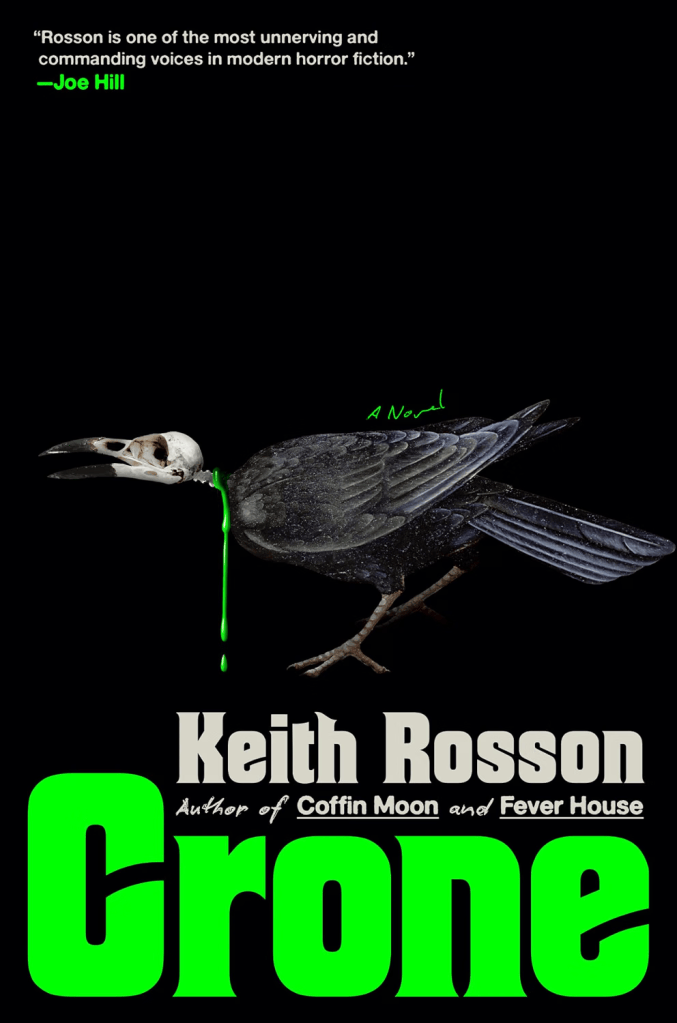
Crone by Keith Rosson, published September 22, 2026 by Random House.


Leave a comment