









TL;DR: Asmodeus is the first heavy metal novel worthy of the name, a Greek tragedy with a demon on cocaine for its chorus and Balaguer’s Santo Domingo for its stage. Indiana rides her fallen seraph through knives, cockroaches, and teenagers until the book turns and rides him back. The verse clanks in places. The goat song underneath it does not.

The demon does cocaine because it lets him believe for an hour that he was born of a woman. He has ridden Rudy Caraquita since a night in 1969 that the book gets to in its own time, and Rudy was once the loudest man on Hispaniola, a heavy metal pioneer with a nippleless nipple he wore like a war medal, and now he is forty-four and impotent and standing before a moldringed mirror in a Led Zeppelin shirt with a dead sardine in his hand. The coke wears off at dawn. What is left is what the book calls the immeasurable weariness of eternity and what Rudy calls a hangover, and the demon, who cannot sleep and never could, leaves the body by way of a punch bowl of yellow vomit and goes looking for a younger horse.
Horse is the book’s word, and mount and steed and mare, the vocabulary of the island’s possession rites, in which the spirit climbs on the believer and the believer is the animal underneath. The witch who got him Rudy, a woman named Mireya in a Balaguer housing block called Mata Hambre, is not a horse at all but a waiting room, with two screens at the back showing what her eyes see and what her apartment holds. An army knife becomes a third place to live. The archangel who guards Rudy’s oldest friend, a psychiatrist named Niurka with a scar to match his, appears by daylight as the Spanish balladeer Rocío Jurado in centurion slippers, and the demon calls her Rocío to her face because it is the only weapon he has left. The book keeps a straight face through all of it.
The week is 1992, Monday to Sunday, in thirty-three chapters, which is the age of Christ at Golgotha, and the book does not mention this and does not have to. Balaguer is back in the palace, blind and old. Mireya is dying of her gift and wants it off her, so she sends it out in the knife with a girl. The girl is Sayuri, eighteen, in cowboy boots and a secondhand Iron Maiden shirt, who came for a spiritual cleansing and left with the demon in her purse, and from her the knife passes to Guinea, the supermarket bagger who wants an electric guitar, and from Guinea to Claudio, the rich boy in Arroyo Hondo, and the demon rides the blade from hand to hand appraising each of them the way a horse trader reads teeth. He wants Claudio. This is a class tragedy and the book knows it.

Then Tuesday. Rudy, wrapped in a bedsheet like a Desert Father, has begun a verse tragedy on a psychiatrist’s prescription pad, and the tragedy is about a poor boy who wants an electric guitar. The demon reads over his shoulder and finds the knife in it. He finds Guinea in it, and Claudio, whose name Rudy has never heard. The devil doesn’t believe in coincidences, Rudy says aloud, and from there the book runs on two rails that do not agree about which one bears the weight, chapters of prose in which the people live and chapters of rhymed décimas in which they are made to sing, and the demon begins to suspect that he is the one being ridden. The décimas are the chorus, the days are the episodes, and the question the book keeps asking is who the tragic hero is, because a tragedy needs one and nobody in the notebook wants the job.
The metal is not set dressing. Under the Sepultura and the Slayer and the Darkthrone is Black Sabbath, because the finest stretch of the book is a memory of 1973 in which a folk singer with an Afro and an orange kurta takes two sheets of acid off a rich friend and hears War Pigs for the first time and understands that the reinforced concrete in the song is the concrete of the apartment he was tortured in, that Ozzy is singing about Balaguer without knowing Balaguer exists, and that a music built to break things is the only honest sound a country can make in the seventh year of a dictatorship, with the students’ bodies going down the Ozama River. Indiana was a thirteen year old headbanger in this city who read Dante. Sayuri is her, give or take.
She was born in Santo Domingo in 1977 and has never treated her other career as a day job. Fronting Rita Indiana y los Misterios she made El Juidero in 2010, the record that got her called La Montra, then left music for ten years to raise children and write, and came back in 2020 with Mandinga Times, nominated for a Latin Grammy. La mucama de Omicunlé, which Obejas carried into English as Tentacle, was the first Spanish language novel to take the Grand Prize of the Association of Caribbean Writers. She runs the MFA in creative writing in Spanish at New York University. Asmodeo came out from Periférica in Spain in 2024, dedicated to that house’s cofounder Julián Rodríguez Marcos, and she told the magazine Zenda that there is nothing more heavy metal than Greek tragedy, that she had built its seven days the way Slayer builds a record, and that her devil came out of the Spanish Golden Age, out of Vélez de Guevara’s limping demon. What she wanted to know, she said, was the reasons of evil, and whether a fallen angel can be redeemed alongside the people it rode.
The dread comes in two grains. The fine grain is the city at noon, a shaved ice vendor coloring his cone with red raspberry blood, a donkey eating burned grass under the flagpoles of a monument to the globe, what Sayuri calls a solar horror, a horror of lights that shine too brightly and scorch the soul. The coarse grain is the set pieces. A chapter called The Pentagram cuts five afternoons into each other in the present tense, a witch washing shit from her father’s sheets and a girl led by the hand into a Caravaggio and a rich kid at a white tablecloth who looks up from a pile of chewed meatballs to find the other diners are not people, and the sequence draws a five pointed star with the demon flung along its edges. There is a chapter in which the words teeth gnashing fall between every sentence of a girl’s insomnia until the words are the thing in the room with her. The worst of it is a chapter called The Table, a landscape of viscera under a sky that is a man’s face. Nothing in it is explained. The demon explains things to himself all week and is wrong about most of them.

The book holds a theology without blinking. The fallen brought fire and memory and the making of stories to a race that would otherwise be drinking at the river like cattle and afraid of its own reflection, and they were damned for the gift. Leviticus sets two goats before the priest, one for the Lord and one for Azazel, and the fallen have made of that second goat a messiah of their own. The Greeks called their darkest art the song of the goat. On Good Friday of 1984, in Monte Cristi, two men hold a goat’s legs for a servant’s machete, and later, on mescaline, they lay its head on a pile of hagstones for the vultures and one of them explains that the birds’ Latin name means the ones who cleanse. That chapter is the center of the book. There the novel stops being clever about tragedy and becomes one.
The seams show in the verse. A décima is ten short lines locked in rhyme, and Obejas has chosen to rhyme them rather than let them lie flat, which is the braver choice, and it costs her. Some of the verse clanks, a rhyme caught by the tail, a line padded to make the count, and a cashier’s rebuke to the bagger reads like something turned in on a Friday, though the demon laughs at her verses too. These are small. They are what is left on the stones after the vultures have finished.
The ending is a Sunday and reads like one. It walks. It goes down an avenue of laurels Trujillo planted after a hurricane toward the building where the whole thing started, and what it finds there is not the vengeance everyone in it has been sharpening for six days but something smaller and stranger and harder to hold. Nothing breaks. It settles, the way silt settles, and the last question in the reader’s hands is not whether the demon gets his horse. It is whether anyone who rides another creature, a witch her client, a torturer his boy, a singer his rich friend, a novelist her city, ever gets down off it clean.
The demon wanted to be born of a woman and did a line to believe it. Whether the book grants him that is the book’s business, and whatever it grants him it does not grant on his terms, because nothing on this island was ever granted on anyone’s terms, not to the torturer’s daughter swabbing his bedsores, not to Rudy Caraquita in a bedsheet writing a tragedy for people he has never met who are already living it three blocks away. Something is riding all of them. The book never says who holds the reins, and by the end that silence is the only thing in it that sounds like mercy.
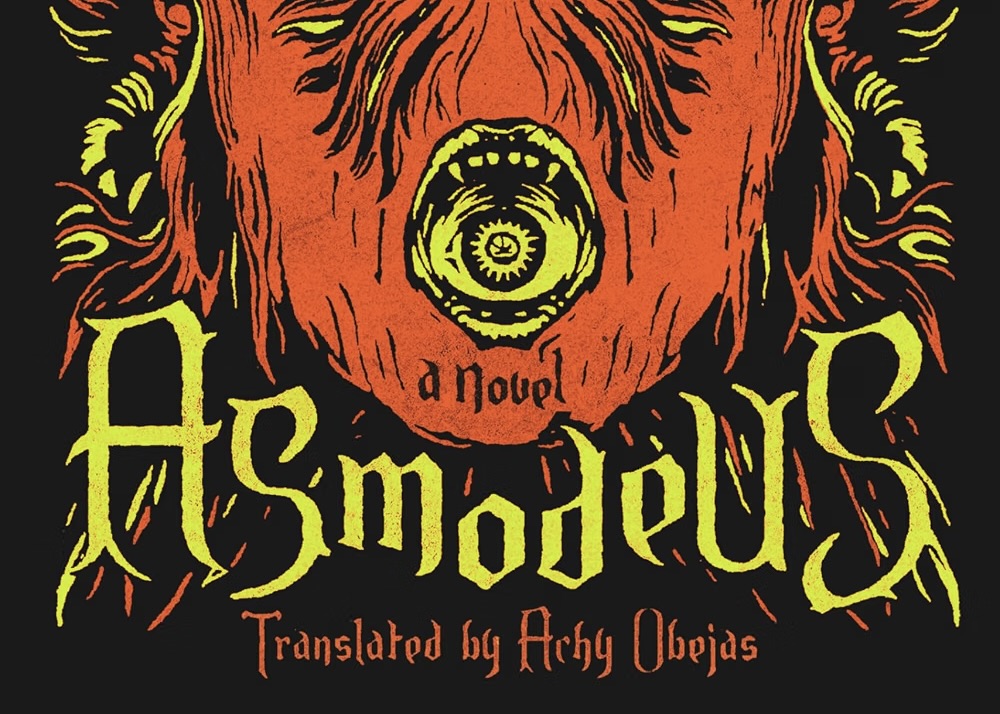
Asmodeus by Rita Indiana, published September 1, 2026 by Graywolf.


Leave a comment