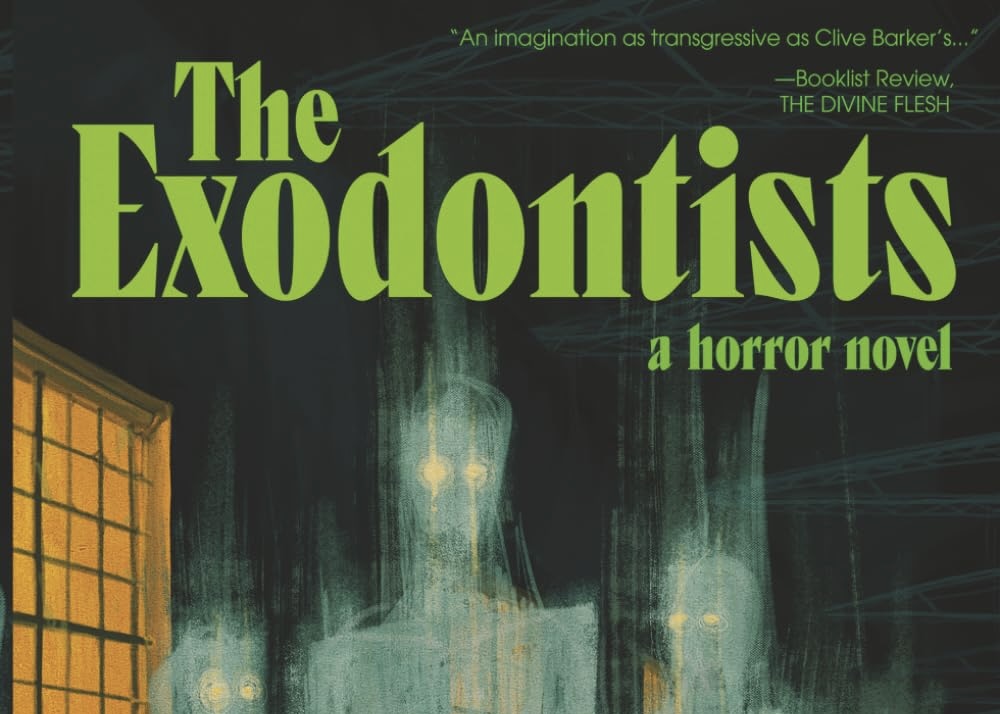
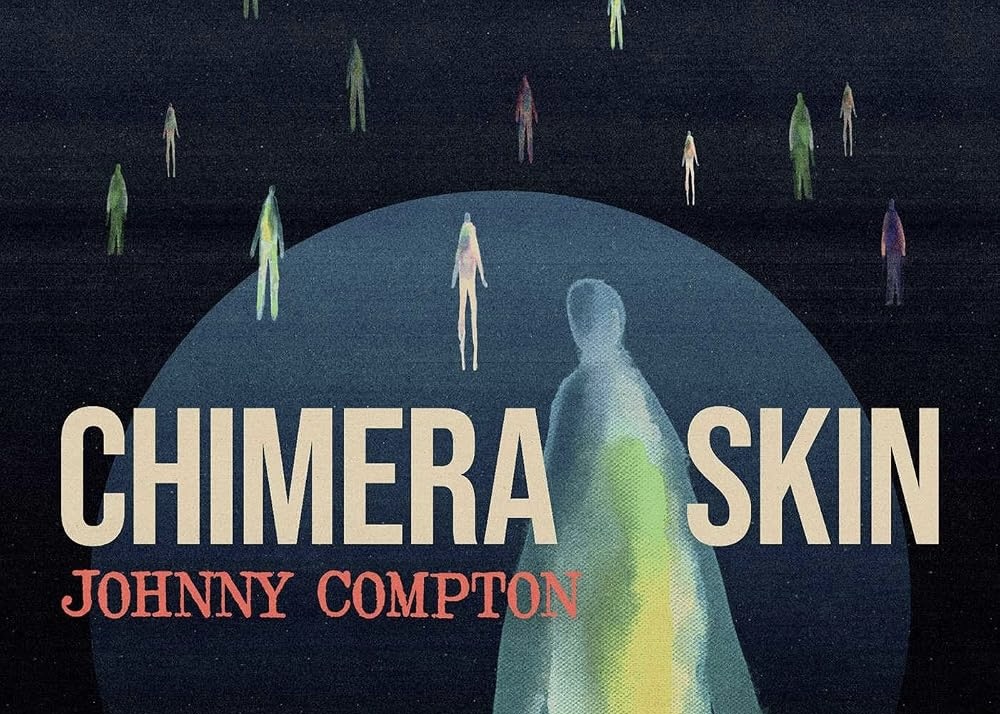
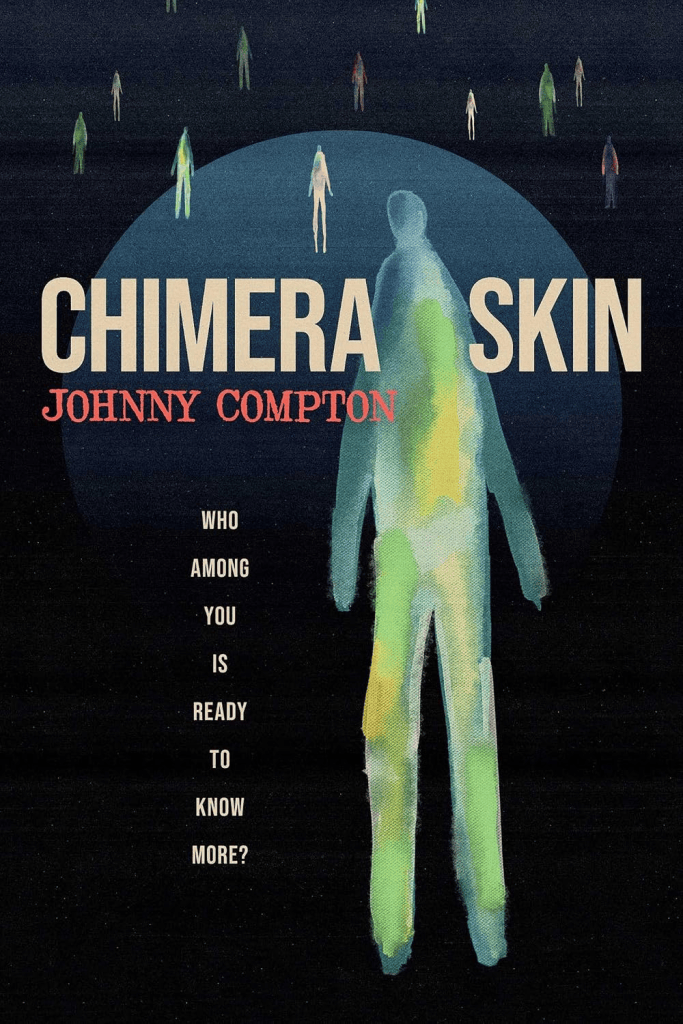
TL;DR: A government scientist goes through a teleporter and comes out wearing other people. Now he guards a Louisiana swamp town from the infected, who feel every cell of themselves at once and kill you for not having to. Compton’s good idea is that knowing your whole body would be hell. His better one is a hero who holds himself together with fear and a villain who is the same man with a worse childhood. Then the fight stops for half the book so the space race can be explained. Fucking Sputnik. Recommended, hands up.



There’s a teleporter in Johnny Compton‘s new novel, and he built it out of other people’s parts.
The machine is called the ADK, after its three inventors, and two of them belong to other writers. Carlos Allende was the pen name of a merchant seaman who, in the mid-fifties, wrote letters to a UFO author claiming the Navy had made a destroyer escort disappear from a Philadelphia dock in 1943 and brought it back with sailors fused into the deck plates. That’s the Philadelphia Experiment legend, and in Compton’s book it simply happened. Andre Delambre is the scientist in George Langelaan’s 1957 story “The Fly,” the one the movies came from, who tests his matter transmitter on himself and gets a housefly through with him. The third name seems to be Compton’s own. Two parts borrowed to one part his.
A year into a slow apocalypse, a giant in scarves patrols the swamp around Colinfort, Louisiana, a Choctaw community of about five hundred. He has seven eyes, three tongues, four lungs, and fingers that used to belong to other men. He went through the teleporter on purpose, carrying a sliver of the enemy’s brain, and the volunteers who went in before him and never came out came out in him, minds included. The enemy is a nine-foot silver man who appeared one morning at the Wright Brothers memorial in North Carolina, asked the crowd who was ready to know more, and let a maintenance worker touch him. The worker went home feeling every cell of himself at once, and two months later tore apart the staff of the facility where they’d locked him up. The infected, who the book calls the “uplifted,” scream “Every part of me is dying” while they work, and they kill anyone who doesn’t have to feel what they feel. The silver man is Danton Baptiste, an American astronaut the government secretly lost in space in 1961. Only his cousin Kelly-Jo and her ten-year-old daughter Khendyl know that the giant used to be Little Lo Swanson, the smartest kid Colinfort ever produced.
All through Part One I thought I had a swamp siege, one man, one town, one long night, no flashbacks, and I was all the fucking way in.
The publisher’s pitch is The Fly meets The Thing meets I Am Legend, which is honest as far as it goes. The Thing, Carpenter’s 1982 film where every piece of the alien is its own animal, is in the blood: shoot one of the uplifted and every drop that leaves the body is alive and on its owner’s side. I Am Legend, Matheson’s 1954 novel, is the frame, one man holding a line against the people who used to be people. Unmentioned: Greg Bear’s Blood Music (1985), where a scientist’s intelligent cells spread by touch until every body is a civilization, which is exactly what the uplifted are; The Quatermass Xperiment (1953), the astronaut who comes home carrying what he met up there; David Brin’s Uplift novels, older alien species raising younger ones, which is where the word comes from; and, for the ending, a late-eighties manga (I’ll let you figure that one out for your own).

In Bear’s book, feeling every cell of yourself is rapture. Compton makes it agony. The uplifted feel the way you feel your breathing the second someone tells you to think about it, except in every organ, all the time, and they kill the rest of us because we don’t have to. In one of the best scenes of the book Swanson sits Khendyl down in his tent, tells her to think about breathing, lets her go twenty breaths toward panic, then opens his nine-fingered hand in her face to shock her lungs back onto autopilot, and tells her that’s what the monsters feel, everywhere. It’s the moment the book hands you its thesis so you’ll quit looking for one.
The book is smarter about control than its monsters are. Swanson’s body is a parliament he rules by force. The lost volunteers get close enough to the surface now and then to ask for thirty minutes a week in a body, and he never answers them. Caught shoplifting at twelve, he watched his whole family turn out at nine at night to scream at him, and his cousin Kelly-Jo, on crutches with a blown knee, drop them to grab him by the collar, and he came away understanding that love mostly shows up as fear. He’s run himself on that fear ever since. Fear is how the hero holds himself together and it’s what the uplifted are wielding when they scream.
Compton’s other smart move is to give the hero and the villain the same life. Baptiste is a poor kid from Kill Devil Hills with a father shot down over Tokyo the day before the surrender and a voice in his head telling him to be like the old man but better. He’s passed over for the Mercury program, by his own account because his name is too French, and picked up by a fringe NASA cell that reads his resentment as an asset. Swanson is a Native kid with a Black grandfather and a White Creole grandmother, a prodigy recruited by the CIA out of Tulane and kept on because he could always be painted as an angry minority if he ever went whistleblower. Two men the secret state uses precisely for what it holds against them. Both go through the machine and come out as something else, and both come home to the town they were born in, one to convert it and one to keep it. Around them Compton builds a plain case against the program. Its scientists cite Tuskegee as proof the country will spend anyone but its golden boys, and they draw test subjects from foreign prisons and from people flagged as suicidal. Their plan for the apocalypse is bunkers under the Rockies. The politics aren’t subtle.
Alright now… the fight you’ve been promised starts at the end of Part One: the silver man rises out of the swamp, demands his brain back, Swanson tells him to come and take it. Turn the page. Sputnik. Fucking Sputnik. Then 1957, the astronaut’s boyhood, the hero’s career, a world war, the aliens, and the fight resumes in Part Five. The battle goes in a drawer for the entire middle of the goddamn book. Compton is doing what Watchmen did in 1986, stopping the plot cold to tell a transformed scientist’s origin out of order, and the middle still reads like a very good Wikipedia hole. A chapter ends with the scare still in the room, and the next one opens in a conference room in 1961.

I first took the alien chapters for the mistake. They’re where the villain becomes a person, and the world he lands on has a rule about death. The mistake is where they sit. His reasons arrive late and in his own memories, like a deposition, and after the climax the book explains how the plan worked and then spends its ending making sure you feel all right. I didn’t want to feel all right. Feeling bad was going great.
Much of the book is delivered as a briefing, footage reviewed and reports summarized, which suits a viewpoint character who spent his career in war rooms and keeps you at one remove: right for the Cold War chapters, wrong for a swamp at night. The sentences run long and plain and explain more than they show. The exception is the chapter where the government tries to mass-produce men like Swanson and we watch what comes out of the machine through bulletproof glass until somebody pulls the oxygen. That’s the one place the book stops explaining and shows you the shit it’s made of.
Compton is from San Antonio and has sold short fiction since 2006. His first two novels, The Spite House (a Stoker nominee) and Devils Kill Devils, were Tor Nightfire books. A story collection came out last December, and in February Putnam published Dead First, about a billionaire who can’t die. This one he took to Alan Lastufka’s Shortwave, a small press that did its own cover and interior. It’s a short novel, and a big house would have asked for a lot more Cold War and gotten it.
Recommended, hands up, caveats where you can see them. I read it in one sitting on a Sunday and got up once, because it mentions an Italian news agency that reported dead cosmonauts before Gagarin ever flew, and I had to know. It was real: Continentale, December 1959, and within a year two brothers outside Turin were in a disused bunker with homemade equipment, taping what they swore were dying Russians. None of that is in the novel. I just wanted you to know about the bunker.