TL;DR: Welcome to the Nordic countries, where the permafrost prevents permanent burials. In Finland a psychologist sighs at a man who’s horny for diapers, and a dining table falls in love and holds a grudge. In Denmark a bog eats landlords and the post delivers a meatball that becomes you. In Iceland a man is dropped off at a family he’s never met and they’ve made a banner. In Norway strangers on a train smother a man for his own good. In Sweden a bureaucrat turns into weather and Santa is not fucking well. The Danes win. Buy it for the Danes.


“Dirty diapers turn me on,” said the caller.
A thirteen-year-old, Eemil, is alone in a Finnish flat at half past one, headphones on, listening to a real 1980s call-in show hosted by a real psychologist, Pekka Sauri, whose method, in the story, is to sigh. The caller works in a nursing home. Of course he fucking does. Marko Hautala sends the kid caller after caller, each one further off the road than the last, and then one that says of the man who invited it somewhere: “He sleeps under the floor now.”
Under the floor is the book.
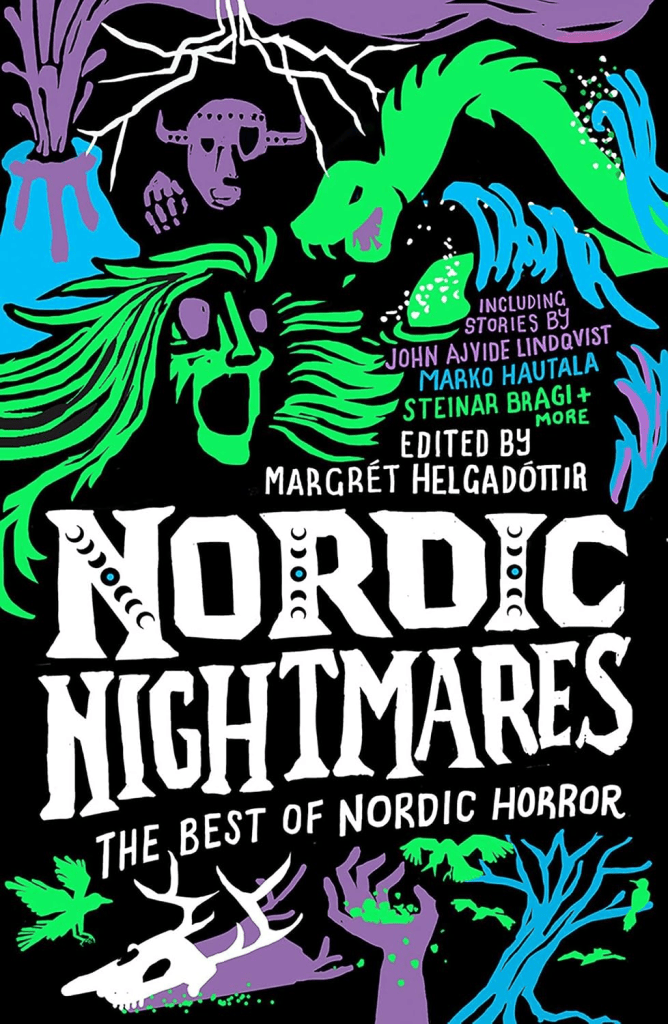
Solaris sells Nordic Nightmares as a map, twenty stories from seven countries, “folkloric beasts, apocalyptic disasters, and psychological terrors.” Shuffle the countries and no story loses a thing. What holds it together is one image twenty writers keep reaching for. A father who went into a Danish bog in his bathrobe. A stranger in a shallow grave by a Swedish road, dug with a snow shovel. A heart under the mulch in a Faroese garden. The Nordic contribution to horror turns out to be the permafrost. Nothing you bury up there rots on schedule, and this is twenty attempts to put something in the ground.
Martin Schjönning’s “Neither Heaven nor Hell” is the one I’d put in anyone’s hand. Two men move into the forest house of one man’s vanished father, a crooked developer, beside a bog where Danish folklore puts the lantern man, the damned ghost of a farmer who moved boundary stones to steal his neighbors’ land. Schjönning makes the boundary mover a landlord. The prose runs hot, a New Year’s tasting menu that ends in ketamine, a page of chemistry about marsh gas that ends in two words of apology, sex written with more care than most of this genre spends on murder, and under all of it a grief about a man who paid his son’s boyfriend to leave, and winter never comes in that story.
A clerk in a bombed city after a war rents a room from a widow whose mute, paralyzed brother beats him at chess. That’s Mikkel Harris Carlsen’s “Mr Schaday,” the other. A new lodger takes the room next door and types all night, badly, like a child spelling, and nobody can describe him. A man from the registry corners the clerk: he and his neighbor must never be in the same room. What follows is a horror story about avoidance, the shape a life takes when it’s organized around not meeting someone, and Carlsen has a theory about who is next door that he holds until the last page, and it’s a lot bigger than a ghost.
Then the half you’ve read before. Johanna Sinisalo’s dining table narrates its love for the woman who waxes it and its loathing for her husband, which is Christine, the car that loved its owner, with place settings, and it first ran in a Finnish interior design magazine, where I think it did more damage. Markus Sköld’s driver scrubs the car at two in the morning and then the man she buried is on her bus, smiling: the hitchhiker from Creepshow 2, who keeps coming back however many times she kills him, moved to a Swedish divorce with a wine fridge. Gewürztraminer turns up twice in this book, once in a Danish forest beside matcha ice cream and once from that fridge.
When the book reaches past the scare it finds a moral. A farmer telling a researcher she has no right to the stones, a mountain that punishes trespass, a diarist asking why we voted for them. Two stories don’t even reach for horror, and together they make up a sixth of the goddamn book. Rakel Helmsdal’s “When the Angels Came” is a 2036 Faroese surveillance diary, drones and barcode tattoos and a husband who informs, The Handmaid’s Tale down to the closing note about where the tapes were found. Boel Bermann’s “The Storm” is, in her own words, a supervillain origin. A civil-contingencies official survives a lightning strike and comes home with weather. Neither is really what the cover promises.
An eight-year-old’s school composition about the Christmas Eve after her father died, with her mother’s boyfriend in the house, a man who pinches her and tells her what he’ll do if she tells. That’s the closer, John Ajvide Lindqvist. The story knows exactly what it’s doing and it’s the heaviest entry in the book.
I read it twice to be sure I’d read it right… I had.
Then it ends on a gift and a joke, and so does the collection, consoled, which is the one place a book this committed to open graves should have kept the fucking dirt on. Tor Åge Bringsværd’s tired man, who apologizes for yawning on a train and whose fellow passengers insist, kindly, that he sleep, would have closed it better. NEVER APOLOGIZE FOR YAWNING.
Thirteen of the twenty are reprints, thirteen are translated. Margrét Helgadóttir is a Norwegian anthologist in Oslo whose Nordic Visions for Solaris in 2023 cast the wider net. This is the horror pulled out of it. Schjönning, Carlsen, Hautala’s radio, Jääskeläinen’s painter paid to put the children back into her paintings, and Bragi’s man delivered to a family he’s never met are the reason to buy it. Whether Lindqvist’s last line is a comfort or the worst sentence in the book, I’ve changed my answer twice since Thursday and I’m not promising the current one.