TL;DR: A family of immortal, toothless monsters runs a free dental clinic in a warehouse until a Halloween store moves into the front half. Sold as a goof, and funny, and underneath it the ugliest argument about love I’ve read this year: to be loved is to have your teeth, your name and your memories pulled, and the pile they sleep in smells like home. The middle third is traps against people who can’t die, and the copy is a goddamn mess. Boy, thirty years old in a child’s body, and the last page carry it. Buy it.


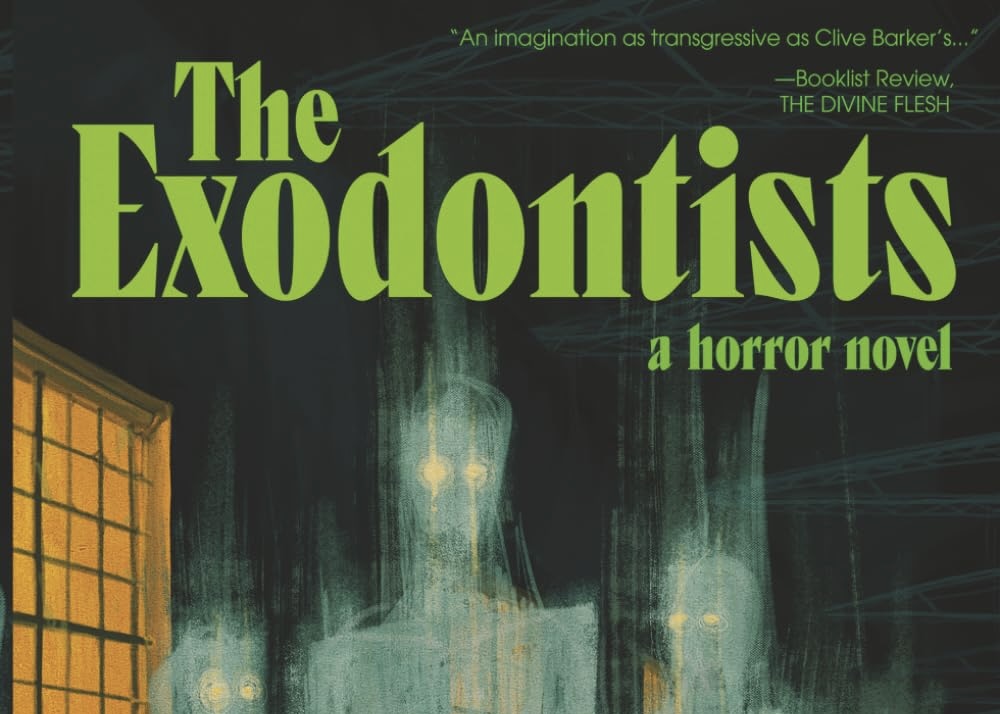
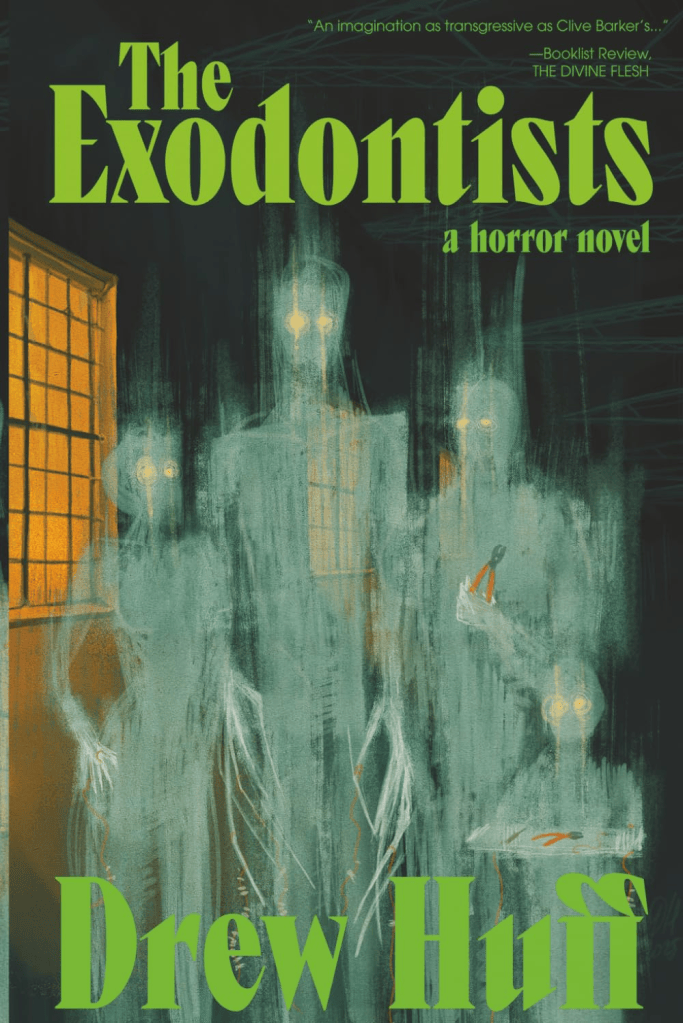
Drew Huff designs book covers for a living, so he painted his own. Four figures stand in a warehouse looking like someone drew them in grey chalk and then dragged a wet thumb down through each one. Gold eyes. One holds a pair of red-handled pliers. A window at the left glows the orange of a lit kitchen seen from the yard. The title is lime green, and under it, in the same green and smaller: a horror novel… you can see it… up above… It’s a cover that knows most people are going to pick this up expecting a goof, and it has already started arguing with them.
Because everything else about the pitch says goof. The jacket calls it “absolutely bonkers” and “a transcendent tale of redemption, family, and teeth.” Huff, asked on Goodreads what he was working on, called it “a fun, Halloween-themed monster novel.” The setup is a Spirit Halloween knockoff (the book calls it Haunted Halloween, and three times forgets to) moving into the derelict warehouse where a family of immortal, toothless monsters has run a free dental clinic for twenty-two years. There’s a zombie-baby display an employee arranges into “a fucked-up daycare situation gone wrong.” We’ve reviewed Huff twice before on this blog (Divine Flesh and My Name Isn’t Paul), one of those made our best-of-2025 list, neither was a Sinister Selection, and I went into this one braced for a romp with gum in it.
I had it wrong by chapter four.
The family: Red, the tall one, and Man, Woman and Boy, which are the only names they’ve got. Bald and toothless, with gold eyes and no sex to speak of. They shed their whole skin every day and sleep in a house-sized pile of the sheddings. At night they pull teeth for the town’s poor, no charge and no questions, and the town forgets where they live until a molar aches, because they can call you through a tooth they once pulled and make your gum throb from twenty miles off until you answer. Red made the other three out of a suburban family twenty-two years ago, at their own dinner table, with pliers, and they don’t remember it. Three humans get pulled toward the pile. Juan, a contractor and a former client, measures the warehouse for the store; his wife is dying of cancer, his drowned sister’s ghost shows up whenever his wife is away, and he wants a deal. Faith, nineteen, an ex-Pentecostal waitress, is raising the baby her pastor put in her when she was seventeen, and the pastor lives twenty miles up the road and wants the baby. And Garrett, twenty-three, an incel with a strangled woman in his bed and pipe bombs on the brain, takes a seasonal job at the store because the back half of the warehouse smells like something he can’t name, like his grandmother’s attic when the Halloween decorations come down, and he walks through the wrong door and comes back out with half his teeth gone and a grudge the rest of the book is built on.
Here’s how an Exodontist is made. You pull the teeth. You feed the bleeding gums the family’s gold saliva. The gums heal in a minute, the skin starts to itch and peel, and the memories go out with the teeth: your name, the people you loved, what you were for, and your sex, which sloughs off a layer at a time. The pile smells like home, and the book is honest enough to make you want it. About a tenth of the way in, Juan lifts one of the “rags” off the pile and spreads it out on the floor: “It is the shed skin of a human, or of something shaped like one.” That’s where I stopped laughing.
What Huff is actually asking is whether being loved is the same as being eaten. He asks it out loud, more than once, and then he builds the question into the biology so it answers itself. The converted forget the people they loved. There’s a bathtub scene a third of the way in, three words long at its worst, that I’m not going to quote, where the book shows you what the exchange costs without raising its voice. A paragraph at the midpoint is built on one euphemism repeated until it stops working. Unconverted relatives drift toward the converted like water finding a drain. And the monsters are the kindest people in the book. Red calls everyone “dear” and fries cockroaches he’s fed garlic for a few days so they taste like lobster. The humans around them rape, strangle, stalk, and drug their own kids.
You want the pile. I wanted the pile. That’s the trap.
Where it comes from is no mystery. The frame is the vampire family that claims a young man who doesn’t want claiming: The Lost Boys and Near Dark. The head vampire who wants a family and the half-turned kid who wants his real one back. Garrett even states the Lost Boys rule, that killing the leader cures the half-turned. The lonely maker and the adult kept in a child’s body are Anne Rice’s, and the book says “Lestat” three times. The third act is Saw II: a hostage on a video monitor, a six-hour clock, a building of traps, a toll paid in flesh, and the book says “Saw 2” too. What none of those own is Huff’s: teeth as the medium, the saliva, the daily molt and the pile, the clinic and the town’s silent compact with it, the pull of kin toward the converted, and the idea that you can keep a child a child forever by taking its teeth.
That last one is Boy, the book’s best character. He is thirty years old in a seven-year-old’s body. He’s stolen a Lamborghini. He keeps his old playmates’ teeth in a satchel and rides the bus to the last stop to look at the stars. He plans like an adult and says “Good. Very good.” when a plan is working, and there’s a chapter where he calls ten children out of their beds with their own baby teeth and has them chant at a woman in her trailer that I’d put against any chapter I’ve read this year. Faith is the other one. She starts as pure appeasement, all “peachy-keen,” with “you fucking man” leaking out between the smiles like a record skipping, and about four-fifths in she makes a decision about her child that is the saddest thing Huff has written.
A thing that goes nowhere: the diner where Faith works, Maureen’s Waffle Shack, puts three jugs of syrup on every table, Maple, Tutti-Frutti Berry, and Strawberry, and I spent an unreasonable amount of the trap chapters wondering what the fuck Tutti-Frutti Berry is.
Now the nitpicks. The Saw II stretch is the sag. For close to a third of the book, traps hit people who cannot fucking die. Electrocution, then sleep and heal. Boiling caramel, so they shed the skin and walk on. A rigged shotgun. Sleep. Heal. The Home Depot trip and a borrowed hearse show up once the clock is already running, and they’re funny, and they’re padding, and the jokes keep the lights on through stretches that would be scarier in the dark. The big piece of dramatic irony is handed to you about a fifth of the way in and the family goes on without it for most of the book, and I still don’t know whether that’s a mistake or the point. Two deaths that would have meant something get taken back before the climax, the climax arrives by talk-down after the book has explained itself twice, and the last two chapters before the epilogue are, in effect, a hug. Garrett’s interior runs the same collapse-and-“foids” monologue five times, and it’s long.
Nefarious Bat is a women-owned independent in the UK that describes itself as publishing “quecer and inclusive, intersectional feminist horror, crime and dark fiction,” which is a hell of a home for a book that spends a good chunk of its pages inside the head of a man who says “foid,” until you watch what the book does to him. TC Parker edited it. Huff’s author bio says his fiction is “pure action,” and the chapter in second person, in a hospital cafeteria, is where I’d send anyone who believes that. By our own earlier reviews’ account this is the third Huff book running about a loving monster whose love consumes, after the godling who “just wants to love and create” and the empathy parasites in human skins, and it’s the one where he found the machinery that makes the idea fucking hurt.
I read it over two nights, and on the second one I got up at one in the morning to brush my teeth, which I’m aware is the stupidest possible response to a book. I’d do it again. Buy it.