TL;DR: Ten stories by Amparo Dávila, Mexican, born 1928, translated by the pair who did The Houseguest. Her characters are lonely enough to fall for whatever’s nearest: a morgue, a hospital mirror, a noise under the floor. The scary part is watching them do it. Then Dávila explains what the morgue meant, and you’re reading a character study with a sad woman in it. Seven of the ten go that way. “The Mirror” and the title story don’t explain a fucking thing, and they’re as frightening as anything out this year. Read it for those two and a last page.




“Empty, like it is now, empty, like it is now, empty, like it is now, empty, like it is now . . .”
A sentence from the first story in Amparo Dávila‘s Behind the Gate, and it embodies the collection. Five words, said four times. A nurse has just explained to Angelina, a secretary in a sanatorium, what the small white building at the end of the garden is for, and Angelina has asked what happens when nobody dies, and the nurse has said it stands empty, like it is now. The sentence has no verb of Angelina’s own and no end. It trails off on the dots, and only the next sentence tells you it was her, repeating the nurse’s words silently. A person takes a phrase from the room and says it until it’s hers. That’s how every story in this book moves. And then the sentence after that one steps in and explains what you just watched, the phrase “had touched and perturbed her,” and that is also how every story in this book moves, and it’s the problem.
Dávila, born 1928 in Zacatecas, dead in 2020, is here for the second time in English. Ten stories, the oldest from 1959, taken from the 2009 Spanish collected edition, by the translators who did The Houseguest for New Directions in 2018, Audrey Harris and Matthew Gleeson. No introduction, no note, no date on anything, which for stories a reader has to date by ear, from the typewriters and the sanatoriums, is a choice. The people in it are a secretary, a son with a mother in hospital, a spinster clerk, a schoolteacher, a musician’s wife, a tired man looking at an apartment, and what the jacket calls tiny nightmares (NPR calls her Mexico’s answer to Shirley Jackson) are mostly what those people do at night with whatever is in the room: a morgue, a wardrobe mirror, a noise under the floor. Four of the ten stories have no monster in them at all.
She builds her people out of a job and a want. Angelina is a secretary who has just scrubbed an old house top to bottom for her sister’s visit with an American husband. The sister is called Baby Girl and the husband is Billy, which is a Hank Williams Jr. duet, and Billy eats breakfast at eight and lunch at one on the dot. I’ve met Billy. He’s at every wedding, asking the DJ to turn it down and the caterer what’s in the fish. Fucking prick. What Angelina wants, under the hosting and the diagnosis that lands her in the garden, is to be somewhere nothing asks her for anything, and the morgue is the only building on the grounds that qualifies, so she falls in love with it, and before long she’s calling it hers. Señorita Julia, in the eighth story, is built from respectability. An exemplary clerk, an engagement of years to the company accountant, who sits on the board of the Knights of Columbus (they have a board… I did not need to know that), and her father’s pharmacopoeias, which she gets down when the traps and the poison fail. Her want, to be seen as the saint she’s been, runs straight into the office’s want for a scandal and the accountant’s want for a clean soul, and the engagement breaks on that collision, an actual plot, with people in it. In half the book the wants collide like that and cause what happens next, and those are the strongest. What goes wrong is what the stories do with the obsession once they’ve grown it. Angelina’s narrator says it outright. She watches the building “as if she meant to paint its portrait. But the portrait was inside her.” Julia’s rats are heard by the reader as well as Julia and then the last page tells you what they were, which turns a woman back into a case. The teacher in the title story is built by the aunt who raised her, and wants the same man and the same money the aunt wants, and the story never once lets you doubt her, which makes what happens to her a punishment. A question would have needed a doubt. Seven of these ten end as portraits. A lonely person and the thing she’d settle for, with the meaning written underneath. A portrait doesn’t ask you anything, and these people, made as well as they are, mostly don’t fucking get to.
Three stories get beyond the portrait, and the one that gets furthest is “The Mirror.” The book’s belief, as far as it has one, is that what haunts you is company you sent for, and a mood is as far as that goes. “The Mirror” turns it into a question about knowing. A sales inspector comes home from three weeks on the road to find his mother in hospital with a broken leg, wasted by something that happens at midnight when the nurse brings her pill, and when he asks she can only say “It’s no one’s fault, it’s the mirror, the mirror.” She can’t describe what’s in it. She can only point at where it isn’t. He does what a reasonable man does, swaps the nurse and tries to move her, and finds the room sunny and the mirror an ordinary wardrobe mirror, because every sensible precaution assumes the trouble is a person or a place. The story’s claim is that some things can only be known as a hole in what ought to be there, and it builds that claim in the only way it can, by giving you the hour and the glass and withholding the thing. Maupassant did the first half of this in “The Horla” in 1887, a man who watches his own reflection fail to arrive because something is standing between him and the glass, and who answers it by setting fire to his house. Maupassant also, the story goes, ate lunch in the restaurant inside the Eiffel Tower most days because it was the one place in Paris he couldn’t see the tower. That’s gotta be the Frenchest solution to a problem on record. Dávila’s mother and son don’t burn anything. Where the story stops short is its last line, which says the stance out loud, resignation, in so many words, and a question that gets answered on the page by the people in it. The other two that reach: a man of forty re-reading his boyhood diary while the two times run under each other, which asks which life is the dream and builds the asking into its shape, except that the hinge is very reminiscent of Cortázar, whose “The Night Face Up” ran two lives in alternation in 1956. And a dream of rooms, each one opening onto a worse one, in which an old man at a table with The Interpretation of Dreams on it says the thesis aloud, that we try to flee ourselves and can’t, which is Freud doing the story’s job for it.
What the mother and son try is the one precaution anyone would take, about four-fifths of the way through the story, and Dávila makes it the scariest fucking scene in the collection, because covering a thing you can’t see gives it a surface to be seen on. The scene lasts five minutes by the clock in the room. It ends with two people weeping and a decision about looking that I’ve watched a hundred horror stories avoid making, and the thing in the mirror never gets a name, and never gets sent away.
The title story is told by a first-grade teacher of twenty-three who lives with her grandmother and the aunt who raised her, Paulina, forty, unmarried since a traveling salesman stopped writing, and a friend’s brother comes home from the north and courts them both. The story withholds one thing from you for its whole length, which is where the teacher is telling it from, and it hands you that in a last paragraph in the present tense, one long sentence with no full stop until it lands. The event in it is caused by a choice a character makes inside the story’s own machinery, told late and as an event, with no explanation after it and no coda to take it back, and nothing I’ve read this year finishes a book harder.
I don’t want to be in a room with that sentence again.

I read “The Mirror” in a laundromat, in the chair that faces the dryers. Dryer doors are round and dark, and it truly creeped me the fuck out… made me squirm. Nine of the ten endings leave you where that one does, with real unease, and that is most of what holds up the collection for me. The rest of what holds it up is those colliding wants. What holds the collection back is that most of the frightening parts were borrowed from others. The rats a woman hears in the walls that nobody else can, and what they do to her, are Lovecraft’s “The Rats in the Walls,” 1924. The genteel lady with a parlor and a garden and something on the property, narrated by the neighbors, is Faulkner’s “A Rose for Emily,” 1930, by way of Arsenic and Old Lace, the 1939 comedy about sweet old ladies who poison their lodgers. The mirror is Maupassant’s, as above.
The ten stories come in no order that means anything. You could read them back to front and lose nothing but the title’s position. And the two stories without a monster that sit back to back in the middle, a scene in an instrument shop and the poisoner, run a fifth of the book between them, the poisoner alone being the second-longest thing in the fucking book.
She’s the best company in the book but doesn’t belong in it. “Matilde Espejo” is told by a violin teacher’s wife remembering 1940 and an old landlady with Chinese wildflower tea and three dead husbands. She’s a woman so grateful to be liked by someone refined that she narrates every clue as a kindness, and never fucking catches on. Espejo is Spanish for mirror, so the book has two stories called The Mirror, and this is the one that reflects (PUN!) worse on everybody. The instrument shop before it is seven pages of a man screaming at two little girls holding maracas about touching his things.
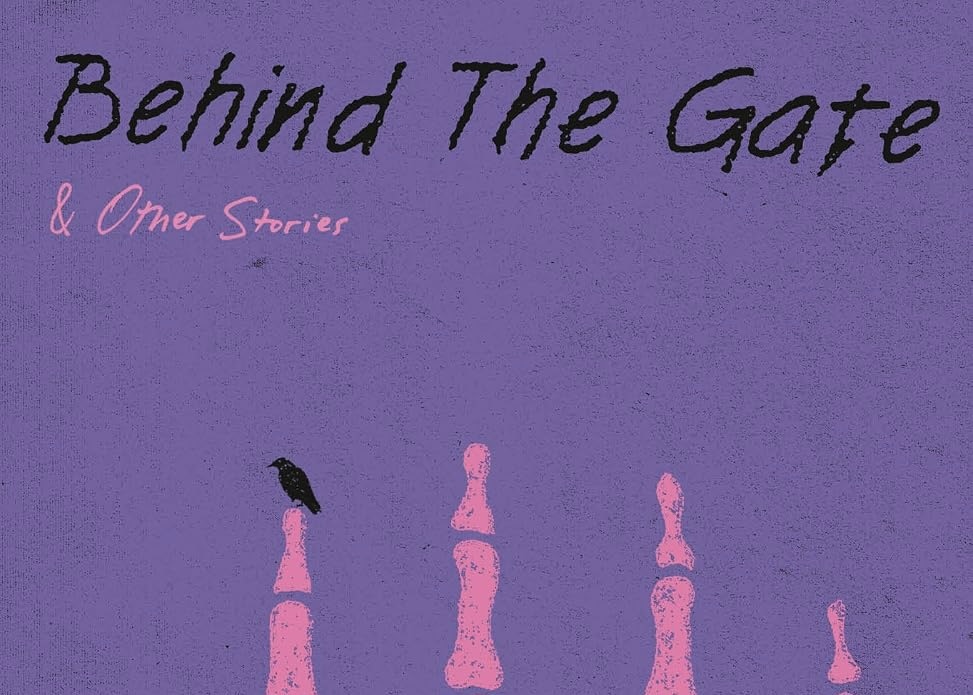
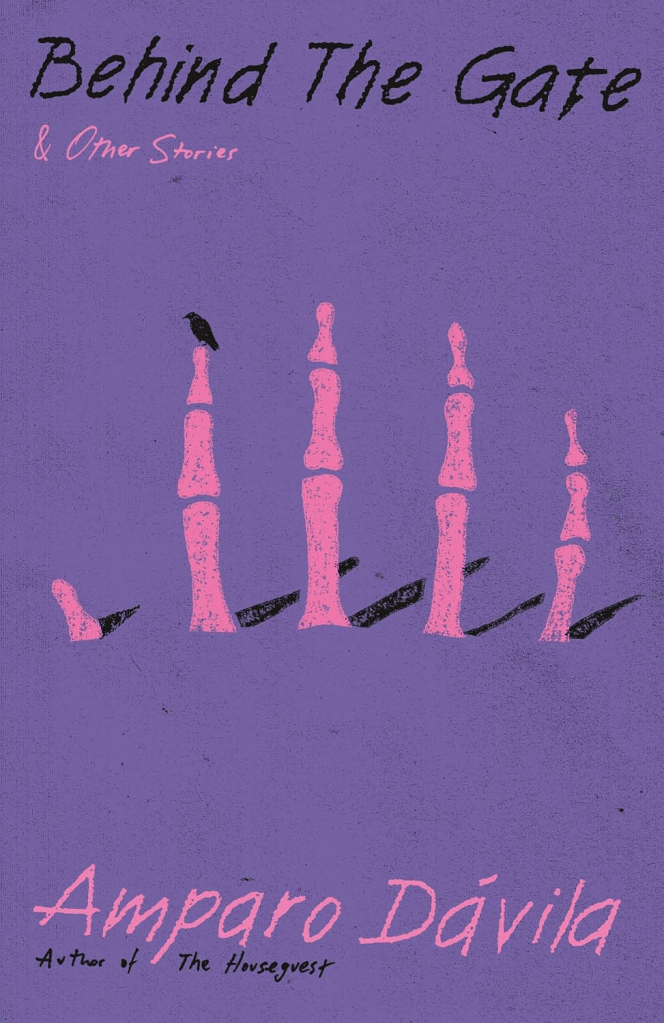
The cover is a purple field with four pink finger bones standing up out of it and a small black bird on one of them. The hand you can work out from the poisoner. I went back through the whole book for the bird. There are birds: a grandmother keeps them in cages in the title story, and the tired man on the roof watches some fly off to a forest he’d like to join. None of them is black and none of them lands on anything. Looks nice anyway, I dig it.
I’d have paid the $16.95 for “The Mirror” and the last page, and I wanted the other eight to make a sucker of me. They sat for their portraits instead.