







TL;DR: Rooted starts as a cursed-statue novel and turns into something stranger and sadder: a mother, a daughter, and a sinking city that refuses to forget. Goût thinks like a sculptor, building every scare from one unshakable image. The prose wobbles. The pictures never do. Ghost pipe through cracked pavement will follow you home. Horror with dirt under its nails.

Mexico City is going down twenty feet a century, and the one thing in the middle of it that won’t go down with the rest is the temple the Spanish pulled apart and used for parts. A tour guide says so through a tinny little speaker hanging off his shoulder, about a third of the way into Rooted. Give it fifty years, he says, and the kids on this tour will be looking up at it. He calls it the Aztecs’ last laugh and walks his group off toward the next thing.
Leopoldo Goût stays at the railing. He stays there for the better part of three hundred pages, and it is a hell of a place to stand.
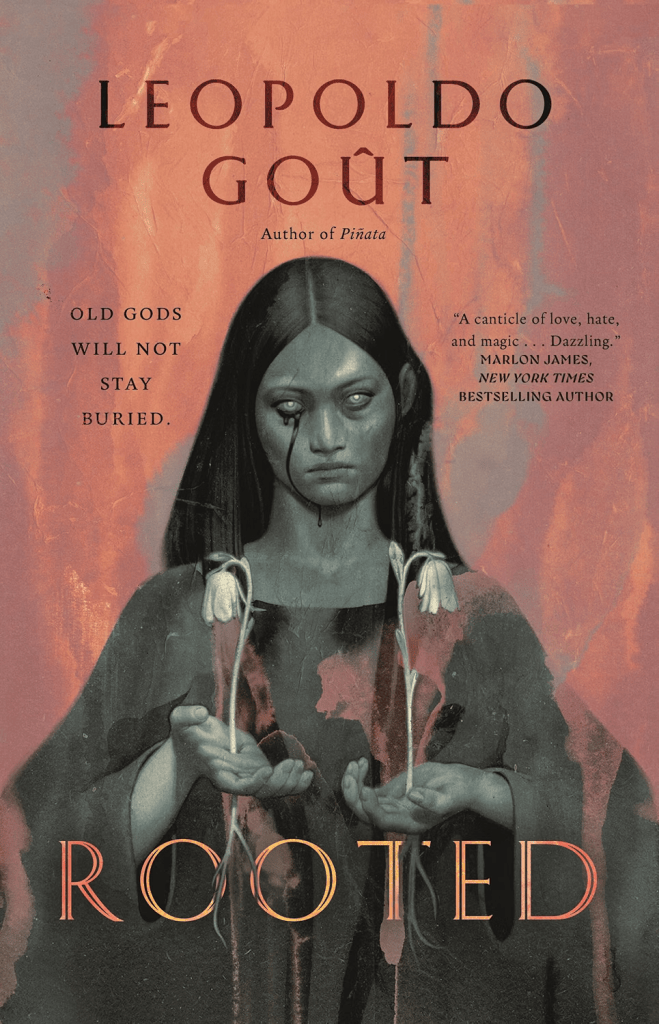
Here is what I wanted from this book. I wanted a cursed statue. I’m weak for a cursed statue the way I’m weak for a Waffle House at two in the morning: I know what it’s going to do to me and I pull in anyway. And the statue is here and it’s a beauty. Xipe Totec, Our Lord the Flayed One, a smiling young man wearing an older man’s skin like a rain poncho, the dead man’s hands dangling loose at his wrists. We meet it first in Spain in the 1840s, in the drawing room of a rich failure who does a bit for his dinner guests where he kneels in front of it and begs it for an ear of corn. His wife is down the hall with a sick baby, and she has started to hear the thing talk. That prologue runs maybe ten pages, it’s the most controlled writing in the novel, and its last image can go fuck itself. I mean that as praise.
Then the present day. The statue comes home from Madrid sealed inside an iron box that nobody in going on two centuries thought to open, with paperwork that describes the box and says not one word about the contents. Aurora Marino, the art lawyer who spent months fighting to get it repatriated, is alone with it under the fluorescents in Room 237 when something inside knocks.

So I got my statue. What I did not see coming is that the statue is the opening act. The headliner is a woman pushing seventy, coughing in the next room and telling her daughter it’s the dry air.
Aurora hasn’t set foot in Mexico City since she was small, since her father died on the living room floor a few feet from the couch where she slept. Now she’s staying in that apartment with her mother, Maria, and it’s the same couch. There’s a corner of that room she will not look at. A grown woman with a law degree, walking to the bathroom at night with her eyes nailed to the ceiling. If you can’t see it, it’s not there. I ran that exact policy until I was eleven on the gap between my closet door and the frame, and I’ve never seen it set down this precisely, the way a kid’s terror comes with bylaws.
Goût is very good at the small true thing, and the small true things carried me through the places where the sentences didn’t. Aurora takes a blood pressure pill because a side effect is that it stops her dreaming, and she keeps it in the same bottle as her homemade mushroom microdoses, all of it packed in matching red and beige capsules, told apart by which ones have a code stamped on the side. At the repatriation ceremony the museum stands up an empty crate with a poster of a giant Olmec stone mouth on it so the photographers have something to shoot, and in the press photos it looks like the gate to the underworld is about to eat a row of lawyers. Plastic champagne flutes. Maria’s mole, and the mezcal nobody gets to touch until she has finished saying how proud she is. A little girl in East Texas coaxes a wild quail into eating seed out of her palm and her grandmother comes across the garden like the bird is a gas leak.
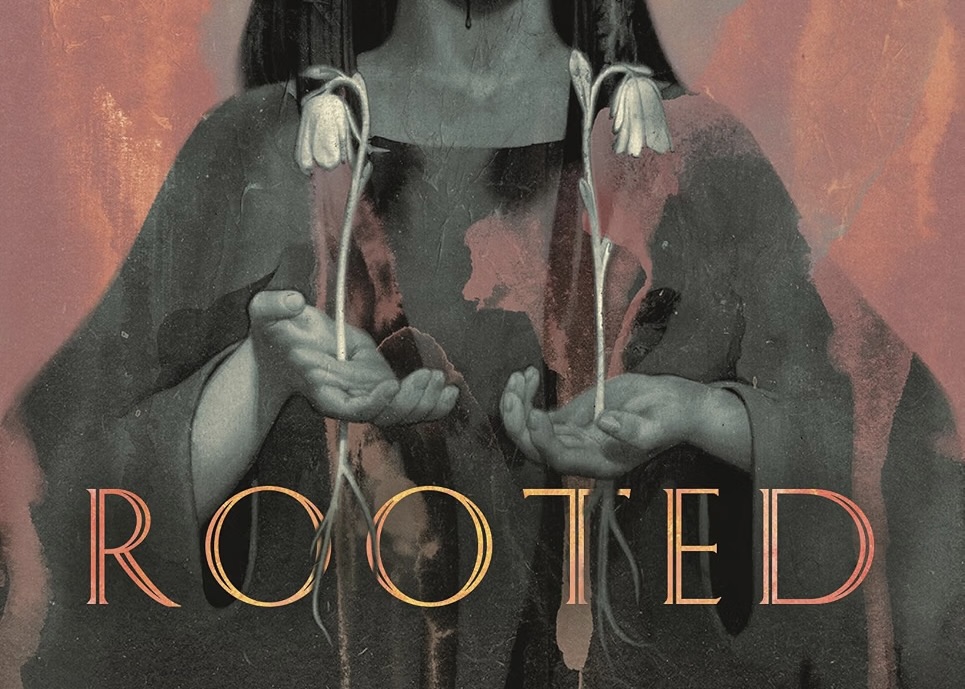
And the ghost pipe. It’s a real plant. I looked it up at one in the morning like an idiot. White as a candle, no chlorophyll, no use for the sun, lives on what it can pull off the fungus and tree roots under the forest floor. In Rooted it starts coming up through the cracks in the pavement, pinkish, warm to the touch, and the bells turn to look at her. I have a high tolerance and that got under it. Everything frightening in this book grows out of that plant and that god: skin that doesn’t sit right on a face, a seam at the corner of an eye, a second set of lips moving behind the first, a city in drought splitting like a heel. It is one image worked over and over and he never lets go of it. Goût trained at Central Saint Martins and was making sculpture and paintings long before he published a novel, he has shown at MoMA PS1, and it figures. Every scare in here is something you could cast.

He is also a television producer, and that figures too. He spent close to a decade in business with James Patterson, the Alex Cross movie and Zoo, and between jobs wrote Ghost Radio, a YA trilogy, an illustrated novella with the filmmaker Eva Aridjis, and Piñata, the 2023 possession novel that was his first for Nightfire and made Esquire’s list of the year’s best horror. That one came out of something he’d learned about the friars who brought the piñata to Mexico. They painted Nahua gods on them, filled them with food, and handed hungry children a stick. He has said what he was chasing was “the pure terror of losing our memory of the past.” He grew up in Mexico City, raised by a single mother who put up Indigenous pilgrims in the house, and later turned up a Zapotec ancestor on his father’s side. Rooted takes that same terror and aims it at the people who think they’re the ones doing the remembering. Aurora’s whole career is moving stolen objects to the correct building. The book’s opinion, and it takes its time arriving, is that a different glass case is not home.
The producer shows in the engine. Chapters end on a button and cut to black. It moves. I read it in two sittings and never once checked how many pages were left. But I came up playing in bands and I have to say it: the prose has about two dynamics. Shivers go down spines. Blood runs cold. Pulses pound in ears, a lot of ears. Aurora retches into two separate wastebaskets. And the dialogue, whenever it has theme to deliver, goes stiff as a press release. Maria is so alive when she’s nagging about papaya and soup, and then over dinner she tells her daughter she’s finally doing “work that truly resonates with your heart,” and no mother has said that, over mole or over anything else. The middle has a loop in it, too. See a flower, run home, Mamá coughs, don’t sleep, go again. Four bars, repeated.
The last act has a lot of explaining to do and does it out loud. The visions hand over the family history in tidy order, like exhibits, and then people who love each other stand in a room and tell each other how the magic works. I wanted less. The pictures had already told me.
But. The best scene in the book has no god in it. It’s a window at the civil registry, a clerk with her hair in a hard bun, a line of people waiting behind Aurora, and a printer warming up. I won’t tell you what she asks for. The look she gets back is the funniest thing in the novel and I laughed, and about four seconds later I felt like shit for laughing, which is the correct sequence. And there’s Ociel, the college ex, an archeologist who gets as giddy about opening a box as a kid at Christmas. At one point he drags a hotel armchair up to the bed, takes her hand, and sets a timer on his phone to wake her before she can sink deep enough to dream. I would have married him in that chair. He scratches at his forearm the whole time. Eczema, he says. Everybody in this book has a perfectly reasonable explanation.
The ending I’m not touching. It goes bigger than I thought a book this apartment-sized had in it, it costs what it ought to cost, and I believed most of it. Then the epilogue goes down into the museum and shows you one picture, the best idea in the whole novel and the truest thing it has to say about what Aurora does for a living, and he held it back until the last five pages. That’s a sculptor. He makes you walk all the way around the thing before he lets you see the face.
Ghost pipe grows in the county where I live. I’ve walked past it for years and thought it was a mushroom.

Rooted by Leopoldo Goût, published September 15, 2026 by Nightfire.


Leave a comment