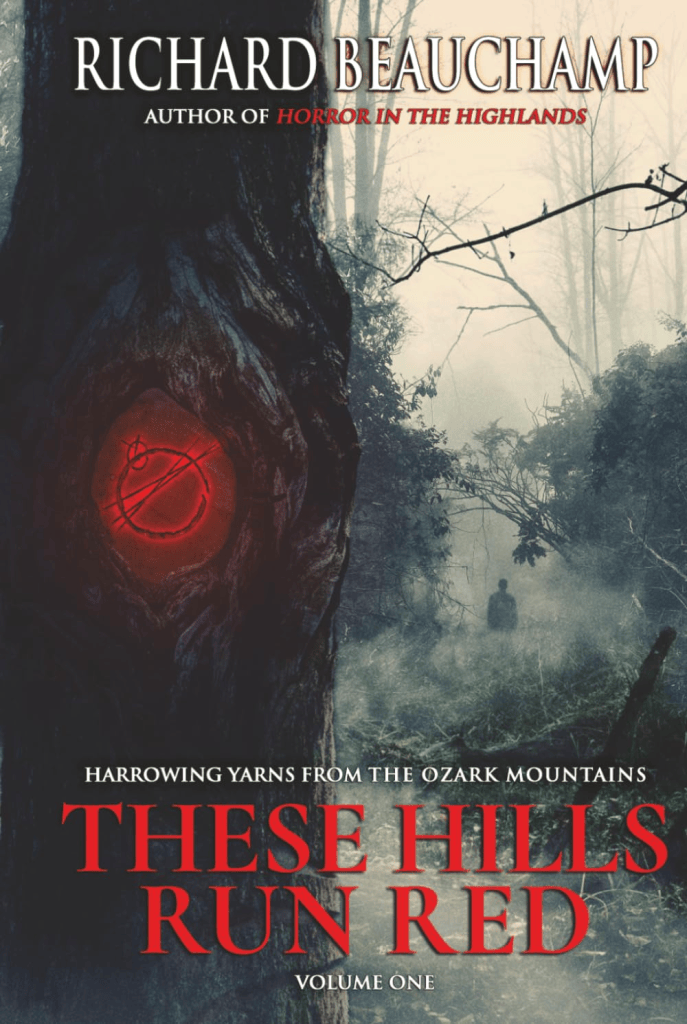
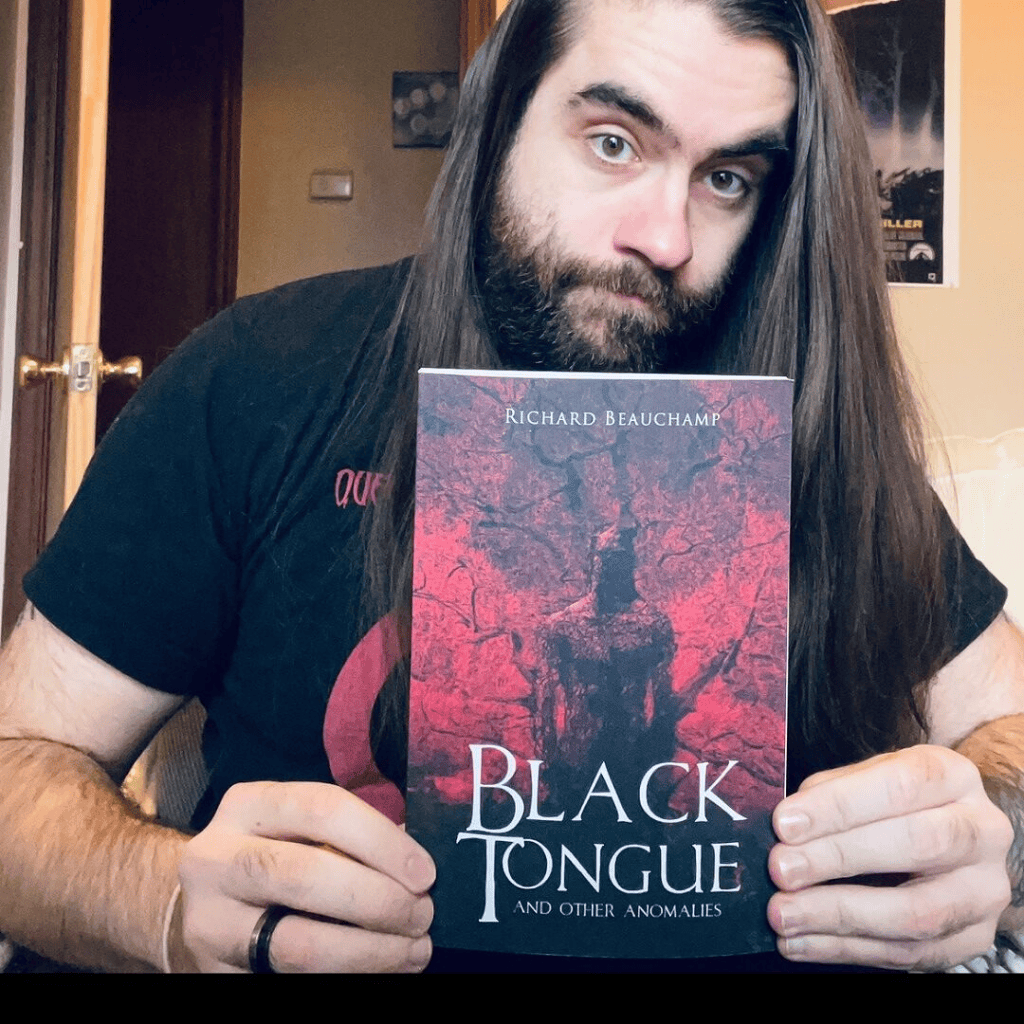
TL;DR: Richard Beauchamp is one of this blog’s favorite indie horror writers, and his twelve-story Ozark collection runs borrowed bones through a real place: The Mist, Hellraiser, Dark Matter, Odd Thomas, Hereditary and Independence Day, with hollers. A third of it isn’t horror and the one real question gets waved off. But the werewolf told from inside and the cave two centuries on are his, and the witch’s granddaughter has the best last line in the book. The closer does something mean with a rescue. 5.3. Read those three and wait for Volume Two with me.





I wanted this to be an eight. I’m telling you first so you can discount accordingly, ’cause Richard Beauchamp is one of this blog’s favorite indie horror writers, has been since Our Lord, the Worm put a tapeworm from hell in a small town and made our 2025 honorable mentions, and I read his new collection the way you watch a friend’s band, wanting it badly and still able to hear the drummer lose the count.
One question, asked twelve times. Can a holler make a borrowed monster new?
The Introduction is in character, a hill-folk host telling you to warm your bones and mind the dog. He quotes Vance Randolph calling the Ozarks “willfully unprogressive” and takes it as a compliment. A content warning ends, after the suicide and the incest, with the slow destruction of a perfectly good ‘98 Ford Ranger. That’s the voice.
Twelve stories, three reprinted from Dark Peninsula and Phobia Books anthologies, set in his own towns: Walker’s Bluff, New Hamlin, Buck’s Point, Ward Knob. A widow in a Carter County holler wakes to a portal in her bedroom corner and learns the only safe place left is underground, a problem, since a cave nearly ate her at fourteen. A junkyard heroin addict takes two thousand dollars to accept a Buick LeSabre with glyphs scratched in the trunk. NEVER ACCEPT A BUICK. A biologist finds “a version, and not a reflection” of herself past the bluffs of a rental lake house, against rule five, the one in capitals.
The answer is mostly no, and it took me until the fourth story to admit it.
The bones aren’t quite his. The widow and the cave is The Mist with a Half-Life accident in it. The Buick that needs feeding is The Hellbound Heart in a barn. The multiverse story is Blake Crouch’s Dark Matter, and its last move belongs to Coherence. The cemetery story is Odd Thomas with a bluegrass singer. The witch’s-granddaughter story is Hereditary’s whole arc. The drunk veteran versus the alien fleet is Randy Quaid’s half of Independence Day with the stupid one-liners removed. Local is texture, and texture isn’t what drives this thing. Swap the Ozarks for any rural county and every goddamn one of these still runs. I’ve read two of his novels. He can build his own machine. Here he mostly rents.
Three times he doesn’t. “Mouths Where None Should Be” is a werewolf’s whole life told from inside, from a bite outside Leipzig through every war since and out past the bombs. Forrest Gump, if Forrest had eaten the dead at Wilson’s Creek. It ends on two words that are resoundingly true. The closer, “Obscura,” is a cave two centuries on, told by a boy who has never seen a tree and calls the moon the god sphere, and if you remember where the first story sent the town, do the arithmetic. It’s Plato’s cave with cannibals and the book has the manners never to say Plato. About two-thirds through, a rescue arrives, and what the cave does with it is the best thing in the book, a hard, shitty thing to do to you, and the only time the order pays.
And “Ma Gentry’s Dream Catcher” has a last line I read three times, a child’s sentence that refuses every comfort a last line usually sells. The next story opens with a hungover man taking a shit and looking at it. That’s the whiplash this book runs on, and it mostly works.
I still can’t tell whether the werewolf story is a war story or an anti-war story, and the two words cut both ways.
I read the last four stories in a parking lot again, which is where Beauchamp and I meet. A third of the book isn’t horror. The multiverse story explains its impossible thing as engineering halfway in, the cemetery story is a consoling ghost procedural, the alien story is a last mission, the cattle story is survival with a news crawl to explain it. They come in two pairs, so twice the book goes thirty pages with no true horror core. Five of the twelve end consoled: vengeance done, a comforting dream, a triumph, a quip, and the quip is a police-report joke a sentence after a detail that should have kept me up. The serious stuff is lore. The one story that asks a real question, whether it’s murder or suicide to kill another version of yourself, asks it and then ignores “these confusing philosophical questions.” That’s the book’s relationship to metaphysics in one sentence. It’s frustrating.
The prose is pulp and heavy on simile. A thing comes through a portal “like a bowel movement from the universe itself,” and “like a” recurs every six hundred words. The portal things are, by the book’s own description, car-lot inflatable tube men with broccoli heads, and Beauchamp sells them anyway. That’s the pulp skill.
There are two Ford Rangers in this book. One crushes a man’s leg and one gets eaten by a tree, and I spent twenty minutes working out which is the ‘98 from the content warning. No year given for either. I’m leaving it.
Disappointed and fair: three stories that bite and nine you can name from across the room. This is called Volume One, so there’s a Two coming. You can bet your ass I’ll read it. I’d just like him to bring his own monster.