




TL;DR: A woman drives north to bury a mother she never knew and finds an observatory with a mirror made of poison. Russell gives his monsters no face, no voice, no motive, and they are terrifying for it. The dread is patient, the body horror unforgettable, the middle a little too talkative.

Renata Scarborough has had psoriasis since she was small, long enough that the cracking and the flaking and the bent aluminum tube of ointment gone soft as a dried banana in the bathroom drawer are simply the terms of owning a body. She knows the pain’s schedule. She knows which fabrics bite. So when the desert begins doing something else to her, something that was never psoriasis and never will be, she is the last woman alive equipped to notice it, because the hurt arrives in the one place she has spent her whole life training herself not to look. That is the engine of this novel. It is the best idea anyone has had about body horror in some time, and Russell does not explain it, he just turns it over slowly in the light for four hundred pages like a man turning a stone he found in a dry wash.
The setup is plain. A Las Vegas summer breaking its own records, cicadas scraped off casino glass with a wide broom, a twenty year old Forerunner losing its front bumper to a hit and run in a parking lot while Renata develops other people’s film inside a print shop her boss hopes will fail. She comes home to a U-Haul’s worth of her mother’s belongings stacked among the mail: journals, bank statements going back to 1988, a coloring book, a purse, a safe, a jewelry box with four necklaces wound on their pegs and an empty locket in the last slot. The aunt who raised her says this is simply how Corinne says goodbye. A check for three hundred thousand dollars arrives in the cul-de-sac mailbox with no letter. Renata does not believe her mother is dead, which is the only ground on which a book like this can be built, and she buys a car with the money and drives two hundred and fifty miles north to a town called McNairy that sits under a mountain that holds a decommissioned observatory whose telescope used a mirror made of spinning liquid mercury.
Three records run through the book and Russell keeps them honest. There is Corinne’s own hand, clipped and abbreviated, using a plus sign where a softer woman would write and, a voice so efficient it seems for a hundred pages to have no interior at all until it opens without warning onto a hospital room and will not let you leave. There is Francis Brown, a river surveyor logging water levels on the Colorado in 1905, who writes long and sonorous and addresses his diary to his wife, a man of the age of Bierce and the Reclamation Service who wants above all to be understood. And there is the present, Renata in the town, asking. What is bracing here is how little Russell protects his diarists. Brown speculates about the blood of a colleague with the easy poison of his century and about his own father’s lips and brow, and Corinne, seventy years later and no better, sets down slurs in her own notebook for the pleasure of hearing herself be precise. Both are meant to be lived with rather than liked. The book is smarter for it, and so is Renata, who reads these people the way a daughter reads, which is to say for herself, and finds herself in the wrong one.
McNairy itself is the finest sustained piece of construction in the book. A bar called the Spyglass with a chalkboard on wheels that gets turned to face the room at last call so the drinkers can guess who wrote the word on it. A post office holding a hundred parcels for a town of seventy souls, its western wall still sooted from a firebomb the postman declines to be upset about. A bald bartender who came out of Maine and never went back to the ocean. A woman who is either everybody’s aunt or somebody’s parole officer. Every last one of them has a rash. They pump their water from a well ten miles west and they are calm about it in the way of people who have already decided, and whatever afflicts these people, whatever they are all quietly not saying to each other, is laid into the town so patiently that by the time it surfaces you have been breathing it for two hundred pages.
The prose is not showy. It is close and dry and it runs long when the eye runs long, and Russell has the desert writer’s one indispensable gift, which is knowing that the horror of that country is not the dark but the distance, the finger of rock on the horizon that stays the same size for ten miles, the man on a ridge who is a man for an hour and then is a stone. But the writing gets up on its hind legs in the possession scenes and those are where the book earns everything. Renata stands rooted in the road under a full moon and cannot move her neck while spines two inches long push up through her arms and the entire world arrives through them at once, coyote shit and yucca pollen and trailer smoke and, far off and unmistakable, water. Later she cannot open her hand around a tarantula. Later still she can feel what a thing feels as it stops feeling. These passages are written from inside the failure of the body, the panic of a woman relearning where her own spine is, and they are goddamned frightening in a way almost nothing else in current horror is, because they do not threaten her with death. They threaten her with detail.
Between the book’s three parts sit two short interstitials in the second person, spoken by something high up and patient, watching a canyon lose its trees over four days. They are the oldest trick in weird fiction, the impersonal watcher, and they should not work this well. They work because Russell refuses the thing every writer alive wants to do with a monster. His creatures have no faces, no speech, no motive a reader can shake hands with. They move at the speed of geology. They want water and they want eyes, and what little of their mind gets through to us arrives as scent and season and pressure, a grammar with no verbs for mercy.
Where it slackens is the telling. The middle of the book runs on testimony, and testimony means people sitting down across from Renata and talking at length, and there are two long turns in the back half where a character opens a vein of exposition and the novel holds still while it drains. Russell knows this and tries to earn it by making the tellers strange, by having Renata note that they seem possessed by the past rather than remembering it, but a monologue is a monologue and the second one comes too soon after the first. The mercury cover-up, likewise, does a great deal of tidy load-bearing. A few of the townspeople exist mainly to withhold. None of this is fatal. It is the difference between a book that never lets go of the throat and one that sets you down twice to catch your breath.
Nicholas Russell is thirty years old, was born and raised in Las Vegas, and has spent close to a decade selling books at the Writer’s Block downtown, which is where he will launch this one. He came up as a critic and not a novelist, a columnist at Defector and formerly Gawker, with essays and film writing in The Believer, McSweeney’s, The Baffler, Sight and Sound and Reverse Shot, and he has said the novel began in a dream of its own last scene and took years of freelance nights to reach. He set out to write the most Nevada book he could and to do it without the usual furniture, without shadows, betting instead on cloudless sky and squinting and never knowing how far away anything is. Of the creatures he has said he did not want them to vocalize or communicate or have faces in any way that would let a reader empathize with their motivations, and he kept his word. When asked for five words he offered: desert, skin, mothers, poison, spores. A critic who can summarize himself that accurately is a critic who has finally stopped reviewing and started building, and the next book is a story collection, and the one after that has werewolves in it.
Renata knew her own pain’s schedule. She knew which fabrics bit. That knowledge was the door, and it was standing open the whole time, and the desert simply waited, as it does, as it will, for her to walk through it on her own two feet.
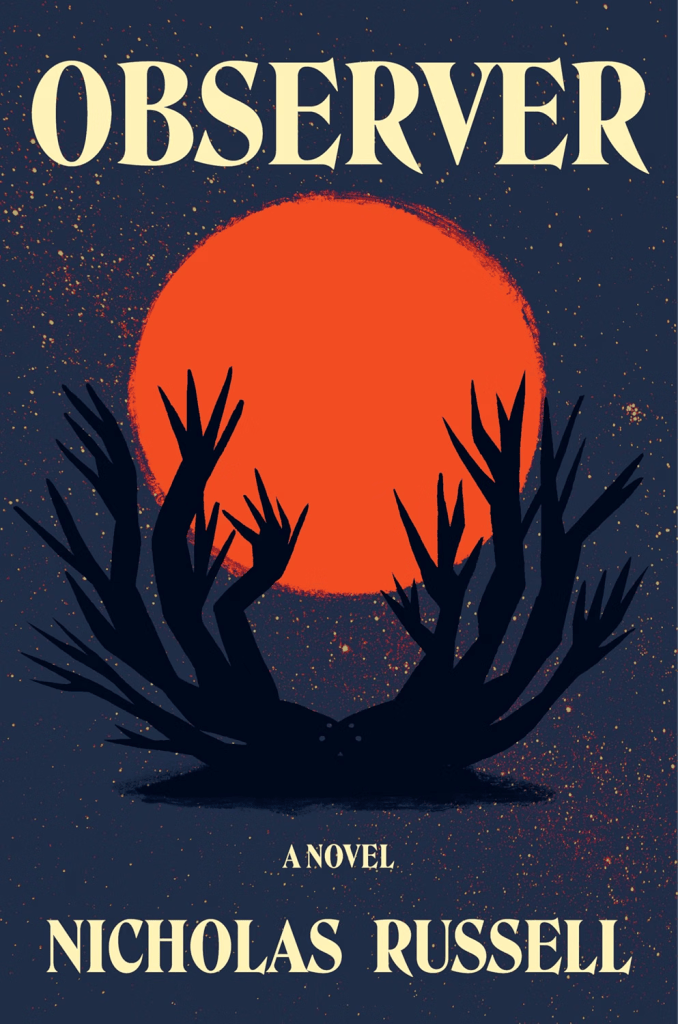
Observer by Nicholas Russell, published September 8, 2026 by Ecco.


Leave a comment