
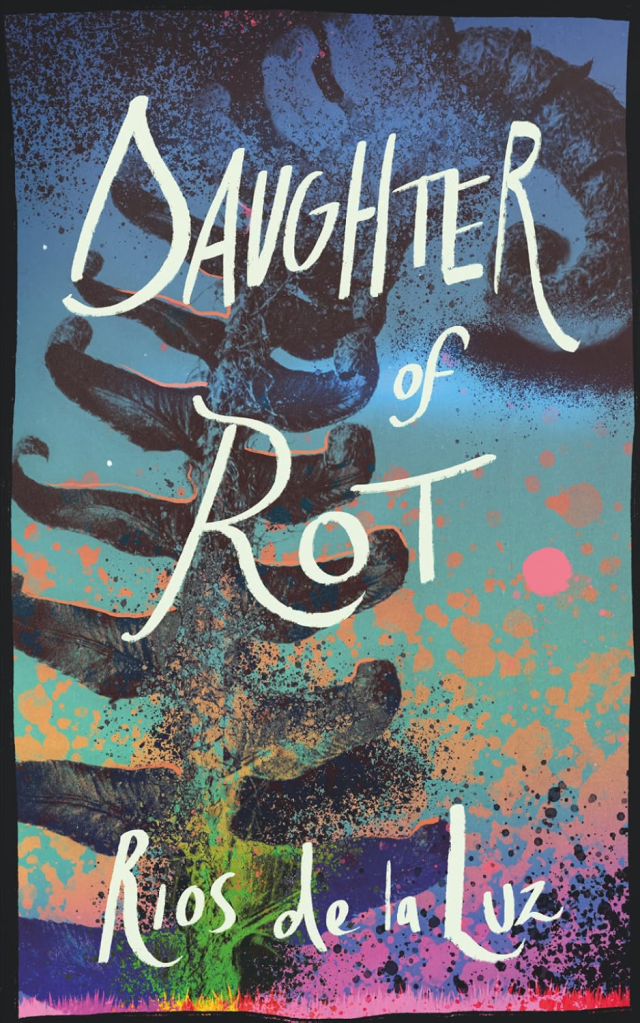







TL;DR: A house that dreams of drowning, a room that gives a lonely kid everything, and a mother who gives her nothing. De la Luz writes in species names and open wounds. It goes lush where it should go lean, but when it lands it takes your feet out from under you. Believe the flowers. Fear the mother.

Daughter of Rot has a room in it that grows its own weather. It has a house that daydreams about drowning. It has an oak tree that cannot remember its first language and is a little embarrassed about it. All of that is good and some of it is better than good. But the thing that put my stomach through the floor was a mother timing her daughter in the bathroom. Fifteen minutes to piss, shower, brush your teeth, fix your face. Come out with your hair wrong and she takes you by it and fixes the hair herself, with no regard at all for how hard she is pulling.
Rios de la Luz does not linger on that scene and that’s why it works.
Here is the setup, which arrives sideways and in pieces, the way everything in this novella arrives. Olivia Velasquez lives in an adobe house at the end of a gravel road in New Mexico with a father who is functionally a rumor and a mother named Isela who wanted to be a famous clairvoyant and got a teller window at a bank instead. Olivia is six. Then she is eight. Then she is ten. She dusts the ceramic chickens. She microwaves her own fideo. She makes juice concoctions as a treat for her one kidney, because she was born with one and nobody ever explained what it does. And then the house, which has its own chapters and its own interior life and wants very badly to die by the sea, grows a new room, and the room has a name, and the room starts handing out gifts.

The chickens are where I knew this writer had me. There are four of them on a shelf. The silkie is Leonora because it sounds fancy. The Polish is Magdalena, Mags on days when her eyes look deeper than they are supposed to. And the speckled Sussex is Roberta the Second, because Roberta the First broke in a “spectral” accident, which means Isela got off the phone angry and pulverized a ceramic hen with a hammer. That is the funniest sentence in the book and it is also a complete forensic report on a childhood, and it is delivered by a kid who has already learned to repeat the family’s official version. No setup. No comment after. De la Luz just sets it down and walks off, and I sat there with my thumb on the page for a while.
The prose is doing something I want to be honest about, because I loved most of it and got tired of some of it. She writes in species. Not flowers, but gold flame honeysuckle and mountain hydrangeas and scarlet waxcap mushrooms and blue oat grass. Not birds, but a black-billed magpie. It reads like a woman naming things so they cannot be taken from her, and at its best it is genuinely a spell, the room shifting cloud forest to wildflower field to shoreline while a kid lies on her back and lets pollen fizz on her tongue. At its worst it is a nursery catalog. Somewhere past the halfway point the transformations started to feel like a lava lamp to me, gorgeous and unfalsifiable, one more chapter of the room being beautiful when I wanted the room to want something. Beauty has diminishing returns. Dread does not.
And the dread here is not mechanical. Nothing is being built. There is no trap tightening, no clock. If you came for architecture you will be pissed off. What there is instead is a permanent hum of wrongness in a small house, and a mother whose chapters are, hand to God, the most electric writing in the book. Isela gets rendered from the inside, not excused, and it is so much worse than a villain. She does not hate her daughter. She is bored and furious and grieving something she never had, and the girl is in the room. De la Luz gives her a monologue over a pot of caldo de albóndigas that starts in mint and oregano and family lineage and slides, by degrees you can barely track, into asking a child whether she wants to ruin her own body on a baby someday. Every immigrant grandmother’s recipe in the world has been sentimentalized to death. This one is a weapon and it is still, somehow, also a recipe. I wrote it down. I am going to make it.

De la Luz has been at this a decade. She is a queer Xicana and Guatemalteca writer who came up through the small presses, The Pulse between Dimensions and the Desert at Ladybox in 2015, then the novella Itzá at Broken River in 2017, then the story collection An Altar of Stories to Liminal Saints in 2023, plus anthology work at Seal Press and the Feminist Press. She has said she builds an altar and talks to her ancestors before she writes, and that she is after healing from trauma through magic rather than around it, and she teaches workshops on body stories, which explains a lot about how this book locates every emotion somewhere anatomical. Her named influences run Sandra Cisneros, Lidia Yuknavitch, Han Kang, del Toro, Ari Aster. You can see all of them in here and she does not sound like any of them. Itzá was a survivor’s spell that she has described as letting the girl heal all the way. This one is tougher and less merciful and better built, and it knows something the earlier work was too generous to say, which is that some people get out and are still not okay.
The best chapter is about past lives. In 1952 Olivia is a Venus flytrap on a windowsill belonging to a young woman who wants to learn how to devour, who bites her own arms, who writes obituaries for the insects and prays they come back as hunters. Three pages. No explanation afterward. I have read it four times.
I read this in one sitting on a Tuesday and then I called my mother, who is fine, who has never once timed me in a bathroom, and I did not tell her why.

Daughter of Rot by Rios de la Luz, published September 8, 2026 by Broken River.

 The Blog Without a Face
Leave a comment