
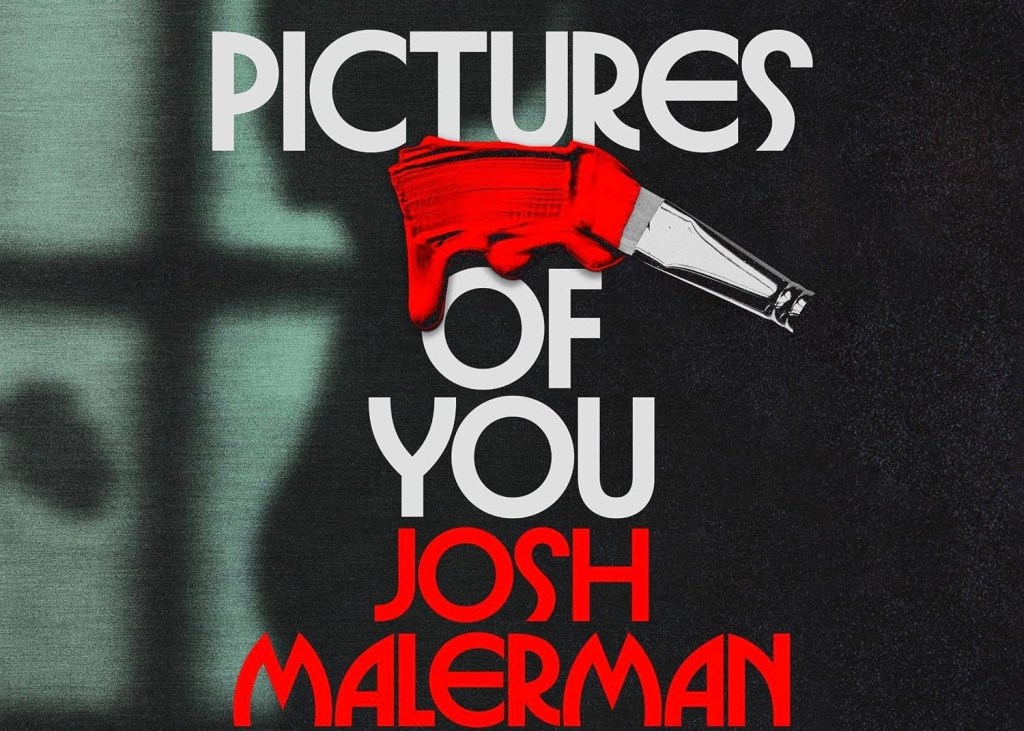
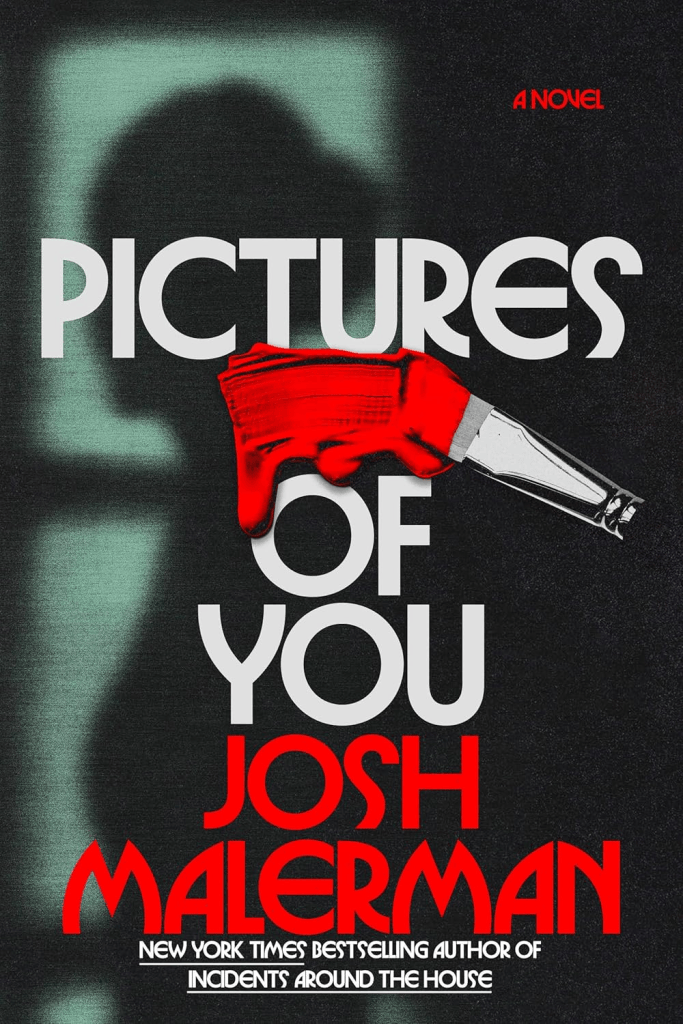





TL;DR: Malerman builds a cage out of nothing but an idea and dares you to stand up. Pictures of You is the rare horror novel that makes you feel the pressure of a held pose. The best chapter he has written in a decade is about a four-year-old and a set of colored pencils. A still life with a pulse.

Nobody ties Emily Moore to the bed.
Emily wakes in a room she does not recognize, hungover in a way that turns out not to be a hangover, wearing a party dress that is not hers and satin gloves that go past the elbow. Pink ceiling. Mauve wall. Yellow floor. A bed big enough to get lost in. A spotlight she cannot see behind. Twenty feet out at the edge of that light, a woman stands behind a picture frame propped on an easel, leaning into it and back out of it the way people do when they are fixing a composition. There is no canvas in the frame. The woman says Emily’s boyfriend Jack is up the hall, and that if Emily leaves the piece, something will happen to him. Then she stops talking and looks.
No rope. No chain. No lock, and for a long stretch Emily cannot even locate the door. She is free to stand up any second she likes. The novel is the cost of that.
Josh Malerman‘s sentences are the opposite of the room. He writes warm and loose and fast, close third that slides into whoever is holding the camera and stays there, ellipses everywhere, clauses that stack up and get excited about themselves. The alternating chapters, which take the couple back through the night before, are the friendliest thing he has published. Emily and Jack are six months in, down from the city of Chaps to a Lake Michigan dune town for a weekend, and they drink something called Butter Crown and eat an entire block of fudge walking down the boulevard and rate the local bars by whether they qualify as a mellow. Jack has a bit about a funeral drummer hired to play the rimshot every time a priest says something untrue about the deceased. He runs it into the ground. It keeps being funny. Then it comes back in the last chapters in a register you will not want. (Wainscott sits in the same Michigan as Goblin and Samhattan and Chowder, and the couple’s small talk is stuffed with sightings from books Malerman has already written, which is either a gift for the regulars or a shrug, depending on how you feel about a world that keeps its own footnotes.)
What the woman with the frame wants is stillness. She calls it a still life and she calls Emily the piece, and when the arrangement satisfies her she says just so, and she says it several hundred times, and the book is correct that the phrase stops meaning anything and starts meaning four or five things instead. The threat here is almost entirely negative space: an empty rectangle, a light with a person somewhere behind it, screams from a hallway Emily has never seen. Twice she stares at a dark spot above the spotlight and decides it must be a camera. There is a mauve wall she becomes fairly sure is not a wall. The violence stays offstage for long stretches, and what comes onstage instead is posture. A woman adjusting a lamp. A wooden flute that makes no note. A man holding one bare foot against the opposite calf for hours because he has been told he is in the painting.

That man is the cruelest thing in the book. He is not a henchman, he is a fan. He has read the same criticism she has and agrees with every word of it, and when she hurts him he apologizes on the way down.
Four strands run in rotation: Emily in the frame, the night before, Jack out searching the town, and a young officer named Jeff Opal. The first two are excellent. The second two are where the novel gives back fifteen or twenty percent of what it has built. Jack circles the same six blocks for a hundred pages, talking himself into and out of panic, telling himself that one sentence will make sense of the whole day, and Malerman lets him say so nine or ten times. The Opal chapters fail in a stranger way: they are charming. He thinks about his mother, his grandmother, his therapist, ten generations of family in law enforcement, whether an instinct is a species of art. Late in the book he stands at a door deciding whether to knock and it goes on for pages. It is a nice piece of writing about a man enjoying his own life, and it lands at the precise moment the reader wants a door opened.
The woman also quotes an art critic named Ted Gwynn the way other people quote scripture. Ted Gwynn says the piece must be true to itself. Ted Gwynn says the title can work like a twist ending. By the midpoint the refrain reads less like character and more like a tic the draft failed to catch. This is where you are supposed to get impatient. There is a reason for it, it is parked at the very end, it is the funniest and meanest thing in the novel, and it retroactively buys most of the repetition, though not all of the volume.
It is worth knowing who wrote this. Malerman finished fourteen novels before anyone published one. He drafted most of them in the passenger seat of a van while his band the High Strung played something like two hundred and fifty shows a year, and when a draft was done he took it to his brother’s print shop in Berkley, Michigan, had it printed, and set it on a pile. Bird Box was a twenty-six-day first draft with no chapter breaks and no quotation marks. He never submitted any of it. What ended the pile was a friend from high school, Dave Simmer, who asked whether he could pass one of the books to some people he knew, and did. In the acknowledgments here, Malerman thanks Simmer for putting a frame around the whole thing in the first place. The dedication is to his wife, the artist Allison Laakko, for letting him watch paintings go from sketch to frame.

So a man who spent a decade making work that nobody was looking at has written a novel about a woman who had the thing and lost it in one afternoon to one adult, and about the adult, who did not have it and never stopped trying to get it.
That novel is chapter thirty-four. It is the best chapter Malerman has written in ten years and it is about a four-year-old and a set of colored pencils. I am not going to describe it. The argument it makes is that discouragement is a form of violence with a longer reach than the other kind, that it can be administered in under a second, and that the person it is administered to will spend thirty years not knowing what was removed. Grown-up Emily can name every painting at her city’s art museum and has never once said out loud what she thinks of one. She assumes she is not the sort of person who has opinions about art. She is wrong about the reason.
The publisher is selling this as a Hitchcockian thriller. It is a captivity horror novel about art criticism, and the ending is loud and literal and answers the question the book has spent three hundred pages declining to answer. It also hands Emily a piece of criticism to say out loud, and she says it, and it is the correct piece of criticism. I follow the logic. A book about a woman who was silenced ought to let her speak. But Malerman has been running a cold engine the whole way and the last two pages turn the heat on, and a measurable amount of dread goes out the vent. Somebody else is going to call those pages the only decent thing he could have done.
Jack wakes alone in the hotel room, sand skating across the parking lot outside, no idea yet what the day is. He finds both their phones on the little table by the door. Hers and his, side by side, squared to the edge of the wood.
Pictures of You by Josh Malerman, published September 8, 2026 by Del Rey.

 The Blog Without a Face
Leave a comment