








TL;DR: Paulette is nineteen and paid to be a rich man’s girlfriend. She pays her best friend by the hour. The anarchists downtown are on somebody’s payroll too, they just don’t know whose. Krilanovich spent sixteen years on this book and you can hear it in every line. The middle drags. The sentences don’t.

Johnny Hasley turns the labels on his pantry jars to face the wall. He could not tell you why. He is rich for San Benito County, he writes parlor songs that a local paper once said ached with a vulnerability unfashionable for the time, and asked once about his inspiration he said, “I get a thrill from punishment. I’ve always been that way.” He sleeps until two in the afternoon. He wears a rat charm with turquoise eyes on a heavy chain. In his bedroom there is an altar built on a bench with four carved jaguar paws and heaped with crystal shards, oozing fruit, holy pictures, and pans of smoldering rosemary, and none of it means a thing, as he would tell you himself at the right hour of the night, which for Johnny is most of them.
Into this house, in 1879, comes Paulette. She is nineteen. She has been hired.
That is the whole engine of Grace Krilanovich‘s second novel, and the pleasure of the thing is watching how long everyone can avoid saying it out loud. Paulette prefers other words. She has transcended grift, she tells us. She won her gilded cushion through the artistry of love. She is no longer her father’s daughter. The book lets her say it as often as she likes, the way you let a child tell you she is not tired. She knows exactly how to arrange herself on a velour sofa, how Johnny likes the chignon (half up, one curling lock over the shoulder), where the line of white powder must stop along her jaw. She sketches floor plans as a hobby because he suggested it. She is the best-employed person in Anzar, California, and the only one who will not admit she is working. “Withholding facts gave me something that was almost like money,” she says, and never notices that she has just told you the rate.
The house alone would make a book. There is Grandma Rat upstairs in her lace day cap and sun-bleached taffeta, a dignified frown giving her the air of a sentient pin cushion, a white rat running treats up and down her arm, cogent only when recounting the most appalling things she has ever seen. Johnny once tried to calculate her age in white rat lifespans and quit because it was so many rats. There is a painting of a slaughtered warhorse hanging over the double doors, neck bent back over the shoulder, a little farther and she would be nuzzling her own death. And there are the boot prints in the herb bed under the kitchen window every morning, which Paulette keeps smoothing over and which keep coming back, and which she recognizes, and lies about, and which are the closest thing this novel has to a knock at the door.

Downhill there is Anzar itself, a town the tramps have decided to move into. Krilanovich has done real reading here and it shows in the grain rather than the footnotes: the jungle a half mile off the rail yard, the forty-cent lodging house where your room is a cubby and the street is your hallway, the private security outfit called the Loganberries who beat people on behalf of an Improvement Commission staffed by the cream of local citizenry. When the city empties five hotels into the alleys, the evicted walk to the park and stay, and the occupation that follows is the best sustained writing in the book. A man holds a banner reading ANTS ARE CAVEMEN. Yeggs in the Blackburn basement build a machine they describe as A Tangible Device Conjuring Up Very Specific Ideas, which never works and damages the building. A thin enormous man carries what appears to be a pet ferret in a sling and turns out to be carrying his own beard and a bandaged arm. When the dog killings start, every single witness gives their name as either Jack or Lavinia Black.
The funniest people in Anzar are the ones with a program. Shelly Holcombe runs the Nascent Freedom Movement from an abandoned tannery and preaches grave-training: make like the dead, lie in a quiet place, deny all weather. Her position on private property is “Seize, and waste.” Violent Olga, surveying the park, says of the tramps and their homemade machines for performing violent abuse, “I love.” A teenage grifter in purple brocade sewn with little gold bells explains to Johnny that the negative energy of women collects in the receptive fibers of modern textiles, that what the house needs is not ventilation but calibration, and that he has chosen to live nine hundred years. The pamphlets have titles: Rapunzel Scissors: When to Cut!, God’s Casket: Answers Inside, Alternatives to Time. I laughed out loud at Alternatives to Time and then sat with it for a minute, because every person in this novel is buying one.
And here is the trap, sprung so quietly that you are in it before you feel the wire. Everyone in Acid Green Velvet believes they have escaped employment. The tramp has the road. The women in the forest camp have founded a society outside money. Paulette has love, which she is certain is a different thing from a job. Every one of them is on somebody’s payroll, and the book proves it without once raising its voice: Paulette pays Shelly by the article of clothing to put on, pays her for the meeting, pays her for the walk, and when she finally asks whether they are friends, Shelly says a friend who charges is fair enough. Krilanovich has written a liberation novel in which every act of freedom is an invoice. The dogs are the least of what comes to collect, and the dogs are bad enough: overgrown in front and ruined behind, chains hung with crude ornaments, something in their sighing that is nearly but not quite laughter. To call it a laugh, she writes, would commit the whole scene to that style of thinking all the way down.

The sentences are the reason to read her. They are plain in build and strange in freight, which is the hard trick. Evening color like lollipop water. A woman’s raised arm hanging there like a piece of celery. Johnny looking across a room with eyes like two vacant and desecrated buildings. Nobody sounds like this. She has said she wrote parts of it by scribbling landscape across huge sheets of paper and hunting for words that turned up by accident, then revising line by line for dozens of passes. You can feel both halves, the found thing and the filed thing, often in one sentence.
It sags. Kenneth Greycroft, the ruined boy who came three hundred miles after Paulette and stands at her window at night like a mammal with its snout to the glass, is given long stretches of dream in which the girl appears at the foot of his bed, and then appears again, and the fourth and fifth visitations do what the first one already did. His body is beautifully made: the concave chest, the invisible ball he seems to carry in front of him, the blank face he trains so that no one will speak to him all day. His interior, past a point, repeats, and there is a stretch in the back half that is simply a man being fucked with by everyone he knows, again. The speechmakers converge too, until the anarchists and the fortune tellers and the tramp philosophers are working one rhythm, and the effect flattens from chorus to drone.
Krilanovich lives in Los Angeles. The Orange Eats Creeps, her 2010 novel about teenage hobo vampires in the Pacific Northwest, got her a National Book Foundation 5 Under 35 pick from Scott Spencer, a Believer Book Award nomination, and a 2025 reissue in Two Dollar Radio’s New Classics line. Then sixteen years. She has been plain about why. She started this novel in 2007, had three children, and lost a decade to it. “There were ten years of torment because I had no time,” she told Southwest Review. “Simply no time. Three hours of childcare per week to just barely stir these coals so it wouldn’t die.” Once her youngest started school she finished the last drafts in eighteen months. She calls the result a Gothic Western and describes its collision as the Gilded Age meeting the Age of Aquarius, which is exact, and which accounts for the anachronisms a certain kind of reader will want to correct. I mention it not to be tender but because Acid Green Velvet is, among other things, a novel in which a woman hands a baby to a camp of women and goes back out on the road, telling herself the child is better off believing itself an orphan, and the woman who wrote that spent ten years unable to get to the desk. Krilanovich does not sentimentalize the arrangement and she does not condemn it either. She just puts it on the page and keeps her hands where you can see them.
There is a moment past the middle when Paulette, alone in the bedroom while Johnny sleeps his ghoulish sleep, notices marks up near the ceiling that she has never seen before. Deliberate gouges under coats of paint, hatch marks bundled in fives, running along the phantom baseboard of a smaller room that once sat above this one. Somebody lying on that floor with a nail. She counts them. Four years’ worth. She wonders, briefly, whether it might be an accounting of joys. Then she sits down at the vanity and applies a vast quantity of cosmetics.

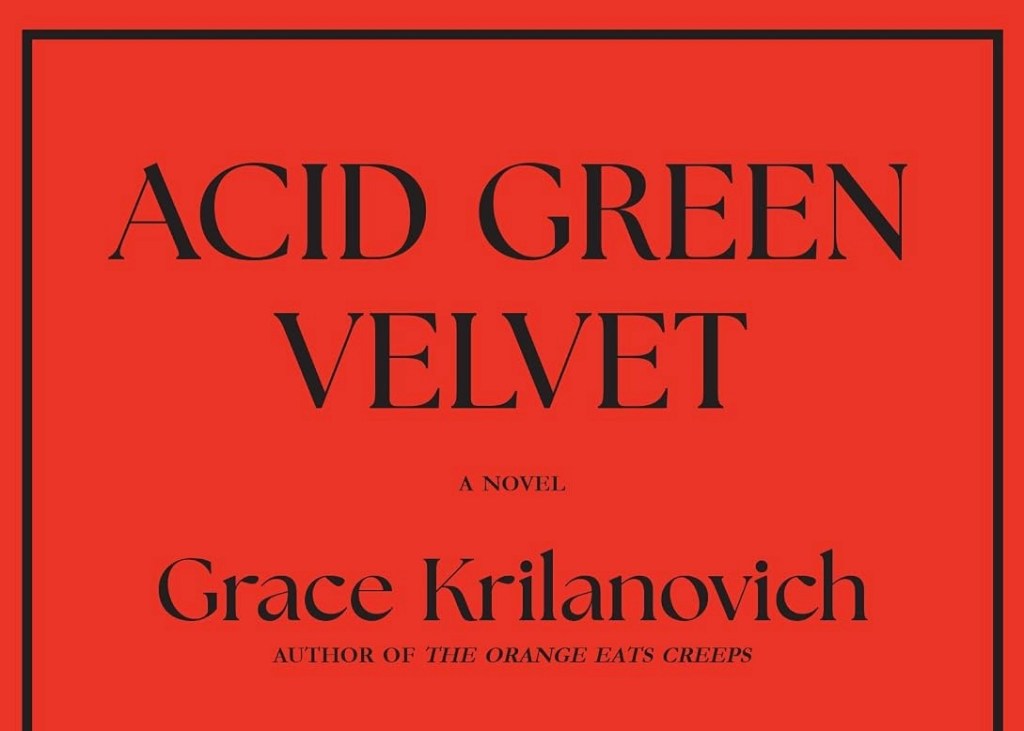
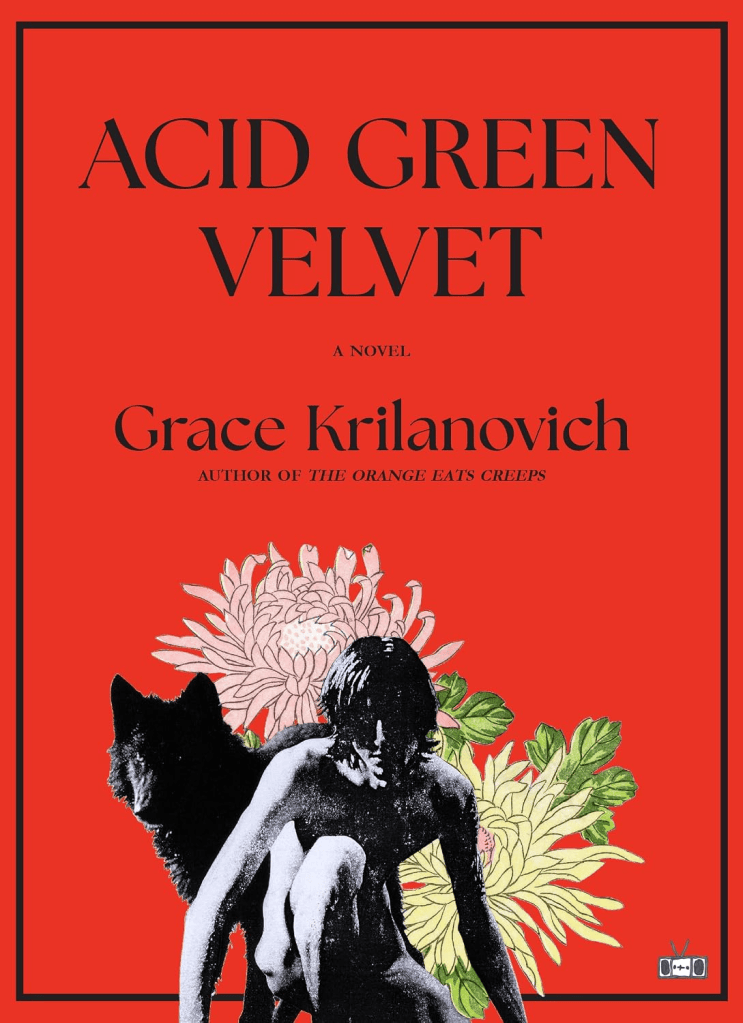
Acid Green Velvet by Grace Krilanovich, published September 8, 2026 by Two Dollar Radio.


 The Blog Without a Face
Leave a comment