




TL;DR: Precious Children is the rare horror novel that needs no monster. Mary G. Thompson builds her dread out of paperwork, dinner tables, and a mother who has stopped feeling things on purpose, and she never once raises her voice. It goes further than a book this size should, and it earns every fucking inch.

Dina Blake wears Jennifer to her son’s second funeral. It was the scent she wanted when she was a girl and could not afford, the most expensive bottle at the mall, and her husband bought it for her their first year together, and now she is standing in the basement of a house in Virginia, in the room between the pool table and the home gym, wondering whether the woman hugging her at arm’s length can tell that it is not Violet Rave. The other woman’s diamonds are natural, naturally. Her newborn is lighter-skinned than she is. A Methodist minister with watery eyes reads the very simple notes he was given about a boy who is already in his vault. There are two nameplates on the wall that say Geoff Blake. The dates are different. The rest of the wall is blank plates, because the architect said it is a lot of bother to add vaults to a home mausoleum later, and it is always fine if you don’t need them.
That’s chapter one, and it’s most of what you need. Mary G. Thompson‘s novel takes place in a United States some decades on, where children born the ordinary way die in droves for reasons nobody can name, where Virginia has passed another tax cut, where the rats have made the news, and where a family with enough money buys a series: four thousand clones of each child, farmed out to people who wanted a baby and could not afford one, on a contract that says the body can be called back. Geoff Blake has now died twice. His parents drive to an office tower where the guard tips his hat and the elevator buttons have been wiped of fingerprints, and in a Square room full of fourteen-year-old boys with their son’s face they choose the one whose drawings are closest. His name is Nathan. He tells them so. My name is Nathan. My parents are Davin and Michelle. We live in Richmond. I have a sister, Karianne, who’s eleven. She expects me to come home tonight. Two men in suits strap him into a chair in the corner of a room decorated to look like somebody’s kitchen, and Dina holds his gaze because it would not be fair to look away.
The jacket copy goes further than I will. It says the boy who came home after the first death is not who his mother thinks he is, and that the families on the other end of these contracts are not all innocent. That is as far as I am going.
Three people narrate, in rotation, in the present tense. Dina’s chapters are the flattest and the best. She owns a device called a SquareStim that she presses to the back of her neck, set to low or medium or high, which does not get you high and does not addict you; you just don’t care about things as much. She tells you she hates Dr. Latham and would like to rip his head off with her bare hands, that her heart rate stays the same, that the feeling is irrational and therefore irrelevant. She notices the celery seed in the stew and the mouth noises and the calorie count her overlay attaches to her son’s plate, and she notices that he has picked up his spoon with his left hand. The Harvard Business School plaque hangs to the left of the original Caralynn Benoit. The orchids on the desk are from Cuba. Twenty-three years ago she was a middle-class graduate of the University of Idaho eating takeout ramen from plastic bowls in Cambridge with a man who would never let her fall. (She returns to that sentence more than once. He would never let her fall. The book lets her keep it.)
Geoff’s chapters belong to a fourteen-year-old boy, profane and hungry and funny in the way that makes you check where the door is. He calls the country club Rich Dicks. He remembers dying, which the parents were assured does not happen. There is a second person inside his skull and he discusses that person the way you would discuss a roommate who keeps touching your things. Di is twelve, and her chapters run on without a place to stop, and every few pages she breaks off to count. In: one two three four. Hold: one two three four. Out: one two three four. She has switched off her backups. If they can’t get a new her, she reasons, they will have to keep this one. Between the chapters Thompson drops paper: a press release, a paragraph of the cloning agreement with its subparagraphs about separate consideration paid to Host, a flyer for the President’s Population Program (Making Great Americans since 2055; an administrative fee applies), a memo headed attorney-client privileged. The paper is where the dread lives. Nothing in the memo raises its voice.
What the book understands is that this kind of horror does not require a monster. It requires a schedule. One vial each night until he quiets. Side effects include nausea, headaches, sudden loss of blood pressure, and memory loss, and then in capitals, the treatment is experimental. The word for a soul here is Congruence and the word for what goes wrong is Incongruity, and once the parents have those two words they can say anything to each other and mean it. That’s only his body, the nanny tells Dina in the hospital, the first time. The whole novel is built on that sentence and Thompson never once puts weight on it. She lets people say it over pie.
It moves. The chapters are short, the plot goes where you expect for a third of the book and then goes somewhere else at speed, and the last fifty pages go further than a novel this size usually permits itself. It is bookended by dinners. The first has stew and homemade bread and a nanny who winks. The second has spaghetti with red sauce, nothing too spicy. What has changed between the two tables is the subject of the book, and the final chapter is the flattest thing in it, and it is the one I keep going back to.
Di’s chapters now and then function as a download, the girl going into Square and coming back with the rules of the world in a paragraph, and the rules get explained to you more than once. There is some hand-waving about quantum states that the book knows is hand-waving. A 2030s rap group named BaSick has a song called “Up Here Up Here,” which is either a misstep or exactly right, and I’ve decided it’s exactly right.
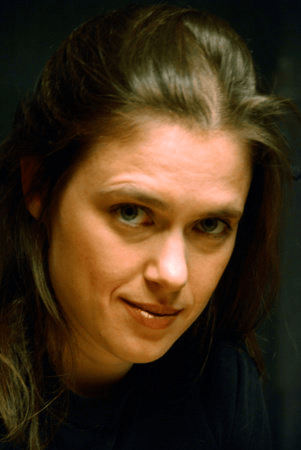
Thompson practiced law for seven years, five of them in the Navy JAG Corps, and works now as a law librarian in Washington, D.C. She has an MFA in writing for children from The New School and did the UCLA screenwriting program. The early books were middle grade and young adult and then last year Tachyon put out One Level Down, a novella about a fifty-eight-year-old woman made to look and act five inside a simulation run by a man she calls Daddy. Asked about that book, Thompson said the scene she keeps coming back to is the father cutting the daughter’s food, which she called everyday horror, and that she is interested in people in seemingly powerless situations finding a way to drive their own stories. The contract excerpts in Precious Children read like they were drafted by someone who has drafted a contract, which is the compliment. In the acknowledgments she thanks her parents for not being like all the terrible parents she writes about. Maybe you need good parents, she says, to have a good time imagining bad ones.
When the boy wakes in the chair and smiles at her, Dina crosses the room. She grabs him and presses her hands into his back and feels for the edges she is familiar with, and they are there. Under the extra muscle she presses the tips of her fingers into the bones of her son.
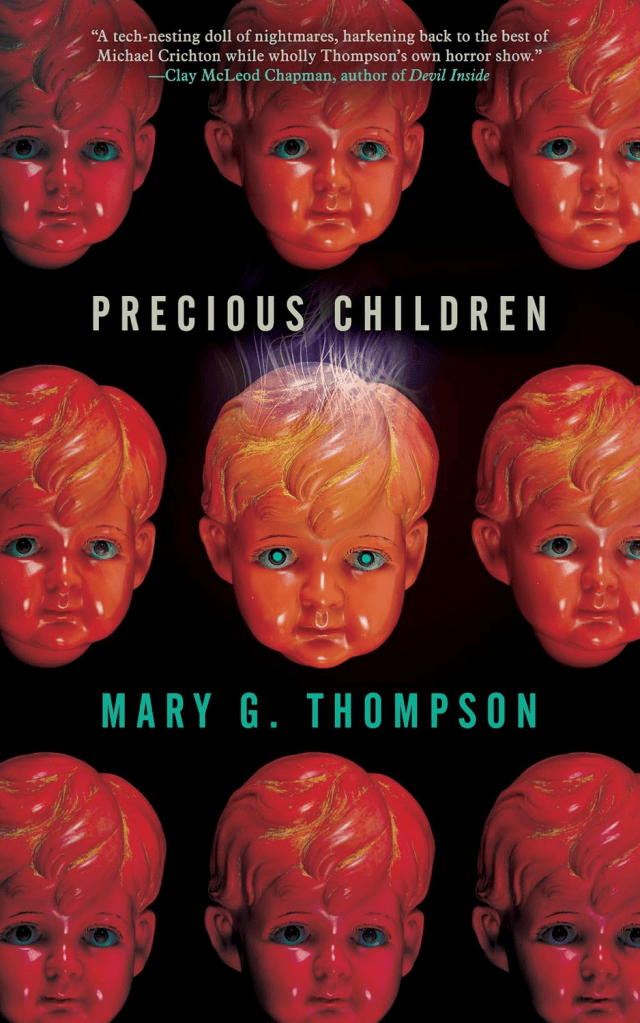
Precious Children by Mary G. Thompson, published September 1, 2026 by Tachyon.

 The Blog Without a Face
Leave a comment