TL;DR: A possession novel that hides inside a rez road comedy for a third of its length, then hands you two second-person chapters that put you in the monster’s suit and won’t say whose body it is. That stretch is the best run of pages Jones has written. Around it: a sequel that admits it’s a sequel, the full Exorcist kit, a demon explained three times in the last fifth, and a coda that heals more than it paid for. The climax runs on the stupidest possible mechanism and it works. Buy it for the helmet.




North Dakota, a Love’s eight hours out of Browning, and Nate Yellow Tail, nineteen, four months out of a coma, has to piss so bad he can tell an ace from a ten by the weight of the ink hitting the table. He can’t. What finally gets him there is the other three people in the van cranking the Jack Gladstone cassette and singing along, a song about Custer, so a kid can take a leak unheard. The driver, who hasn’t said one word since Montana, sings in sounds that aren’t words. Nate calls it the most glorious burn of his life.
I laughed. Two nights later I understood this chapter was the first brick of the climax, laid where I could see it while I thought Stephen Graham Jones was killing time. That’s the method. The dumbest fucking thing in the room is holding the roof up.
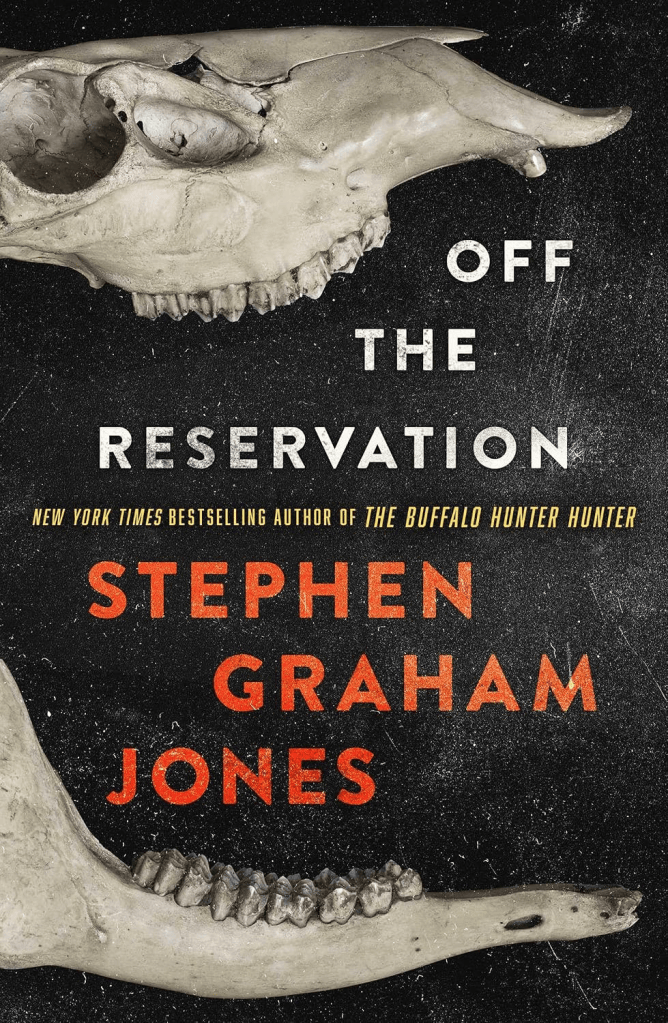
The setup, per the jacket: five years after the Duck Lake massacre of The Only Good Indians, Nate and his friend Sebby break into a historian’s lake cabin, a gravel truck puts Sebby on a breathing machine, and a fifty-eight-year-old nurse with sticky fingers and a Wounded Knee story that may or may not be true decides the world is out of balance and the fix is driving to Carlisle, Pennsylvania, to dig up a boy who died at the Indian school in 1879. Four is the sacred number, so Nate’s coming. The ride is an early-eighties Sundancer with a dead stuntman’s dirt bike jammed through its back wall and his jumpsuit stapled flat beside it. Its owner carries an ice pick. What the jacket is hiding is that this is a possession novel, and for about a third of its length it does a convincing impression of a rez road comedy with visions.
That third costs it. Twelve of twenty chapters end with the scare still in the room, and most of the ones that don’t come early, the book resetting its own unease so a woman can giggle “We therrrre yet?” one more time. I liked the woman. I noticed the reset. When it holds, it holds: a VHS of War Party, the movie every house on the rez owns, has been recorded over from about deer height.

Then it stops being funny, and the way it stops is why I buy it. Two midpoint chapters are written in the second person. You are in the stunt suit. “Your vision is limited by the helmet’s face shield.” You have hands you can do things with, and a spine, which is new, and you walk into a travel plaza and the book does not tell you whose body you’re wearing. It knows. You find out much later, and when you do, two chapters you lived inside get rewritten under you. Fallen let its demon narrate. So did Dreamcatcher. Neither made me want the thing I was reading to hurry up and get to the children, then left me holding that shit for forty pages. Those forty pages are the book.
Everything else is furniture, and furniture is where familiarity lands. The acknowledgments, four thousand words out of a grad seminar on possession narratives, say Jones wanted a possession story with no priest in crisis and no standard-issue exorcism, and that the point of view handed forward like a baton is Monstrilio‘s shape. The goddamn ceiling from The Exorcist is here. The vomit is here, and the dead talking out of a living mouth, and a cassock in a mirror, and the one word that casts out. The book names its own mummy, through Karloff, and its own wendigo. It’s a sequel that says “standing in the sequel” on page one, and his third Blackfeet horror novel in six years, the second in a row built over the Marias massacre.
The scariest sentence in the novel is about a background check, and the monster’s history, when the book finally supplies one, has two authors, and the second is the people it hunts.
Now why it’s a seven and not an eight. Three times in the last fifth the book explains its demon, and the third time, inside a character’s head, it explains the plan before it shows the plan. The idea also gets said aloud as a pun, a word about colonizing. A book that enacted its thesis in form did not need to say it, and it says it, and then it consoles. The last chapter is built as healing, a ride home and a line about nobody being broken. I’d have paid for that with two more corpses.

The climax runs on a bodily function the book has been setting up since that Love’s. It’s planted as mechanism, not gag, and it happens in the only place it could. Some readers will call it cheesy. This blog called the climax of The Only Good Indians cheesy, back when it did stars. I’ve argued this one with myself across the kitchen table and lost from both chairs, so that’s where it stays.
Jones is thirty books in and Blackfeet, writing his own nation’s dead, and wrote this one in three months around a kidney stone he thanks in the acknowledgments. Mooch’s chapters are the slow ones. They also carry the ice pick and the gentlest exit in the book, so I’m not charging them. The Army, meanwhile, has been disinterring children from the Carlisle Barracks cemetery and sending them home since 2017, with forms. This crew brings a come-along.
There’s an inflatable T. rex costume in this, the meme one. I own one. It’s in a closet. I don’t remember why, and the book never says why its dinosaur is there either.
About four-fifths in there’s a hug. I put the book down and went and stood in my kitchen with the light off.