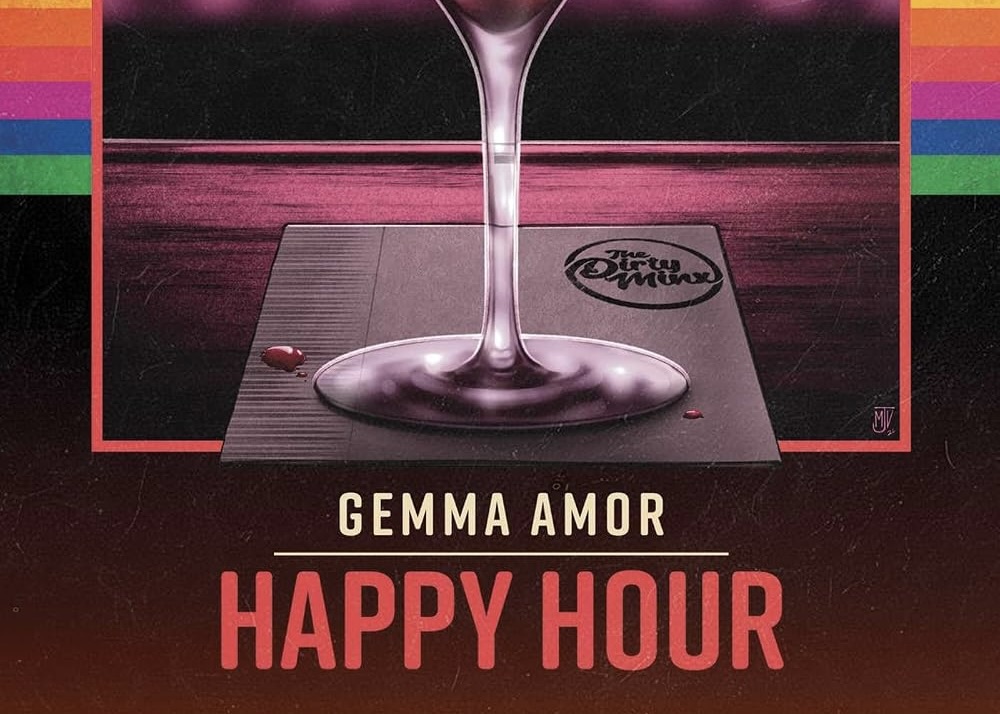
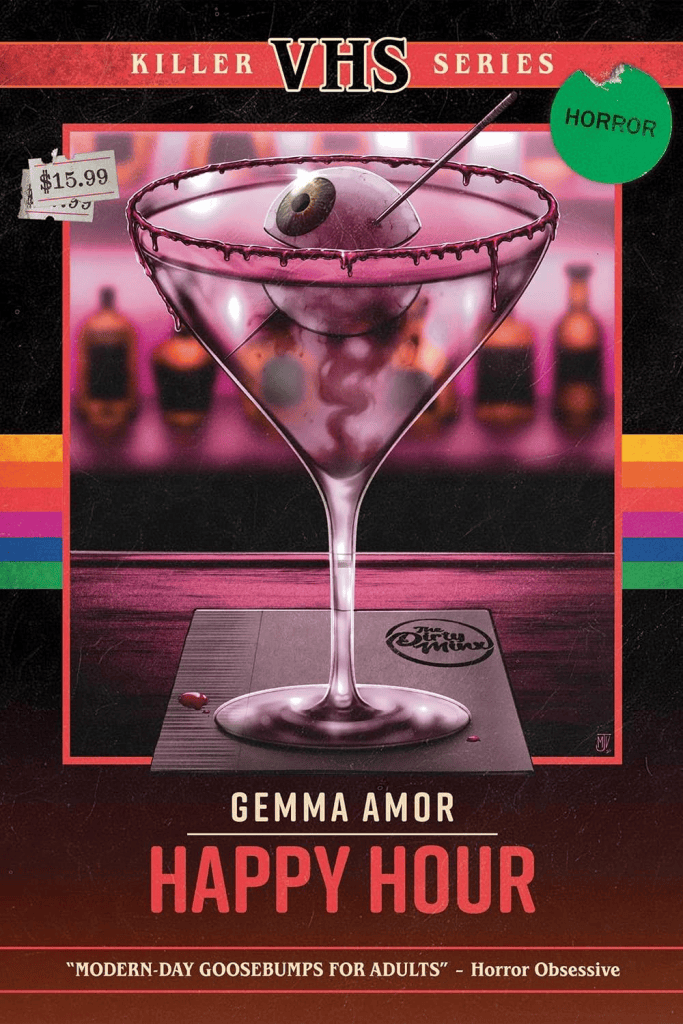
TL;DR: A London bar owner is pulping his bank manager’s skull with a pestle when his new bartender walks in. She tastes the brains and suggests the gin still. That’s chapter one. Then it’s Sweeney Todd with a cocktail menu: a man with a grudge and Tchaikovsky in his head kills people who had it coming, and the book laughs. Funny, fast, no monster, and it scared me for maybe three fucking pages. It’s in a series called Killer VHS. 3.2, because this blog scores horror and this is a comedy with corpses. Drink it anyway.



In October 1880 Tchaikovsky wrote to Nadezhda von Meck that the overture he owed a Moscow trade fair would be very loud and noisy, and that he’d written it without any warm feeling, so it would probably have no artistic merit. He meant the 1812. The one with the cannons.
He was wrong, or he was right and nobody cared. Honestly not sure which. Americans fire artillery to it every Fourth of July for a Russian victory over the French. Loud is a whole fucking career.
Brian Babel hears it eighteen times in Happy Hour, first in the cellar of the Dirty Minx, London’s most exclusive cocktail club, where he’s beating his bank manager’s head flat with a marble pestle, each swing on a cymbal crash. “Tchaikovsky, Brian thinks, would have been proud.” He’d have asked him to keep it down.
An eccentric owner of a Nineties underground London bar watches everyone and disappears the ones who don’t behave. It’s hiding that this is a revenge comedy, and that the eye is thirty-two monitors and a shelf of VCRs out of which nothing is ever summoned. Jenny, the new bartender, walks in on this and does not run. She scrapes a bit of the man off Brian’s forehead and tastes it, tells him he’s spraying DNA, finds a dustpan, points at Bertha, the two-thousand-liter copper still, says the alcohol will tenderize him, and when Brian objects that you can’t distil from meat he remembers mezcal de pechuga, which is real, a raw chicken breast hung in the still for the third pass, and he has a batch on order.
Dead Man’s Gin.

This is book nine of Shortwave’s Killer VHS Series, which promises movie monsters and tapes that summon buried evils. Horror Obsessive calls it Goosebumps for adults, and I suppose a supermodel’s protest shit on a toilet lid is the adult part. The tapes are CCTV cassettes, and the scariest thing one does is carry the wrong time stamp. I kept waiting for the gin to do something.
It’s gin. It’s fucking gin.
Gemma Amor is based in Bristol, started on the NoSleep Podcast in 2018 and was a Stoker finalist for her first novel, Dear Laura, the year after. The protagonist is named for Brian McAuley, who got her in the door, and the acknowledgments apologize to a real Neil for bumping him off.
Every chapter is two scenes stitched together: the present, in present tense, the night of the bank manager and what it sets off; and the past, in past tense, Brian and his older brother Neil from a council flat with the electricity cut off to the rave years. Neil is dead by page one. The past strand is the long walk toward how. Amor cuts between them mid-sentence, thirty-seven times. The present stops on “He should have” and the past takes over, and when the present returns a chapter later it sometimes finishes the sentence and sometimes doesn’t bother.
It works. The book opens on a murder and won’t say why until nearly the end, and it holds the brother’s death back the same way. The splice delivers both in pieces, a paragraph of the past dropped into a killing in the present, so you learn what made Brian while watching what he’s become. Those pieces hold the few unsettling pages. But a crime up front with the flashbacks closing in is noir’s oldest frame: Double Indemnity in 1944, Sunset Boulevard in 1950, the body in the pool telling you how it got there. The cut may be Amor’s. The job it does is eighty years old.
Nothing driving this is new. A tradesman kills the people who cross him and the woman beside him suggests the bodies go into the product: Sweeney Todd, with Jenny as Mrs. Lovett, the accomplice with the pie shop, and the gin still as her oven. A celebrity host who judges his rich guests and executes the ones who fail is the 2022 film The Menu. Brian kills only people who deserve it and says “I have a code” out loud, which is Dexter. Take those away and what’s left of Amor’s own is the still and the splice. The still changes how the bodies leave the room. It doesn’t change what the book is.
Take out the gore. A man grieves his brother, keeps a grudge, gets squeezed on a crooked loan, meets a predator, and settles it with kitchen equipment.
Not one sentence of that needs a horror word.

The jokes belong to the killers and the book wants you laughing beside them, and a killing that comforts you isn’t scaring you. Six chapters in twenty-one end with the unease still in the room; the rest open on décor or chamomile tea. A seventh of the book passes, midway, without a turn. One passage the jokes never reach, the death in the past strand, and the plot spends it as licence for everything after.
About three-quarters in Jenny tells Brian he’s got a taste for killing and isn’t better than any of them, and the book answers for him with a guest so vile the question fucks off and never comes back.
What works: everyone in the book wants something that has nothing to do with horror, Brian his brother’s memory and his club, the people around him money or spite, and the plot moves when those wants collide, which is more than most books with a body count manage. And there’s the funeral. Right after a paragraph of Brian hating the woman he blames for his brother’s death, the book gives the funeral three lines: “There was a funeral. A lot of people came. Brian didn’t know who any of them were.” Best writing in the book, and the only time I put it down.
The score here measures how much work the horror does and how much of the core of the book is uniquely Gemma, and the answer to both is almost none. The floor of the blog’s Brutal Curve holds some bad books, and this isn’t one. It’s a quick, dirty revenge comedy, well made, that arrived in a box marked Killer VHS. “Good” isn’t what the score measures.
I read this fucker in one sitting on Sunday with a gin and tonic I regretted by page forty, and I still don’t know whether the thirty-seven cuts are a device or a tic.