

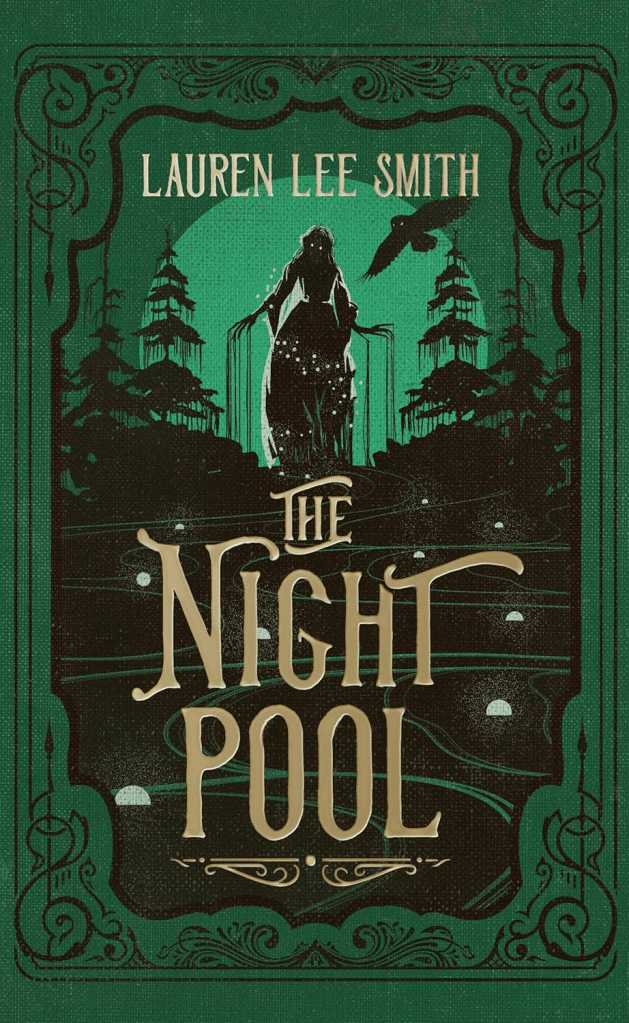





TL;DR: The Night Pool does what the best historical horror does: it makes you feel the specific weight of a specific injustice, and then it makes something ancient and hungry crawl out of it. A debut that is stranger, smarter, and more alive than it has any right to be. Lauren Lee Smith is the real thing.

The first thing Haloke sees is the ants. They are crossing the bridge of her dead brother’s nose, pausing at his dried lips, conducting their intimate work without ceremony or malice on this body that was a child’s body an hour ago. She carries him out of the woods the way you would carry a child you loved, which is what she is doing, and when her mother sees her walk out from between the trees with Misu in her arms the mother’s face does something that cannot be undone. The daughter learns, in that moment, the specific quality of being survived by someone who wishes it had been you instead.
This is page twenty-three or so. Not the horror set piece. Not the supernatural creature or the luminous bodies of light that lure women into dark water or the lamprey that thrash and bite in the service of an ancient thing that hunts a California valley. Just a girl carrying her murdered brother through an oak forest in 1865, and Lauren Lee Smith writes it so precisely that the ground shifts under you. The bone fragments glint like seashells in the dappled light. The ants are doing their work. The mother screams and what she is really screaming is not grief but accusation, and Haloke understands both.
The Night Pool knows what its real horror is. It’s not the creature, though the creature is good, horned and scaled and attended by lamprey in a hidden hot spring pool strung with ancient wards. It’s the thing the creature lives inside of, which is a historical moment so comprehensively catastrophic that the supernatural can barely compete with it. The Gold Rush as apocalypse. The valley being eaten alive by men who arrived with the absolute conviction that they were owed it. Nisenan people dying of smallpox and starvation and casual, unpunished murder while their river gets packed with sluice boxes and their grandmother’s grinding rock gets buried under a hog pen. Smith grew up outside Placerville, a few miles from Coloma where this novel lives, and she is writing land she knows the way you know a place that was given to you as a child and then watched be taken away. The historical horror is load-bearing. Everything else sits on top of it.

Haloke carries this book on her back and does not complain about it. She’s twenty or so, her village is shrinking toward nothing, her brother is dead, and she has been chosen by her dead grandmother’s shaman-stone for a purpose she doesn’t entirely want. Her interiority is written with a specificity that earns your trust immediately: the burning under her breastbone that is rage trying to cook her from the inside, the way she knows her mother’s face, the particular quality of moving through woods you have belonged to your entire life and now must watch be destroyed. When the novel lives in Haloke’s head it is doing something difficult, rendering the experience of a Nisenan woman in colonial California with particularity and care, and mostly it succeeds. The ants on Misu’s face will stay with me longer than most horror I’ve read this year.
Clara arrives in Coloma by wagon and nearly jumps off a boulder into a river in the first quarter. She’s grim and stubborn and not quite of her time, a blacksmith’s daughter who has read too many medical texts and refuses to perform the social dance required of her, and she works best in the scenes where the book lets her be exactly as strange and inconvenient as she is. She assists an amputation in a frontier doctor’s one-room cabin, one hand on the chloroform sponge, one on the patient’s thrashing shoulder, and the prose hits a pitch of controlled panic that is impressive. The bone saw is doing its thing. Nobody waited for anyone to be ready. And Will Fury, the enigmatic outlaw, is close enough for Clara to notice the gold caps on his canine teeth and feel something she has no vocabulary for in 1865 California.
Will Fury is extremely cool. I know that is not a critical term. He is tall and tattooed and possibly supernatural and he shows up when things are going badly and leaves before they’re resolved, and both Clara’s feelings and the novel’s own feelings about him carry the same feverish unfinished quality, which is to say they don’t entirely land, because the book is clearly planning to do more with this man somewhere else. He is sequel bait wearing the coat of a romantic lead, and while that is not a capital offense, it does leave Clara’s emotional arc feeling like a down payment the first novel doesn’t collect. I believe Smith knows exactly what his story is. But I needed more of it here, or I needed to trust the ambiguity more completely, and right now it sits between those two things, fully committed to neither.

Smith is a debut novelist and a screenwriter, she writes horror for Hollywood alongside this first book. The Night Pool moves. It visualizes itself. The creature is physically specific the way film creatures have to be: horns tangled with waterweed, metallic scales catching moonlight through alder leaves, lamprey thrashing at its master’s heel like eager, awful dogs. The Night Pool itself, a hot spring in a clearing surrounded by old wards, is a set you believe in immediately. The chapter count is eighty-five across less than four hundred pages. This book thinks in scenes, which is the right instinct. Her short fiction appeared in Kandisha Press‘s 2025 Women in Horror anthology, where her story “Selkie’s Stew” was called out as a standout by reviewers, and the short-form instinct benefits the novel’s propulsion. Based on her author’s note, Smith has been carrying this book since she was a child sitting in a cave behind her house outside Placerville trying to figure out whose fire had made those smoke stains on the walls.
Where the pacing goes wrong is roughly chapters thirty through sixty, where a run of Clara-navigates-1865-social-machinery scenes piles up without enough forward momentum to carry them. Smith’s real gift is for the charged encounter, the scene where something fundamental is at stake, and those scenes thin out when the stakes are merely social. I skimmed. I don’t use that word without guilt about a novel that is otherwise trying to do something. But I skimmed, and you might too, and it matters because the back half of this book is so damn good that the drag in the middle feels like the only thing standing between this and something really exceptional.
The ending earns everything. The novel builds toward a decision for Haloke about what kind of person she is going to be on the other side of her grief, and Smith handles it with a moral specificity that refuses both easy vengeance and easy forgiveness. Something passes out of the book and into the air. The prose holds still there, the way prose only does when the writer knew exactly where she was going all along.
The Night Pool is a strong debut from someone who understands that effective horror locates itself inside historical grief. The colonial atrocity is the fuel the supernatural feeds on. Haloke’s valley is already being obliterated by men who require no horns or lamprey to tear the life out of a place and its people, and the creature Smith invents for this novel is something like the valley’s terminal logic, what gets called up from the dark water to answer what is being done to it, or to offer a warning, or simply to grieve alongside. I don’t think the book is entirely sure which of those things the creature is. I think it would rather leave that open. I think that’s right.
Carry your brother out of the woods. Feel your grief seep into the hot dark water. Watch something down there open its eyes. The soil of this valley has been holding what was done to it since 1849. Lauren Lee Smith has been listening to it since she was old enough to go into the woods alone. This novel is what it told her.

The Night Pool by Lauren Lee Smith, published August 25, 2026 by Blackstone Publishing.






Leave a Reply