
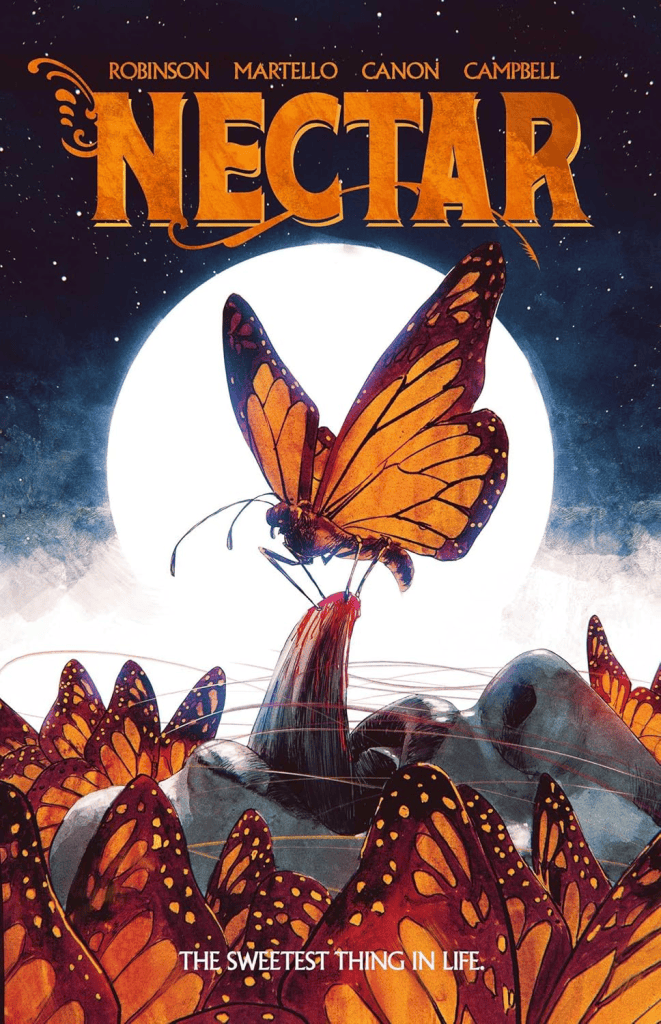



TL;DR: Nectar is historical plague horror with a killer visual hook: black-and-orange butterflies that turn a puritan town’s fear into a spreading sickness, then into a fucking verdict. It lands because the art weaponizes restraint, then punches in with color and body-horror at exactly the wrong moments. Read it if you like dread that feels contagious, not theatrical.

The first thing Nectar does is teach you a color: that hot, rotten orange that looks like late-afternoon sun and fresh blood at the same time. The book keeps dropping that orange into a world of soot-gray coats, weathered wood, and Puritan bleakness like a warning label you cannot peel off. Every time those butterflies show up, the page feels contaminated. It is simple, nasty visual storytelling, and it works.
In 1837, a strange affliction spreads, tangled up with black-and-orange butterflies that do not behave like anything God intended. We follow a small community as panic, faith, and opportunism collide, while a doctor tries to understand what is happening and keep the people he can still reach from sliding into frenzy. The “dancing plague” idea is the hook, but the real nightmare is how quickly the town starts making human choices that are worse than the insects.
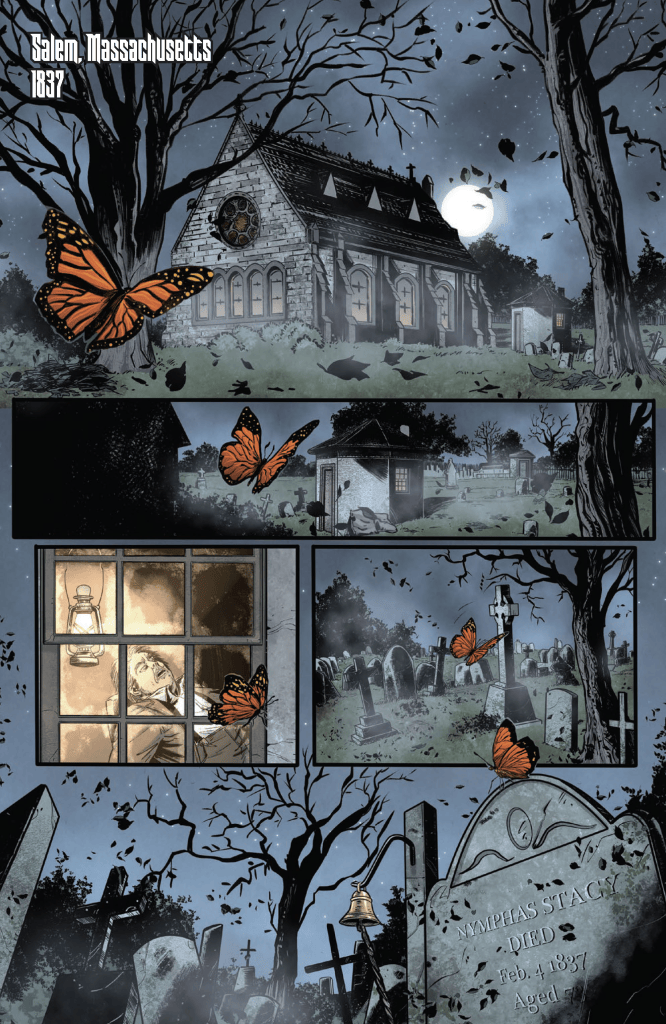
The inks lean scratchy and weathered, with texture that makes skin look chilled and cloth look damp, like everything has been left outside too long. Faces read clearly, even when the expressions get small and afraid, and the staging is mostly clean: you understand where bodies are in a room, how close someone is to someone else, and when the space is becoming unsafe. When chaos hits, the book does not smear into incomprehensible “action lines and prayers.” It keeps enough spatial coherence that the horror feels physical, not abstract.
Backgrounds often sit in desaturated browns and grays that sell the period vibe without turning every page into a history diorama. Then the butterflies and the blood show up and suddenly the palette has teeth. Sometimes the orange reads like firelight, sometimes like sickness, sometimes like a bruise you can see through the skin. That restraint makes the gore moments land harder because the book has not been screaming at you the whole time. It saves the volume for when it matters.
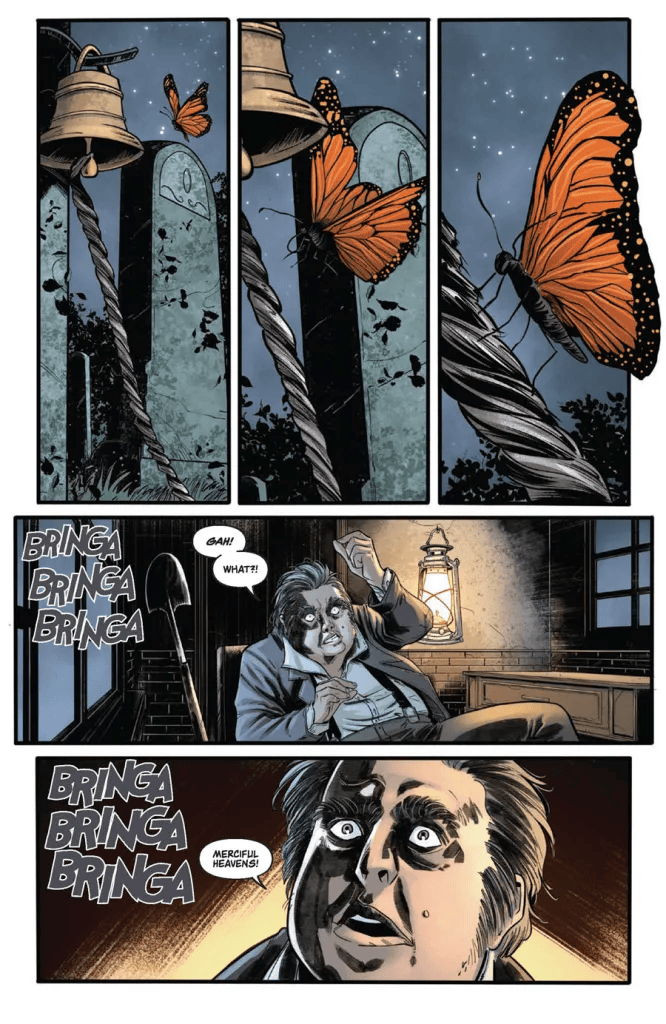
A lot of pages use calm, readable grids to establish routine, then crack that rhythm with a sudden close-up or a tall, thin panel that forces your eye to linger on something you want to look away from. Page turns are used for “oh no” reveals rather than twisty plot gymnastics: a door opens, a body is wrong, the swarm is already here. There are good silent beats too, where the book lets an image sit without dialogue to explain it, which is exactly how dread should work. You do not need a caption box to tell you a room feels cursed when the art is already sweating.
Balloons are generally sized so conversations stay readable even when characters start spiraling, and the dialogue “sounds” period-appropriate without becoming a cosplay of antique spelling. The sound effects are used like little punctuation knives, not a wall of cartoon noise. When something clinks, splashes, or hits wet, it is placed so your eye catches it at the same moment your stomach does. There is also a nice contrast between the calm, measured captioning when someone is trying to be rational and the tighter, more frantic ballooning when the town’s mood turns. It is subtle, but it helps the emotional temperature swing.
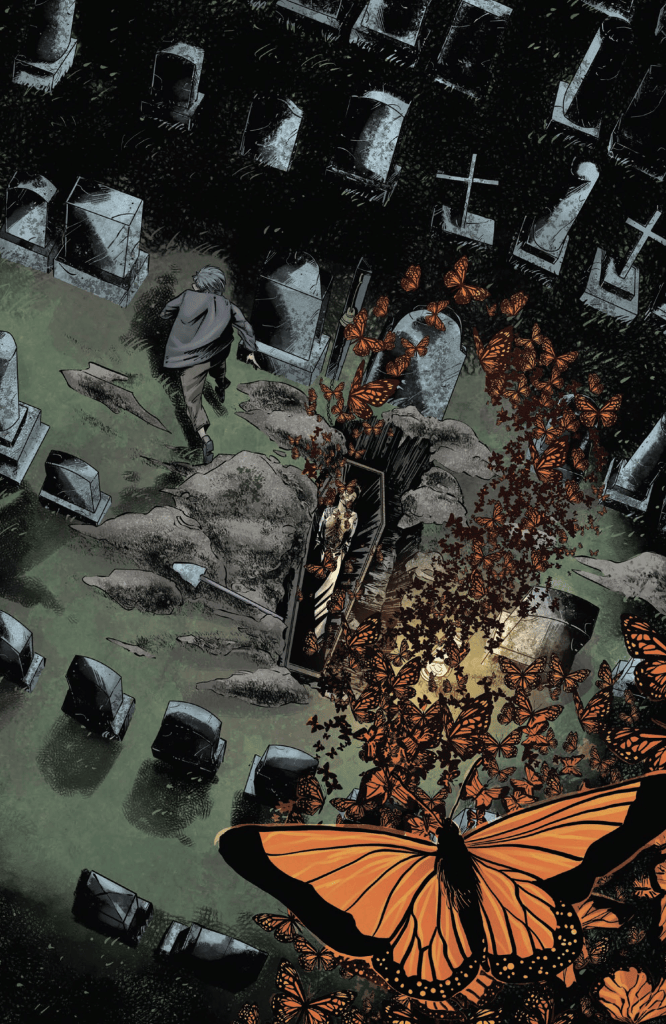
There is a three-part trap here. First: the butterflies as a visual omen and physical threat, small enough to feel unstoppable because you cannot punch a swarm. Second: the “dancing” as loss of bodily autonomy, which is inherently terrifying because it hijacks the most basic human promise, that your body will obey you. Third: the social infection, where fear and religious certainty give people permission to do monstrous things and call it righteousness. The book keeps bouncing between those three, so the tension never depends on one single “monster reveal.” Even when the insects are off-panel, the town is still dangerous.
The horror itself is where this thing earns its keep. The violence is staged to be felt, but it is not gratuitous in a way that makes it silly. You get sharp, ugly imagery when it counts, and the book knows when to imply instead of showing every inch of a bad outcome. When it does show, it often does it with a clinical clarity that is worse than splatter-for-splatter’s-sake. A cocoon-like form, a wet spill of color, an abrupt close-up that says “this is irreversible now.” The nastiness is not just there to high-five you for being hardcore, it is there to underline the theme of consumption.
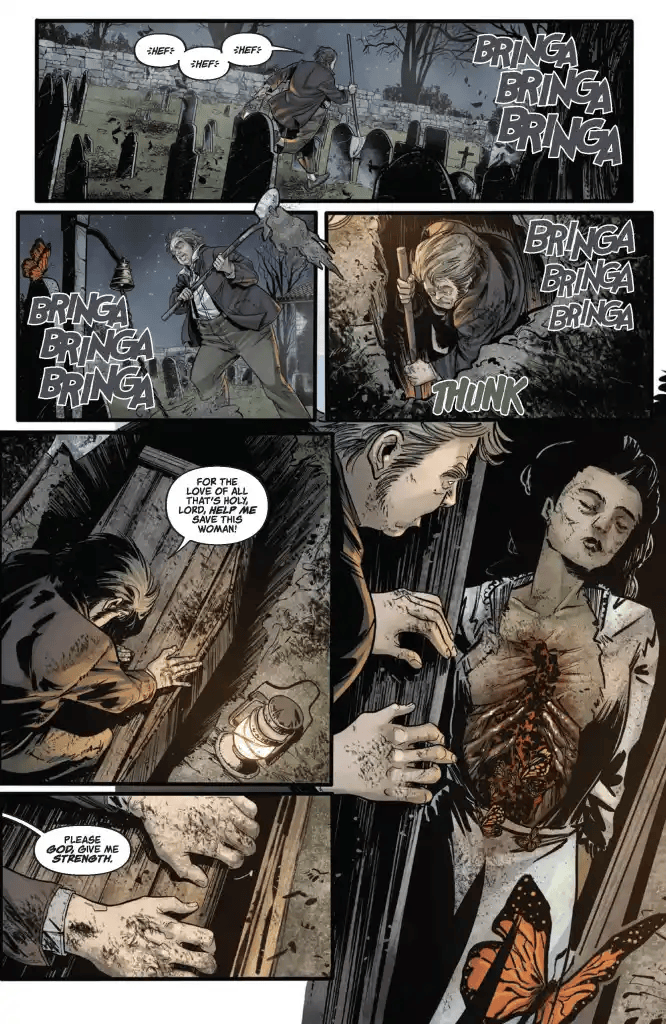
Who gets fed on, who gets blamed, and who gets used. On the surface, it is plague horror with a bug twist. Underneath, it is about a community that would rather find a sinner than find a solution, and about how easily “purity” becomes an excuse to control bodies, especially women’s bodies. The butterflies are an external parasite, sure, but the book keeps pointing at the internal one: the hunger for certainty, authority, and scapegoats. Everybody wants a clean story about why this is happening, and the horror is that a clean story is often just a pretty wrapper on cruelty.
The book sometimes moves with the efficiency of a pulp engine, which I mean as a compliment and a mild criticism. It wants forward motion. That means a few character beats feel more functional than fully lived-in, and some moral lines are drawn a little bold. If you want a slow-burn historical horror that luxuriates in psychology for pages and pages, this might feel a touch direct. But if you want a nasty, readable, visually confident plague tale with a killer motif and a strong sense of momentum, you are going to have a good time.
Read if you want historical horror where the vibe is “Puritan gray” until the page suddenly screams orange and your stomach files a complaint.
Skip if you hate bugs, swarms, or anything fluttery that should not be fluttering near human mouths and wounds.
Written by Jeremy Robinson. Art by Annapaola Martello and Francesco Francini. Colors by Steve Canon. Letters by Jim Campbell.
Published August 4, 2026 by Vault Comics.

 The Blog Without a Face
Leave a comment