

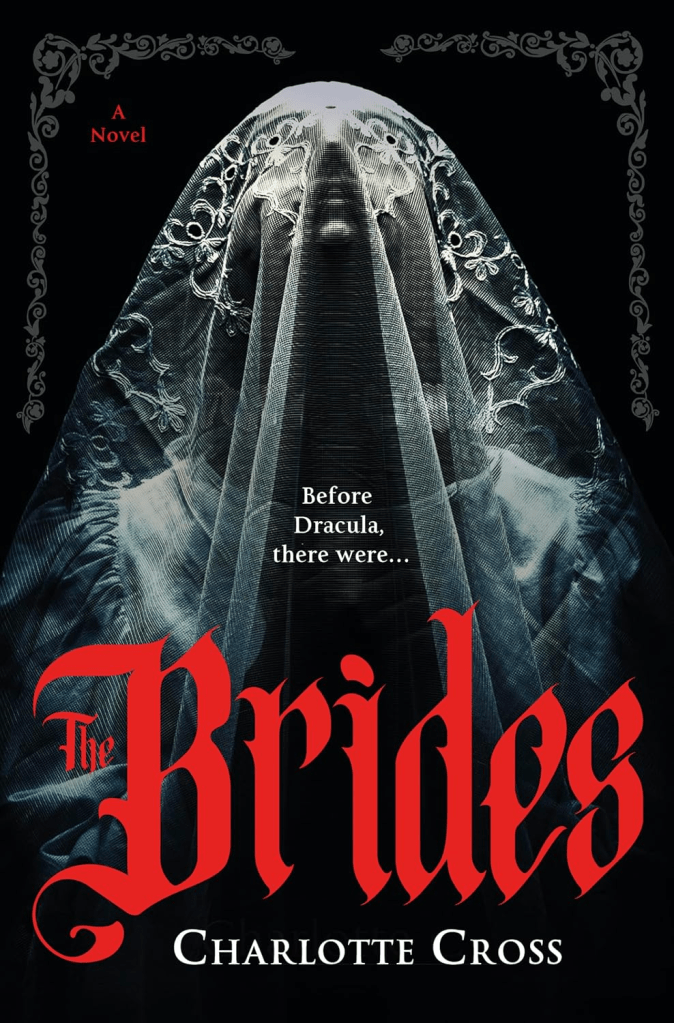





TL;DR: A debut of genuine confidence, Cross gives Dracula’s footnotes full, devastating lives, and writes them in voices so inhabited you’ll grieve when the horror finally arrives. The horror arrives too late, and lingers too long in the drawing room getting there. But when it lands, it lands. Gothic horror with a sapphic heart and real teeth.

The prologue knows what it’s doing. A woman in a green dress made for someone long dead, fitted like snakeskin, holding out a cold white hand. “Come to me,” she whispers, “and be mine for eternity.” It’s nineteen words of promise and rot, and it is the most frightening thing in The Brides. Everything that follows is reaching back toward that image, trying to earn it.
Charlotte Cross‘s debut is a Dracula expansion told in the original’s epistolary form: letters, diary entries, psychiatric case notes, weaving a dual timeline between 1884, when four women travel from London and Budapest toward Castle Dracula with increasingly terrible consequences, and 1903, when Sir John Seward takes a post at a Victorian asylum and finds a patient whose history drags him straight back into a horror he spent a decade trying to forget. It’s part Gothic romance, part trauma narrative, part queer love story, and it has both the virtues and frustrations that list implies.
The first problem with writing a Dracula expansion in 2026 is that the graveyard is absolutely packed. Literary sequels, feminist retellings, queer reimaginings, villain-POV prequels, epistolary pastiches, academic annotated editions, and at least one where the Count is inexplicably wistful about the whole thing. He has been handed to basically every genre and sent home with a participation ribbon. So the question Cross has to answer before the first letter is opened is: what does this add that the pile does not? The answer is specificity. Not a new angle on Dracula himself, but an investment in the women Stoker used as scenery, written with enough historical texture that they stop being archetypes and start being people. That doesn’t automatically make the book great. But it makes the attempt worth something.

The prose is careful and inhabited. Cross writes multiple Victorian voices that feel lived-in rather than costumed. Seward is formally anxious, perpetually apologizing for his own feelings. Lucy North is lyrical and observant, someone who wanted to be a writer and clearly is one. Alice Smith, the working-class servant, writes plainly and hides her real observations in postscripts that only her sister will read. Cross mostly resists making everyone sound like a prose stylist. The letters feel like letters. That is harder than it sounds.
What Cross does with the horror, though, is a different question. The answer, for most of the book’s length, is: she implies it. Strategically. With patience. Maybe too much damn patience.
The book’s real subject is how women get erased from stories about their own suffering. The three who become the Count’s brides are fully realized before the horror reaches them: a grieving Budapest widow, a kind English chaperon, and the fierce half-Hungarian Mafalda Lowell, whose relationship with Lucy North is the emotional engine of everything. The horror works precisely because you’ve spent two hundred pages caring about these people. But getting there requires surviving a significant stretch of drawing rooms, travel delays, and letters about hairstyles and sheep-shearing. The domestic detail is purposeful. It is also, at times, a lot.
The 1903 frame works better than it has any right to. Seward deciding how much of the truth to share with his brilliant new colleague Dr. Beatrice Knight is genuinely tense. Knight herself is one of the novel’s best inventions: a graduate of the London School of Medicine for Women, former director of the Bombay Women’s Asylum, entirely uninterested in being treated as lesser. Watching Seward fall clumsily in love with her while both of them try to treat a patient they only partly understand is warm and funny and quietly moving. Cross uses the warmth of 1903 to make 1884 feel colder. That’s smart architecture.

Charlotte Cross spent her pandemic years in the Oxford suburb of Littlemore, which is, with some nice irony, the exact location she’d give the asylum at the center of the 1903 timeline. She completed Oxford’s Advanced Creative Writing programme during lockdown, eventually finding agent Francesca Riccardi at Kate Nash Literary Agency and editor Sophie Robinson at Tor UK, who pushed Cross to dial up the dread. The pandemic origins feel visible: a story about women trapped by circumstance, made invisible by the assumptions of the world around them, dependent on each other in ways nobody names out loud. The blurbs call it feminist horror reclamation and they are not wrong, though that framing sounds more polemical than the book actually is. This is a story about how much women lose because history keeps them as footnotes. The rage is quiet and genuine.
Alice Smith touching the Colonel’s hand and glimpsing, without warning, a man alone at night with a photograph, weeping with grief so enormous she staggers outside afterward. The Count’s first appearance: almost not there, yet the wrongness of him completely present. Lucy awake in early morning while Mafalda sleeps beside her, grey circles under her eyes, dark hair on white pillow, written down in the language of love and the texture of dread because we already know, from 1903, that this will not last. The prologue’s green-dressed figure arrives late, and by then you are not scared of her. You are grief-stricken. That is the actual project.
The frustration is pacing. The middle section could lose thirty pages without losing anything. The horror is back-loaded in a way that mostly pays off but asks real patience from a reader who is, honestly, here because of the vampire. It is occasionally tiresome enough that you find yourself skimming a very charming letter about the castle funicular.
For readers who love Stoker’s original, slow-burn Gothic, or a queer love story with genuinely awful implications: this is worth what it asks. Just know the scary parts live in the final third.
Brides by Charlotte Cross,
published July 7, 2026 by Hanover Square Press.


Leave a Reply