



TL;DR: A neon-lit Baltimore funhouse where fentanyl, guns, grief, and the supernatural all crash the same house party, then dare you to call an Uber. It lands more often than it whiffs, with a sick little talent for making you laugh and then immediately feel bad about laughing. Not flawless, but compulsively readable.

David Simmons comes out of the “Ghosts of Baltimore” lane, writing the city like it is a haunted organ that keeps beating even after it should have stopped. His bio and bylines float through a mix of genre and lit spaces, and he’s also tied to Books to Prisoners, which feels spiritually consistent with this collection’s obsession with cages, consequences, and the way systems grind people into paste.
This is a story collection, but the connective tissue is strong enough that it reads like a mixtape with a unified mood: sodium streetlights, cheap interiors, bodies doing weird body things, and a constant sense that the everyday has already become the nightmare and nobody filed the paperwork. The settings skew Baltimore and adjacent psychic territory, where the rules of realism keep getting mugged in an alley for their wallet.

With the focus on the title story as your anchor: we’re with a narrator caught in a spiral of dependence and distortion, where the need for relief becomes a kind of theology. Their “normal” breaks when the world starts swapping faces, swapping roles, swapping reality itself, until the body feels like it’s being managed by someone else. What they want is simple and human: to get through the night without collapsing, without withdrawal, without being swallowed by the city’s hungry machinery. What’s in the way is everything, including their own brain. The texture is hallucination-meets-street-level grit: medical spaces turning sinister, doppelgänger dread, and the titular mix of fetty and switches as both literal threat and metaphor for a life set to full-auto.
The voice is incredible. Simmons writes like he’s got one hand on the throat of the reader and the other flipping through a joke book he found in a gutter. He’s great at taking a premise that sounds like a dare and then committing hard enough that it becomes, against all odds, emotionally legible. In “Gigi’s Hands,” for example, the grotesquerie isn’t just decoration, it’s relationship and dependency and the weird intimacy of being stuck with someone’s hunger in your home. In “Frog Money,” the middle-school cruelty and institutional stupidity become this sour little engine that revs into something more surreal and sick. In “Whole Time,” the idea of a man so loaded with lead he can’t die becomes both a flex and a tragedy, like invincibility as a civic disease. Even when the stories go conceptually off-road, they keep returning to consequences: who pays, who vanishes, who gets memorialized wrong.
The prose is punchy and conversational, built for momentum. The best lines feel tossed-off, like someone telling you the worst thing you’ve ever heard while they’re also trying to find a lighter. Simmons favors a compressed, present-tense immediacy in places, with riffs that feel like oral storytelling, the kind of cadence that can pivot from funny to brutal in half a breath. Pacing is generally sharp, though a few pieces lean on vibe over escalation, and the collection occasionally stacks similar emotional notes back-to-back: frantic need, street surrealism, bodily dread, the city as an uncaring god. When it hits, it hits fucking hard; when it misses, it’s usually because the ending chooses drift over detonation.
The themes that linger most are addiction and identity erosion, plus the broader idea of “the self” as something the world keeps repossessing. The horror machinery expresses that by making the body unreliable and the environment predatory. People are haunted less by ghosts than by cravings, debts, old violence, and the way a neighborhood remembers you even when it’s pretending not to. The collection leaves a metallic tang. You close the book and your brain is still hearing distant sirens, still seeing the flicker of something not-quite-human behind the curtain of daily life, still thinking about how easy it is for a person to get turned into a punchline or a statistic.
This is a confident swing at making “crime-horror” mean something beyond aesthetics: not just violence-as-style, but violence-as-weather, with absurdism as the only sane response. It’s not the collection that reinvents the form, but it’s one I’d hand to people who want their horror mean, funny, and wired directly into the bloodstream of a place.
A jagged, entertaining, sometimes genuinely gutting collection that’s got a distinct voice and several standout tracks, even if a few pieces blur together in the same feverish glow.

Read if you crave gritty surreal crime-horror with real emotional bruises; wild premises played straight, then played mean; Baltimore-as-myth, with dark humor as the flashlight.
Skip if you need clean realism or tidy moral lessons; consistently “big” endings with neat closure; low-stress reading that won’t make you mutter “oh, shit” out loud.
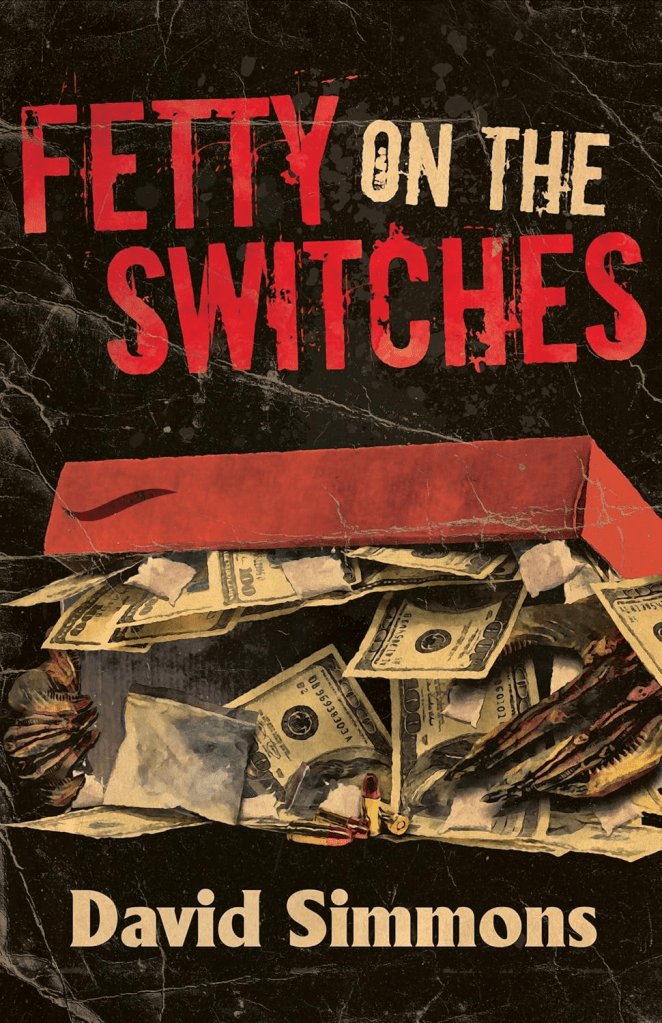
Fetty on the Switches by David Simmons,
published June 30, 2026 by CLASH Books.


Leave a comment