
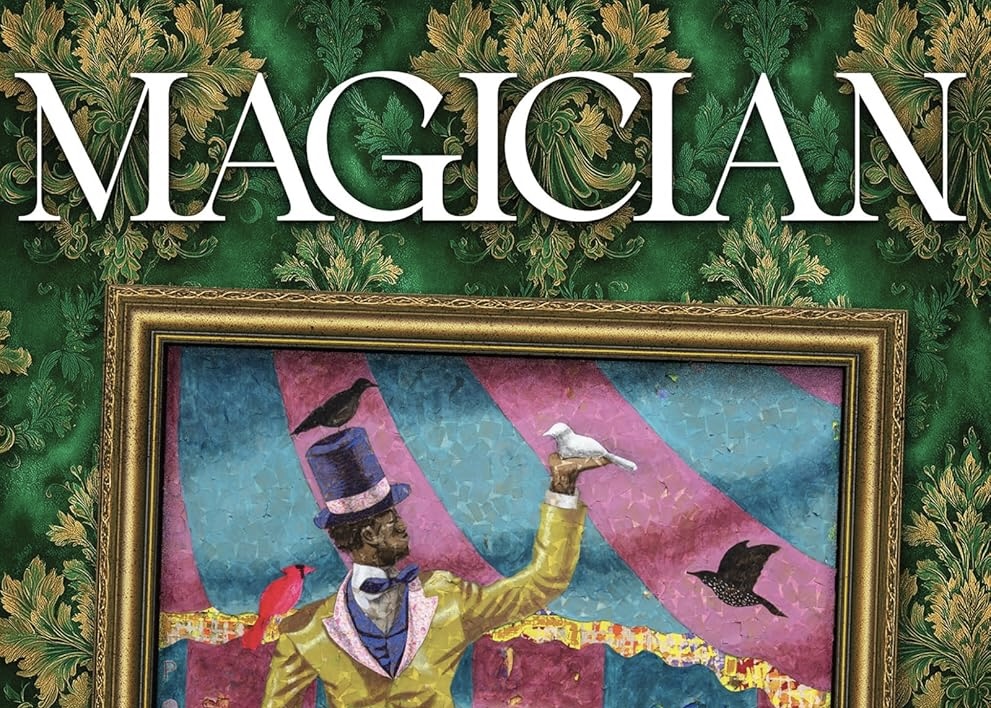
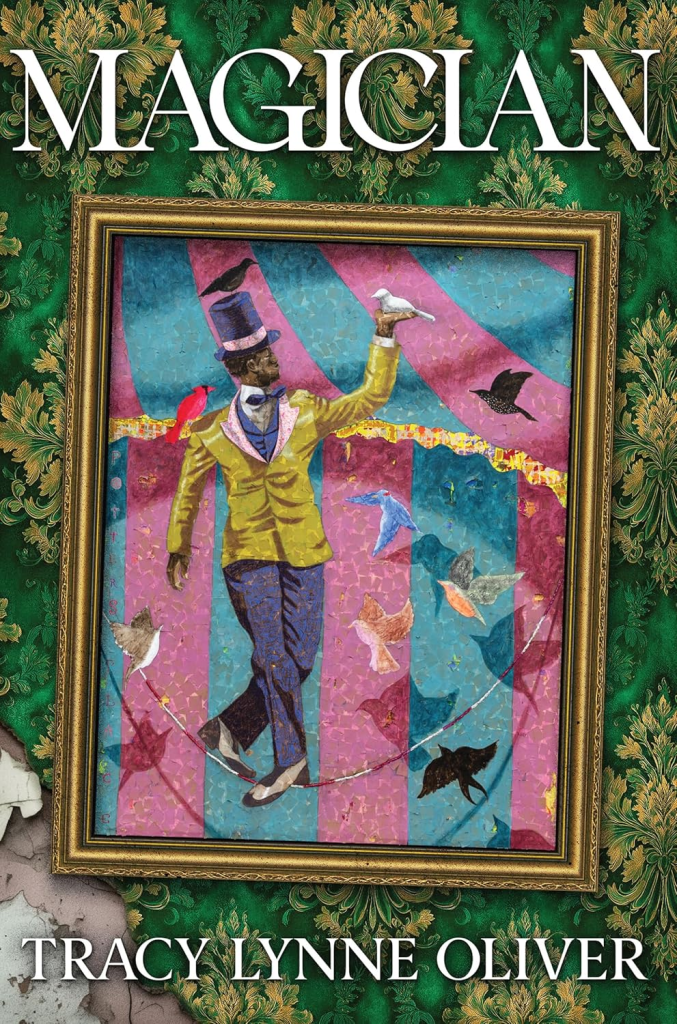



TL;DR: A monstrous mother, a boy with eldritch power, and prose so lush it could choke you. Tracy Lynne Oliver’s debut conjures one of the year’s most beautiful, brutal voices, then holds it at a single pitch for 448 pages until the spell thins. Astonishing at the sentence, still learning the mile. Read it for the writing.

I read three pages of this book at eleven at night and then I got up and checked that the back door was locked, which I have not done in years, and nothing in those three pages is about a door. It is about a little girl in lace and ribbons carrying a kitten down a dirt road on the way to where the cars come. Thirty-three times she drops it. She counts. She has learned exactly how broken a kitten needs to be so it will lie still in the tire track and wait, and she sings the whole walk, something high and sunny, a song she got from her own mother.
That is the book introducing itself. Believe it the first time.
Magician is Tracy Lynne Oliver‘s debut, and it is a literary horror novel built like an epic poem, which is a phrase people use to sell you something soft and is, in this case, a warning. There is a Mother. There is a Son she did not want and tried, across nine months rendered in detail I am not going to repeat to you, to make leave. There is the thing inside the boy that he comes to call the Morethan, a power that arrives from somewhere the book describes as a barren elsewhere, a nothing that is also everything, and it does what he needs before he knows how to ask for it. He grows. He runs. A circus takes him in. He becomes the Magician of the title, and the title is the smallest, latest thing he ever is, which should tell you the book is not really about the magic.
It is about inheritance. It is about what a mother can hand down that is worse than her face.
The prose is the whole machine, and it is the thing I want to put in your hands and the thing I have to warn you about, and both are true in the same sentence. Oliver writes in fragments and incantation, single lines left standing alone like dropped stones, the same word stacked at the head of clause after clause until it stops reading like grammar and starts beating like a pulse. There is a passage where a nurse holds the newborn for thirty seconds, and his skin burns her hands, and the book renders her entire ruined life afterward in a wall of sentences that every one of them begins with “The nurse.” It is one of the best things I read this year. Kirkus called the writing lush and sumptuous, and they were being polite about how far it gets up under the nails.

Here is the caveat.
The book does this at one pitch for four hundred forty-eight pages. Everything is heightened, everything capitalized and mythic and pulsing, and the thing about a spell held at full volume for that long is that it quits being a spell and becomes weather, and you stop flinching. The dread is built gorgeously and then it never modulates, so by the middle, when the boy wanders an enchanted forest that loops and duplicates itself, the book loops you right along with him: lovely, becalmed, going nowhere on purpose. I felt the purpose. I also felt the nowhere. The Mother section is a portrait, not a plot, and the engine does not really turn over until the carnival. When you read a book that will not let a single plain sentence breathe, you start to crave a plain sentence the way the boy craves a hand on his shoulder, and the book, like the Mother, mostly refuses to give you one. That is a fucking shame, because the flinch was the whole point.
And the people are emblems. The Boy, the Son, the Young Man, the Man, the Magician, all of him kept at fable arm’s length with no name to hold onto, and there are long stretches where I wanted a person and got an archetype in very beautiful clothes.
But oh, when it lands. There is a puppy. There are twin girls in the circus troupe who hand him a glued-up river rock and a little carved tiger because he taught them to swim and called one of them Little Fish, and I am not going to tell you what happens, but I will tell you those two cheap trinkets did more to me than all the kittens. That is the book at its best: violence and tenderness arriving in the same breath, not taking turns. The boy builds a dog out of dust and lint pulled from under the furniture and loves it like it is real, because it is the only thing that has ever loved him back. You will not forget the dust dog. I have tried.

Oliver is a writer based in Los Angeles who built her name in microfiction and online flash, the kind of work where every sentence has to detonate on its own because there are only forty of them, and her story landed in Best Microfiction 2019. She co-wrote the graphic novel The Sacrifice of Darkness with Roxane Gay, who now publishes her. You can see both trainings on the page. The flash writer is why every paragraph is a standalone shard. The comics collaborator is why the whole thing moves like panels, one held image after another, the white space doing the screaming. Magician is her first novel, and it reads exactly like a debut by someone who is astonishing at the sentence and still learning the mile. The jacket sells it to readers of Our Share of Night and The Changeling, and that is fair company, the LaValle especially, the way it makes a parent’s love and a parent’s monstrousness into the same supernatural weather.
So read it for the sentences. Read it knowing it will wear you down, and that some of the wearing is the point and some of it is a thing a second draft would have caught. Oliver can do almost anything with a sentence. She has not yet learned when to set one down.
And that song, the sunny one the little girl hums on her way to the road. It is the mother’s song. Everybody in this book is humming it, whether they know it or not.
Magician by Tracy Lynne Oliver, published May 19, 2026 by Roxane Gay Books.


Leave a Reply