








TL;DR: Romo makes the vampire mean what it always should have meant: conquest, written into the blood and beating in the chest. Filth Eaters is a thousand years of inherited despair told out of order, and the assembly costs you. But the engine is fierce and the ending earns its light. A strange, bloody, ambitious debut.

There is a city at the end of this book that has drowned and gone on living. Half of Manhattan stands in saltrotted water the color of an old bruise and the men who decide what gets repaired and what is left to rot ride down out of their boat garages in the gray sky sealed behind tinted glass with perfumed silk held to their noses against the stink of the channel they have learned to call the Deep Lower, and down in the cold beneath them among the noodle carts and the fish stalls and the militarized police a vampire walks with a camera pinned to his lapel and hunts two young men by the heartbeat of the live frogs in their paper bag. He films it. He sells it. The bleeding heart emojis come up out of the bottom of the little screen like flies lifting off a carcass. This is the world Ito Romo hands you first and it is the strongest case the book makes for itself, because long before you are told where these creatures came from you understand exactly what they have been made into.
What they are is the book’s one true invention and it is a good one. These are not Stoker’s pale aristocrats nor Rice’s beautiful mourners. They eat the heart. They take it whole and still beating from the chest and in the blood of it they take the rest, the hate and the cruelty and the long sediment of human sin that a body carries the way a riverbed carries silt, and they name themselves Filth Eaters because that is the accurate word and Romo does not soften it. The conceit holds because it is built into the flesh and not bolted onto it. The European dead are kept off by silver. The older American kind, the Mexica vampires who lived beside their people for a thousand years and let themselves be paid in the hearts of the sacrificed, are held down by nothing but the thorn of the maguey, their own land’s plant turned against them, and they can wear silver as jewelry though it greens their skin. That single reversal does more thematic labor than a hundred pages of argument could. Conquest here is not metaphor laid over the vampire. It is the vampire. The creature that crosses an ocean to feed on a new world and the creature already in that world waiting to be ransomed for its gold are the same animal seen from two ends of the wound.

The structure is the great ambition and it is also the great cost. The book travels from a mangrove delta in 1099 to a Granada bathhouse the year the Moors lose the city to a sacked Tenochtitlán to a forgotten Teotihuacán to the drowned New York of the next century, and it does not travel in order. You assemble the bloodline as you go, maker to made to made again, and the assembly is part of the pleasure, the slow recognition of how one cold figure on a balcony connects to a boy streaming his own damnation seven hundred years on. But the novel is short and the labor it asks is real, and some of the historical chapters land as set pieces more than as load-bearing rooms in the house. Two of them are letters from Cortés rewritten so that the conquistador’s bureaucratic greed makes room for vampires, the friars demanding a full fifth of the looted treasure to silver their doors against the living dead, and the device is clever and quietly savage and very funny in the way the elevated dispatch turns and turns and never once admits what it is admitting. It is also clotted with inventory, the necklaces and the gold wheels and the feathered crowns counted out at length, and it comes back a second time when once would have been enough.
Romo was born and raised in Laredo and his family has held that stretch of border for eleven generations, since before there was a line to be on either side of. He spent two books and the better part of a career writing the dark gritty length of Interstate 35, work that got called Chicano Gothic and Chicano Noir, story cycles published out of New Mexico that critics set beside Carver and Rulfo, and he took a doctorate from Texas Tech and taught Mexican American and multicultural literature at St. Mary’s in San Antonio and was put into the Texas Institute of Letters in 2019. This is his first novel. A man who has written one small violent corner of the map his whole life has here taken that same corner and stretched it across a thousand years and three continents, and the seam shows in places, the way it does when a writer of the compressed and the local reaches for the epic. What does not show as seam is the center. The book is dedicated to the grandmother who took him to Teotihuacán when he was six, and the emotional heart of the whole genealogy is buried in that pyramid, and you feel the difference between the parts he has read about and the parts he has stood inside.
The prose is best when it is closest to the body. A bathhouse seduction that turns to feeding is rendered with a patience that makes the eroticism and the violence the same gesture, which is what the book believes about both. Blood rubies cut from flash frozen blood and served on a gloved hand. Noodles scattered from a tipped cart steaming in grimy snow. Two black hairless dogs that walk a wasted creature home. These are the things that stay. The dread is built less from monsters than from accumulation, the sense that nothing is ever paid for and everything is inherited, that the filth goes down the line and gathers weight and one day arrives whole in someone who did not ask for it.

Where it strains is where it tells. The love that is meant to carry the back half of the book is asserted more than it is earned, consecrated in ceremonies before it is fully lived, and a late chapter downloads centuries of history straight into a character’s mind through a sacred tongue that speaks without speaking, which is a graceful image and also a confession that the book has more past than it has room to dramatize. The thesis, that hate is a thing the body carries and can be made to swallow, is stated outright more than a careful book would let it be stated.
And still the ending works, and it works precisely because the despair is not the character’s alone but the whole bloodline’s, a thing built clause by clause and conquest by conquest until it has nowhere left to go but up into the light. Romo does not earn the close with a trick. He earns it the long way, by making you carry the weight down the centuries until it is yours too. The book reaches for the scale of a creation myth at the last and mostly touches it.
A flawed and ambitious and genuinely strange thing, then, more interesting in its failures than most novels are in their successes. The frogs go on screaming in the bag. The emojis go on rising off the dead like flies, and somewhere up in the gray sky the men who own the water hold their silk to their faces and do not look down.
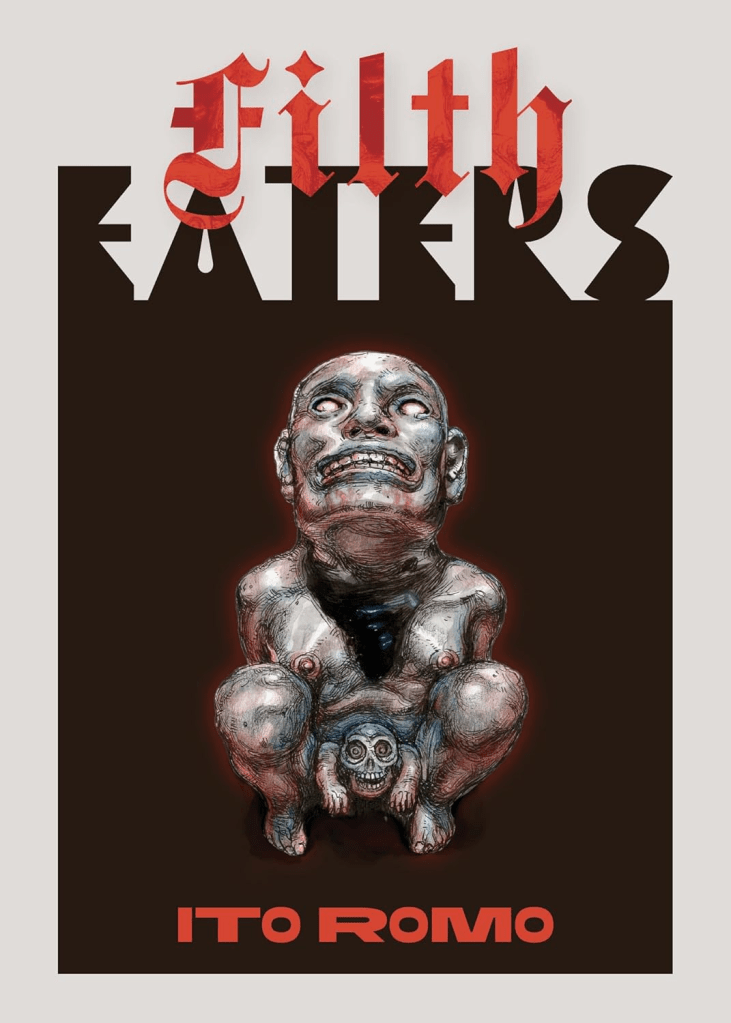
Filth Eaters by Ito Romo, published May 19, 2026 by Deep Vellum.



Leave a Reply