
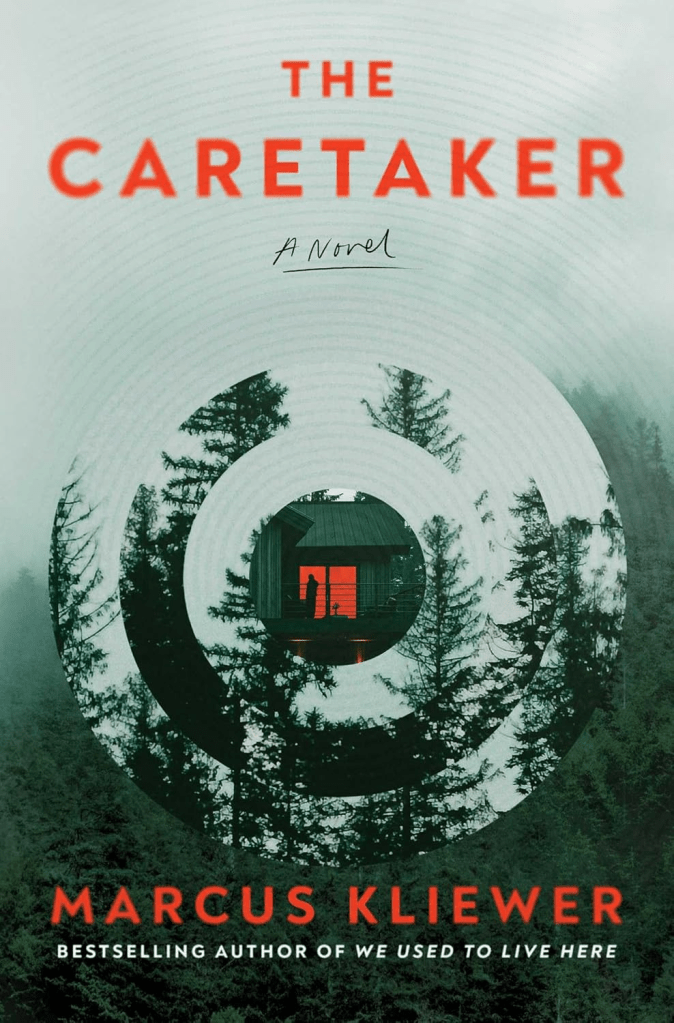


TL;DR: Kliewer’s second novel turns OCD and grief into horror machinery with procedural bite. The dread lands in seconds and objects, the protagonist is funny and specific, and the class eye is unusual for the genre. The mythology never fully builds and the interludes say out loud what the prose was already whispering. Worth it.

Macy Mullins is twenty-two. She has a Pikachu backpack she has not replaced since middle school, a seventeen-year-old sister she is the legal guardian of, and a bank balance she will not look at. She wears her father’s parachute jacket. Her father drove his truck off a rain-slicked road into the Willamette River three years ago. She answers a Craigslist ad for caretaking in Brooksview Heights, an hour and a half from Salem by Coastal Connector plus another thirty minutes on foot. The pay is nine thousand dollars for the weekend. There is a dead husband. There is a rotary phone. There is a VHS tape.
The tape explains the Rites. Keep the main-floor and second-floor lights off between three and four a.m. Catch any rabbit that gets inside the house within ten minutes. Do not talk to anyone with cold blue eyes who shows up after six p.m. Do whatever the person on the phone tells you. There are three envelopes on top of the fridge. IN CASE OF LIGHTS. IN CASE OF RABBITS. IN CASE OF EMERGENCY. You open them when you fail.
The engine of the novel is the architecture of failure. Miss the three-minute mandate by seven seconds and open the first envelope. A rabbit slips past and you open the second. The mechanism is legible from the outside by roughly the midpoint, and Kliewer knows it (he has his protagonist name the legibility aloud more than once). What the mechanism is delivering through the exposure of its own gears is the real question.
It is, for most of the novel, worth the exposure. The Rites are a diagram of OCD rendered through a horror conceit. The nagging voice insisting Macy turn off a light before the clock strikes the hour. The wriggling grub of a thought she cannot not reach for. The rush of relief at the click of a switch, the identical rush at the check of a lock she has already checked. (The word Macy uses is dopamine. The word Kliewer is circling is compulsion. The book is clear-eyed about both.) The sickening feeling of failure when a ritual is interrupted at the wrong second, scaled from moderate to devastating depending on which rule, which second, which door. A clinical picture of a specific interior carried by horror machinery, and the carrying is deft.

Grief is the second layer. Macy counts the times her father has died since he did it the first time (eleven hundred and twenty-seven). She smokes vanilla-flavored Woodbury Golds because he did. She has not cried in three years. She has a memory of a night at the Hawthorne Hotel the novel does not unpack until it has to, and does not need to. Her sister Jemma, seventeen, funnier than she is, shoplifts from Walmart on principle and runs in italics through Macy’s interior monologue like a movie-night heckler. The Jemma sections are the warmest writing in the book. Two Mullins girls in a repurposed motel. A pink plastic lawn chair on a concrete patio facing a flooded field facing the Oregon State Penitentiary. The guard tower lights. Woodbury Golds. The same brand Dad smoked.
Marcus Kliewer is a stop-motion animator from Vancouver. His debut, We Used to Live Here, began as serialized fiction on the r/NoSleep subreddit, won the forum’s 2021 Scariest Story of the Year, was acquired by Simon & Schuster before a full-length manuscript existed, and sold film rights to Netflix with Blake Lively attached before the novel version was finished. The Caretaker is his second book and the inaugural title of 12:01 Books, a new Atria imprint under manager Scott Glassgold. The structural DNA of NoSleep serialization is visible in both novels: isolated Pacific Northwest setting, unreliable-narrator machinery, paratext inserts (transcribed VHS, phone-call instructions scribbled on a forearm, envelopes, carved compass-rose symbols), a mythology more alluded to than worked out. That DNA is what makes the book move. It is also what keeps it from moving further.
The horror lands in the procedural stretches. Light patrol loop twenty-six. A storage-closet bulb that flips on at 3:56:35 a.m., one second after Macy leaves frame on the Ring camera, and stays on for three minutes and seven seconds. The seven seconds matter. A visitor with impossibly long limbs crouching at the foot of a bed, a chrome-plated switchblade buried in the Achilles tendon, the tendon twitching. A basement hallway with no bulbs in the sockets and a television at the end of it. Kliewer is good at dread when he runs it through objects and through time.
What he is less sure of is when to stop. The novel is divided into five parts separated by italicized interludes. CONTACT. WALK. OBSCURE. BLUE. Macy, in direct address, explains to the reader what she has been feeling, what she was feeling at fourteen, what she feels when she thinks about her father. The writing in these passages is not bad. The surrounding narrative was already doing the same work through action, and better, and a book that trusted its own images would have cut them. Jemma’s heckler-commentary has the same effect in miniature: a register running parallel to the narration that names the genre move just before the narration delivers it. The mythology does not fare much better. A Last Enduring God. A Ward of the House. Compass-rose symbols carved into boulders that hint at a cosmology but never resolve into one. The ending throws two reversals at the reader in quick sequence and then a final beat meant to reinstate the first reversal, and the sequence blurs where it should hit.

What stays is Macy. Her eye for the flesh-pink tarp over the dead pool, for the brown water stains streaking the stucco of her motel, for the AI-generated couples on the condo billboards with a few too many teeth. A three-thousand-dollar wire transfer gone inside ten minutes, to rent and bills and a ninety-eight-dollar inhaler prescription her sister has needed for six weeks. The eviction warning scraped off the front door before Jemma can see it. It is unusual for a horror novel to be this alert to what a hundred dollars does and does not do, and the alertness is what keeps the supernatural frame feeling like it is about something.
Worth reading, with caveats. Readers who came to Kliewer through NoSleep will find the same hand at work, probably steadier. Readers who want horror with a worked-out cosmology will find the cosmology thin and the signposting heavy. Underneath both is a novel about a depressed twenty-two-year-old raising her sister and failing to grieve her father, braided with a second novel that keeps asking to be louder than the first. The braid is uneven. The first novel is the one worth reading.
The sun rises over the Windfall Bluff in the final paragraph. What color it turns out to be is the one question the book is willing to answer outright, and it answers it in the last line.



Leave a Reply