
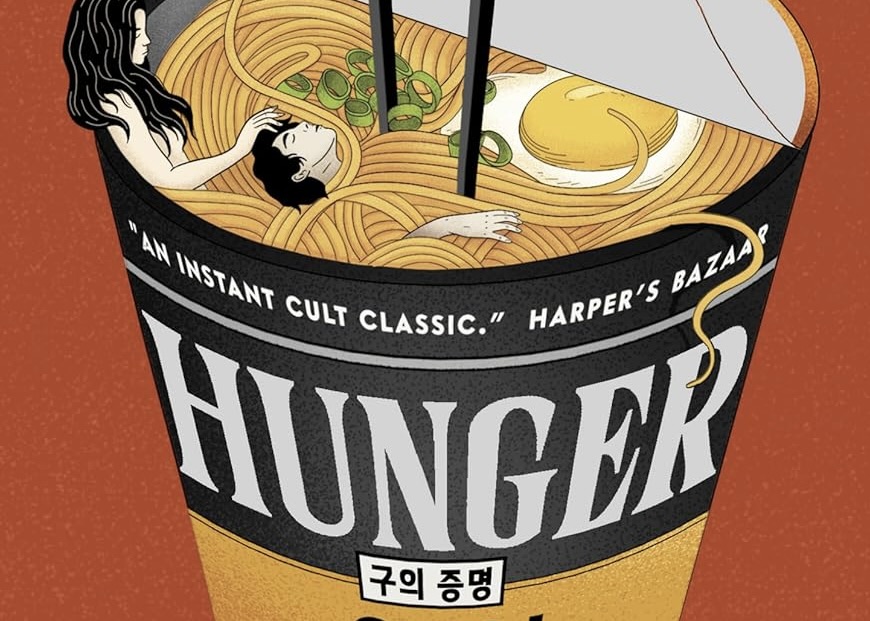
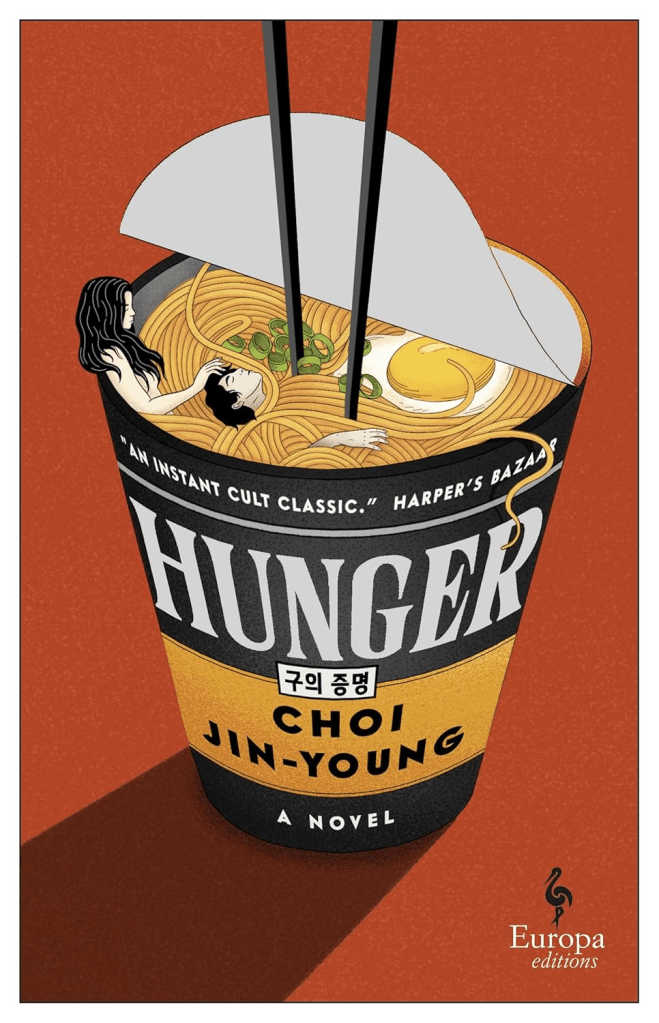






TL;DR: A cannibalism story that’s really a love story that’s really an indictment of what poverty does to people a country has priced as meat. Choi writes the unthinkable with the tenderness of a shared bath and never flinches. It holds one chord of grief until your teeth ache, offers no monster to kill, and keeps your lamp on past one anyway.

I finished this one at a kitchen table past one in the morning and then sat there a while with the lamp still on, the way you leave a light burning for a kid who is scared of the dark. The kid was me. The book was the dark.
Choi Jin-young hands you the whole deal on page one and does not clear her throat to do it. A young woman has eaten a person, and she would like to know whether that counts as a sin. The person is Gu. She has loved him since they were eight years old, two broke kids licking white sugar off their fingers against a kitchen sink because there was no money for anything sweeter. When the world finally did to Gu what the world does to people it has priced and decided are worth less than the money it lent their parents, she would not let it burn him, or bury him, or sell him off in parts to the men who had always treated his body as inventory. So she washed him instead. She swallowed whatever came loose, the hair, the clippings, the small nothings, because she could not bear to lose a single piece of him. Then she sat down to the rest. And Gu, from the far side of his own death, narrates the funeral while she eats it.
That is a love story. I want to be clear about that before anyone starts clutching their pearls over the cannibalism.
The sentences, in Soje’s cold clean translation, do not flinch and they do not gloat, which is the only register this could have survived in. Choi writes the washing of the body with the exact tenderness of a bath two lovers used to take together in a plastic basin hauled in from the yard, steam rising off their shoulders, and she does not change her tone one degree when the bath becomes the thing it becomes. The horror and the love arrive in the same breath, never taking turns, and you cannot pull them apart without killing what makes the page work. I tried. You can’t.

She is also funny, in the way that only writers who are not trying to be funny manage. Dam’s aunt, an ex-nun who came down off a mountain to raise a niece she never knew she had, works a line in a shipping-container factory, and when Dam asks what she made today the aunt says she made darkness. Light bulbs. She made beauty one day, which was hand mirrors. The joke is a fact and the fact breaks your heart, and Choi just keeps walking. Later two doomed kids lie in the dark and tell each other the legend of Sawney Bean as pillow talk, a whole Scottish cave family who ate travelers for twenty-five years and felt nothing, and they discuss it the way other couples discuss baby names, which, it turns out, is also what they are doing. I laughed out loud and then I did not feel good about it, and that is the book operating exactly as designed.
What it understands best is waiting. The whole thing is built out of it. A girl at a factory gate, a boy on a bicycle, a payphone, an aunt’s plum wine bottled two summers back and saved for a winter that may not come. There is a younger boy who gets folded into their little orbit and a bicycle and a stretch of dark road, and the book teaches you, fast, to brace every time it hands you somebody to love. Music runs under all of it like a held pedal note. There is a knife sharpened nightly to a string quartet, an MP3 player loaded with a dead woman’s radio station, and in her own afterword Choi confesses she wrote the book with a single three-minute song on repeat for hours at a stretch, trying not to think about anything. You believe her. The thing reads like it was written inside one long song.
A word on who wrote it. Choi Jin-young is not some debut found in a slush pile and dressed up for the horror shelf. She is one of South Korea’s most decorated literary novelists, debuting in 2006 with the Silcheon new-writer award and collecting the Hankyoreh Literary Award, the Shin Dong-yup Prize, and more recently the Yi Sang Literary Award, the closest thing Korean letters has to a crown. English readers may know her post-apocalyptic queer road novel To the Warm Horizon, also carried over by Soje. This book first appeared in Korea in 2015 under a title that means, more or less, the proof of Gu, and it became a quarter-million-copy word-of-mouth cult thing, passed hand to hand mostly by the young. Worth knowing, because the English packaging sells it as horror and that is only half true. Choi has always written about the kids a prosperous country quietly decides it has no use for. The cannibalism is new. The argument is not.

Which is where my reservations live, and they are real ones. The book runs on a single note held very long, and over a hundred-odd pages of pure grief at one unbroken pitch, even a beautiful note can start to ring flat. It is at its weakest when it stops trusting itself, in the late stretches where Dam steps back from the body to philosophize out loud about money and power and whether wealth is just survival of the fittest in a nicer coat. She is right. She is also telling me what the body already proved three chapters back, and the prose loosens its grip the second it reaches for thesis. There is a middle estrangement section that goes slack and sentimental in a way the rest earns its way out of. And if you come to this as a horror reader hunting for a scare engine, you will be confused. There is no monster you can kill. The dread here is poverty, and being looked at and seen as meat, and that lands harder than any haunted house but it does not jump out at you.
Still. Read it. Go in knowing it is a love story wearing horror’s coat, knowing it will hold one chord until your teeth ache, and let it. The eating was never the horror. The horror is a country that can look at two people and tally only what they are worth, and the proof of Gu is what the title actually means, and proof is the entire job. She eats him so the world cannot finish pretending he was never here. It is the only language she had left, and the awful thing, the thing that kept my lamp on, is how completely it works.

Hunger by Choi Jin-Young, published May 12, 2026 by Europa Editions.


Leave a Reply