
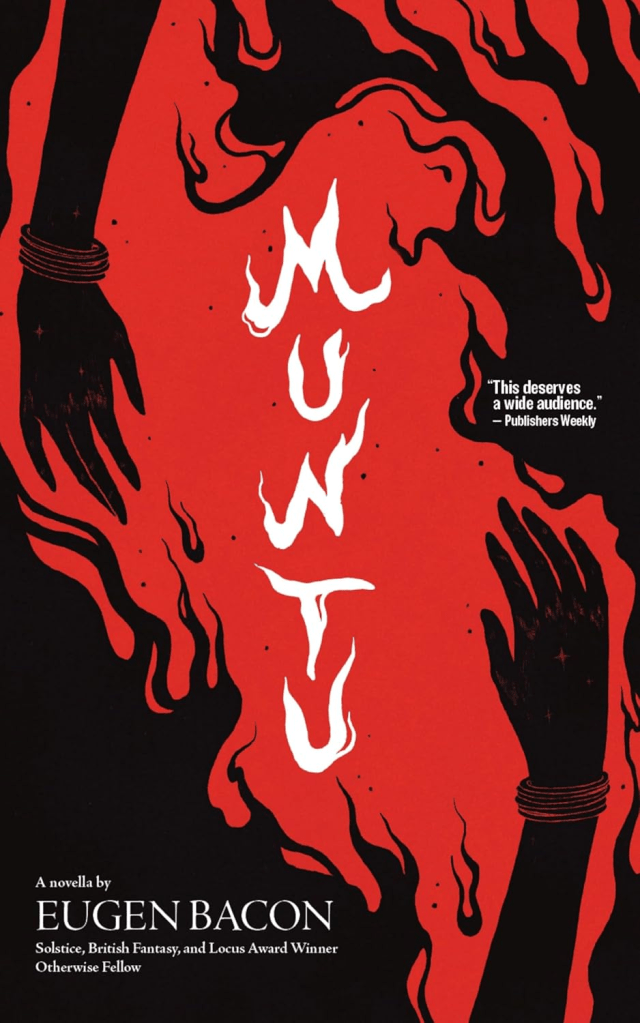








TL;DR: Bacon builds a cosmos that rips worlds off their roots and sings the dead dirt back into bloom, then proves the holiest thing in it was never the world but the voice. Muntu sags whenever it plays cop, but its myth, its dread, and its garbage-bag orphan wreck you. Saturated, strange, occasionally homework. Mostly a marvel.

There is a crow early in Muntu that walks up to a foster kid eating a coconut-jam sandwich, stares her down like a weaponed bandit, lifts the whole triangle out of her hand, eats it peck by peck, and then, before it flaps off, gives her a parting look of complete disdain. At what, the kid wonders. I wondered too. And I knew right there that Eugen Bacon can see, and that the seeing is most of the reason to be in this book at all.
That is what Muntu is before it is anything else: a sustained act of looking, rendered in prose so saturated it leaves a stain on your fingers. Bacon does not describe a sky, she tells you the sound went tri-color. She does not say a world died, she shows you a patch of land that tore itself off the Earth in grief and flung itself past two asteroid belts to sulk in the moon’s orbit, and then she shows you the people stranded on it singing the dead red dirt back into bloom. Singing. They sing of the green sea and the white sun and the gods who used to listen, and the song feeds the galaxy until it blossoms. I have read stacks of fantasy that want me to feel worldmaking is holy. This is the rare one that pulled it off, because it understood the holy thing was never the world. It was the voice.
So here is the engine. A killer is loose in Sydney. Men turn up clawed open inside and out and dusted in ash hard as diamond, the women beside them left alive but scooped hollow, not one word left in any of them. Detective Inspector Ivory Tembo, who used to be a foster kid named Izett with everything she owned in a garbage bag, does not believe in seers and goes hunting one anyway, because she has run out of everything else to try. Under the procedure sits a myth older than the city: a beautiful outcast burned alive for loving the wrong twin, and a soul that came apart in the fire. One half went looking for the woman he loved. The other half is the thing in Sydney, and it is hungry, and it cannot find its missing piece, and it is taking the city apart in the search.

That is a hell of a lot of book. Afro-surreal myth welded to a noir welded to an interdimensional quest, body horror and folk horror and grief all idling at once. When Bacon keeps her hands on the myth and the dread, it moves like nothing else on the 2026 shelf.
The trouble, and the reason this is a recommend-with-caveats and not a thing I shove into your chest, is that the books inside Muntu are not equally alive. The myth is alive. The orphan is alive. The detective is the one that sags. When Bacon drops into the Sydney cop machinery, the barking superintendent, the wisecracking partner who calls Ivory “Whitey,” the budget meeting played for laughs, the prose stops singing and starts filling out paperwork. It is competent procedure and I did not give a single damn about it, and every page of it I spent missing the red dirt and the song.
The book is scariest, oddly, when it quits being a crime novel and lets the cosmos go wrong. There is a long stretch in a courtly place where bodies twitch impaled on spires, where a drugged feast goes on a few courses too long, where a king’s face keeps rearranging itself and a baby crown prince watches Ivory with a hatred she mentally captions: smiles when ravenous for flesh. That is the best dread in the book. Dread with manners. The worst kind. It frightened me in a way the actual murders, lurid as they are, never quite managed, because the murders are described and that courtly horror is felt.
I should warn you that Bacon has no reverse gear on a sentence, and mostly that is the gift. There is a passage where the prose itself starts doubling, the same moment told once in past tense and once in present as Ivory comes apart at that poisoned table, and I could not tell you whether it is the most controlled thing in the book or a printer’s accident. I read it as deliberate. I am fairly sure the ambiguity is the point. Other times the reaching is just reaching, one more color, one more flower named, the catalog of flora and fauna tipping from hypnotic into homework. The same hand that gives you the crow gives you a paragraph you have to wade.

And under all of it is the garbage bag. The tiny photo of herself in a bassinet, the rag doll named Janey, the chocolate bar a dying friend tells her she earned by being brave with the needle. A toy elephant pressed into a weeping foster dad’s hands with the line, she wants a cuddle. I will confess the orphan got me worse than any of the monsters. The whole cosmic apparatus, the demons and the galaxies, is finally just scaffolding around one tired girl who wanted to be allowed to stay somewhere, and Bacon knows it, and she is right.
The ending chooses tenderness. It resolves, it gathers everyone into one room, it ties the knot gently after all that vastness and grief. Whether that lands on you depends entirely on what you walked in wanting. I wanted the frayed thing and got the warm one, and I cannot pretend I wasn’t a little let down, and I also cannot pretend the warmth wasn’t earned.
Bacon is worth knowing whatever you make of this one. Born Eugen Matoyo in Tanzania, a computer scientist before she was a writer, now an African Australian out of Melbourne who calls herself the queen of genre bending and is not wrong. She is reviews editor at Aurealis, a twice World Fantasy finalist, a British Fantasy and Locus and Ignyte winner, a Philip K. Dick and Shirley Jackson and Nommo finalist, with the novel Serengotti shortlisted for the Victorian Premier’s Literary Award. Her obsessions are all over Muntu: family and roots and loss, and above all sound as a kind of magic, the same fixation that drives her Sauutiverse stories where people work spells out of song. Here is the wrinkle worth knowing before you buy. Muntu carries the subtitle Ivory’s Story, which is the title Bacon published as a novella through NewCon Press back in 2020, so what Bad Hand Books, Todd Keisling’s indie horror house, has put out in 2026 reads as that earlier book brought back and handed a bigger frame.
Bacon built a whole cosmos that rips worlds off their roots and sings them back into bloom, and the thing that actually wrecked me was a little girl with a garbage bag who just wanted to be allowed to stay.

Muntu by Eugen Bacon, published May 12, 2026 by Bad Hand Books.


Leave a Reply