



TL;DR: A puzzle-box horror novel that takes the trans-killer trope apart with a small knife and builds something stranger and more human in its place. Packert Burke turns one locked house into a theater of dread, sex, and ritual, and never loosens her grip. Brilliant, fearless, impossible to put down. A monster of a book.

The book opens with a cast list. EDNA ST. CLOUD, 36. Eldest daughter; twin; massacre survivor; photographer. ROGER MERRILOW, 46. Edna’s husband; successful true-crime writer. It runs down through the daughter, the sister, the brother and his girlfriend, a local girl, and lands on a final entry that reads, in full, THE MONSTER. Then a setting (May 31, a brick house at 507 Hackberry Road, a small Virginia city) and a prologue with the stage direction HOUSE LIGHTS UP. All Us Saints is a horror novel wearing the clothes of a play and it does not let you forget the costume. There is an Act I and an Act II. There is an Intermission. There are Intertexts at the back, listed the way a program lists what it borrowed.
The premise is a closed room. Nineteen years ago a teenage boy named Roland St. Cloud killed his twin sister’s three friends during a basement séance, and the sister stabbed him on the stairs before he could finish her. He did not die. He does not speak. Every May 31 the surviving family gathers in the house where it happened, boards the windows, locks every door, and acts the killings out again, line by line, Roger narrating while the others step forward to be touched on the throat or the heart or the eye and blow out a candle. They call it the ritual. They believe it keeps them safe. Burke hands you the whole machine in the first thirty pages: the walkie-talkies, the candle that has to burn until sunrise, the bricked-over bedroom no one is permitted to breathe the air of.
The prose runs in present tense and slides from one head to another without a seam, which is the right engine for a book about people who have agreed to live inside a story. Brand names carry the dread. Roland used to walk little James down the horror aisle at Blockbuster because the boy was too scared to go alone. A three-thousand-dollar bottle of Château Pétrus, opened wrong, the cork shoved down into the wine. The medium-format Leica Edna saved up for at seventeen, before the knife. Shirley Bassey looping in her head for two decades. The named real thing in the wrong place, every time, doing the work that an adjective would do badly.
The center of the book is the Intermission, titled THE MONSTER SPEAKS, where the play apparatus drops away and Roland gets seventy pages of first person. It is the best writing in the novel and the most exposed, because it is the part most likely to be read wrong. The monologue keeps reopening on the same question, addressed to you: What would you want? You came for the origin story. You want the boy explained. Burke gives you an origin and then refuses to let it function as one. There is the doll-carving mentor, Mr. Catten, with his hand laid over Roland’s hand on the knife. There is a man in the woods named Patrick, pornography hidden in a hollow log, a catalogue of mutilated saints recited like comfort. There is the photographer twin who poses her brother naked in the dirt and tells him to shave the hair off his lip. And there is a Friday night at the movies where Roland watches a man with almost his brother’s name skin women to make himself a softer skin, and takes it as instruction. (This is how you make yourself, the screen tells him.) A line runs through all of it like a stitch pulled tight. I never try on the dress. The dress is in the closet for the length of the book and the book never once lets him wear it.
What Burke is doing is putting Norman Bates and Buffalo Bill and Angela from Sleepaway Camp on a table and taking them apart with a small knife. Roland is a closeted trans girl in 1992 Virginia who is handed, by the culture and by every adult whose hands find her, one available script for what she is, and the script is killer. Roger’s bestseller is called Doll Parts: Isolation, Transvestism, and the St. Cloud Family Murders, and we read long stretches of it, and it is exactly the confident, sympathetic, wholly wrong book the genre manufactures. He invents a diary Roland never kept. He explains. The quietest horror in the novel is watching a family slowly believe the version of themselves a stranger wrote down for money.
The thread that ties the house together is three words that turn up in nearly every bed in it. Tell me I’m a good girl, James whispers to Heather with a tartan skirt around his thighs. Good girl, the local girl says to Calla. That’s a good girl, Edna says to her fifteen-year-old, Wren, the only one in the place looking for a door. The same phrase means tenderness, control, want, and threat depending on the mouth, and Burke trusts you to feel which without a footnote.
The reservation is the single voice. This is a family of storytellers (dead parents who wrote plays, an aunt who writes plays, a husband who writes books, a wife who makes pictures) and every one of them talks the same way, which is to say beautifully, constantly, in quotation. Wren is homeschooled and fifteen and she clocks Eliot and Barthes and Auden before her aunt can finish the reference. Calla reaches for Sontag. It is plainly on purpose, a house where everyone was raised inside one library, and it is also the cost: the people start to sound like a single very well-read mind distributed across seven bodies, and the one outsider, Heather the baker, keeps getting pulled up into the family register when the book needs her sharp. The Intertexts page at the back, with Carol Clover and Janet Malcolm and Rachel Monroe on it, is honest about how much theory is loaded into the chassis. Most of it the book carries. Some of it you can see riding.
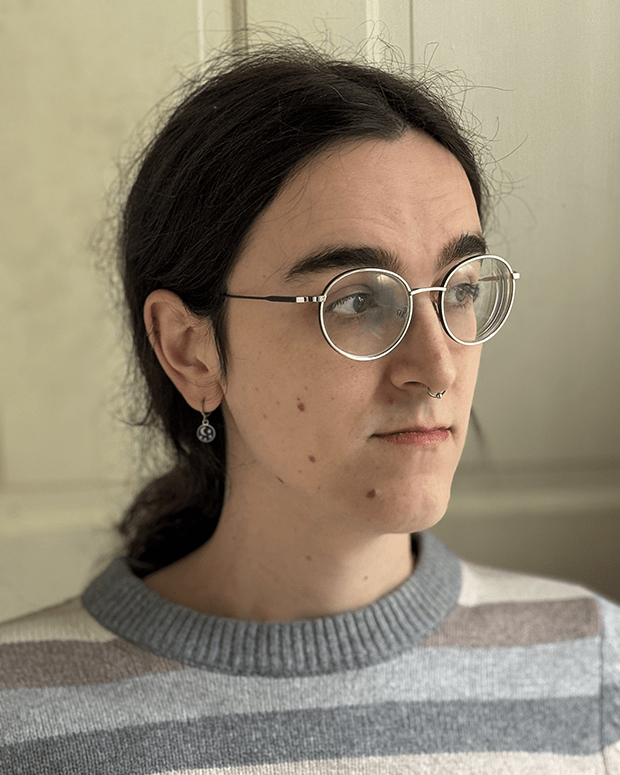
Burke comes from the literary side of the room, though the wall is thinner than it looks. Still Life (Norton, 2024) was an autofiction-adjacent novel about a trans woman writer in a red state, grief, and Sondheim, the kind of quiet interior book where the tension never quite snaps; one review faulted it for promising an explosion it declined to set off. She trained at the Clarion Workshop, which is a horror and science fiction shop, and the Alabama MFA, which is not, and All Us Saints reads like a writer using both halves at once. In an interview she traced the book to Ed Gein, and to the way one obviously sick man in 1950s Wisconsin, reported to be sewing a suit of his mother’s skin, became the blueprint for Psycho and Texas Chain Saw and The Silence of the Lambs. She also put the difference between her two novels plainly: the first is about what happens when you leave, this one about what happens when you stay. The second act, a year on, takes the apparatus apart. The ritual begins to forget its own lines. And when the chamber piece finally goes off, and it does go off, the machinery that gets it there (a new lover, a plan, a red can of gas) is the most conventional thing in the book, the part that looks most like a horror movie and least like the strange theatrical animal around it. Still Life withheld its explosion. This one delivers. I am not convinced the explosion is the best thing in it.
There is a video game running underneath all of this, a procedurally generated world several characters disappear into, where you can build the house and burn it and build it again, and where a vault grows in the basement that no one can open. When it opens there is nothing behind it. Sometimes, the girl who opens it is told, we put too much power into a thing. The St. Clouds have spent nineteen years putting everything they have into a single locked room. The book never tells you whether they were wrong to. It boards the windows, lights the candle, and leaves you in the house to wait out the dark, which is the only thing the family knows how to do and the only thing it has ever asked of them. What were they keeping out. The candle burns until sunrise. Then someone has to open the door.
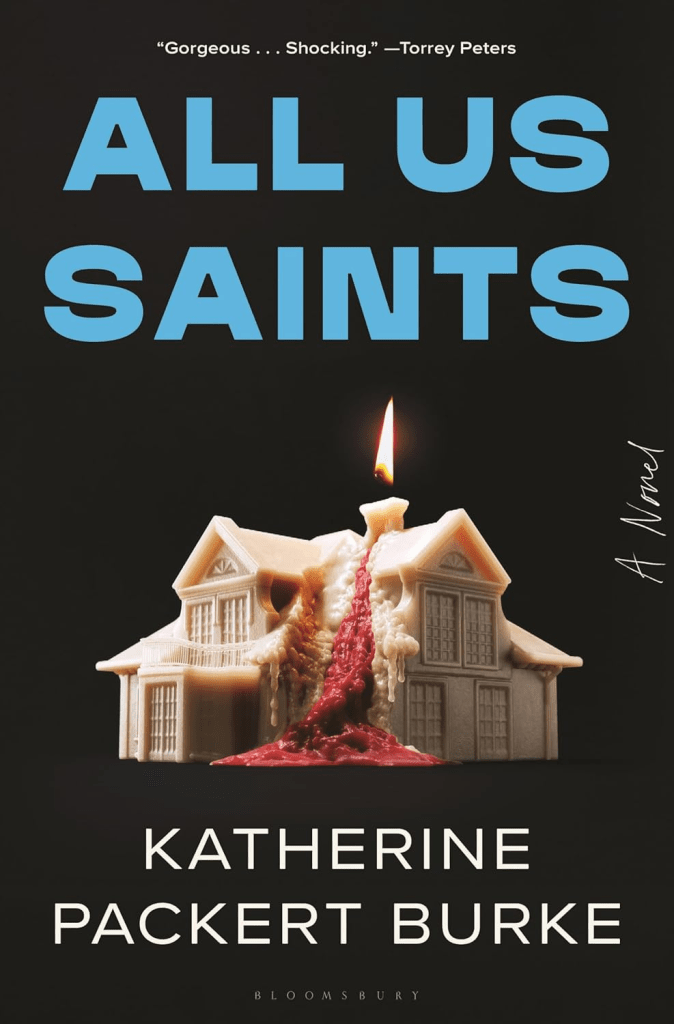
All Us Saints by Katherine Packert Burke, published May 19, 2026 by Bloomsbury.


Leave a Reply