

Eight books this volume, most of them trying to be two books at once. A Montana vampire procedural grafted onto a Pentagon thriller. A ruined Okinawan resort with a slasher folded into it. A dark fantasy where a saltwater god waits four hundred pages for the court drama to get off her. An Appalachian creature feature that turns out to also be about multi-level marketing. April 2026 was the month of the hybrid, and the seam kept showing. When the landscapes were good, and a handful were very good, you could forgive a book for a while. The writers’ day jobs were on the page this month: a water-rights litigator, a medieval scholar, a translator of Japanese crime, an anthology editor. You can see them looking. Whether they knew what to do with the looking was the real question.
Blood Trail: DEVGRU vs. Dracula
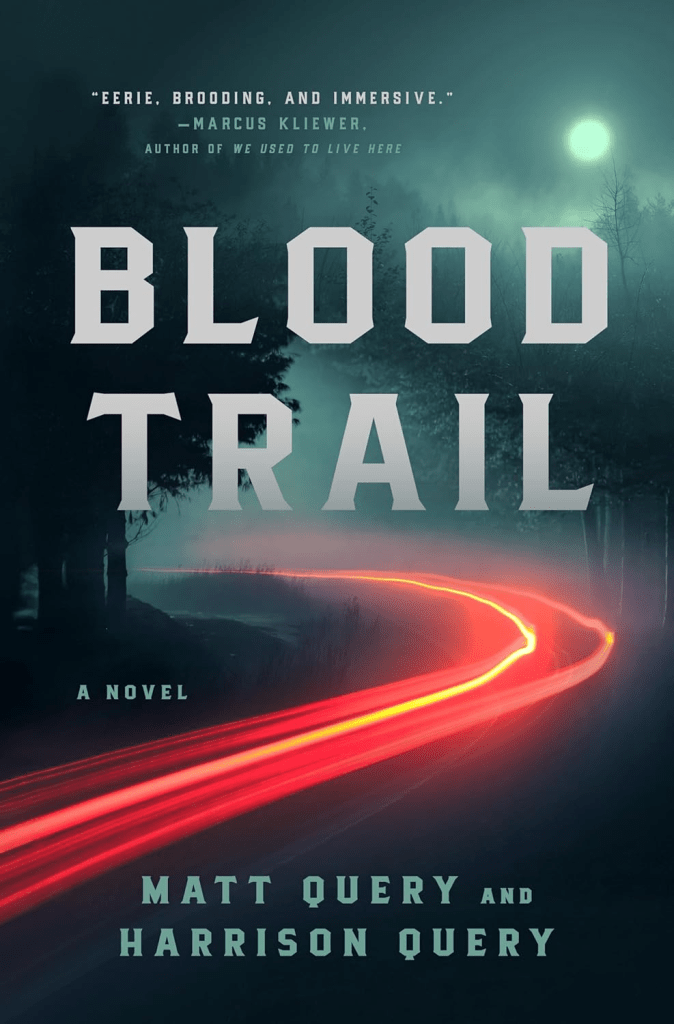







Here is what a Montana game warden sounds like when the guy writing him has actually met one. Here is what a half-starved horse looks like when the guy writing it has actually knelt in the dust and cupped water for it. That is Blood Trail at its best, and at its best it is very good. Matt Query is a water-rights litigator. It shows. The valleys smell like sage. The poacher in the prologue dies specifically.
Then the book remembers it is also a CIA Special Operations Group vampire thriller. I am not making that up. A game warden in a soft black Stetson with a horse named Quincey gets yanked into a classified SOG kill-capture op, and suddenly we are at Langley, at the Pentagon, sitting in with DEVGRU guys and JSOC QRF elements and a quiet little man named Malcolm Thorn whose job it is to know when the first of four cometh. The acronyms do not stop. FPCON Delta and REDCON-1 appear in consecutive lines of dialogue. There is a character named Lucy Westerna and somebody winking real hard from offstage.
The two halves never fuse. They alternate. I kept waiting for one to eat the other and neither would relent. You can feel the Query brothers at two separate desks, the lawyer-hunter and the Ridley Scott screenwriter, meeting in the middle at the manuscript. The Montana novel is the better one. The Pentagon novel has more plot. Reader, I was torn, and then tired.
When it works it is because of Clark. The scene where he opens a desk drawer and finds his dead son’s bracelet is as good as anything I have read in horror lately. A man on his kitchen floor at dawn after two days on horseback combing every rock on a mountain trail, making deals with a God he already knew was not taking them. Clark keeping a family photograph on his office wall as a cilice he forces himself to stare at until he cannot bear another second. That is a character choice with blood in it. I believed every inch.
What drags is how much the book will not shut up. Every feeling gets narrated then annotated. Every character arrives with a dossier. Every vein of backstory opens whether you asked or not. The prose is not sterling. It is exhaustive. It reads the way a very good lawyer writes a novel, and I mean that with respect, because Matt Query is by all accounts a very good lawyer.
The horror itself is procedural. Blood-drained bodies wired to chairs in a 103-degree henhouse. Cultists who will not break character. A vampire who, in the climax, likes Waylon Jennings. The dread lives in the landscape, not the monster. Old Country knew this about the Querys. Blood Trail forgets.
A Montana novel and a Pentagon novel sharing one spine. The seam shows. There is a horse in it I will think about for a while.


The Seventh Sister: Folk Horror, with Full Glossary.
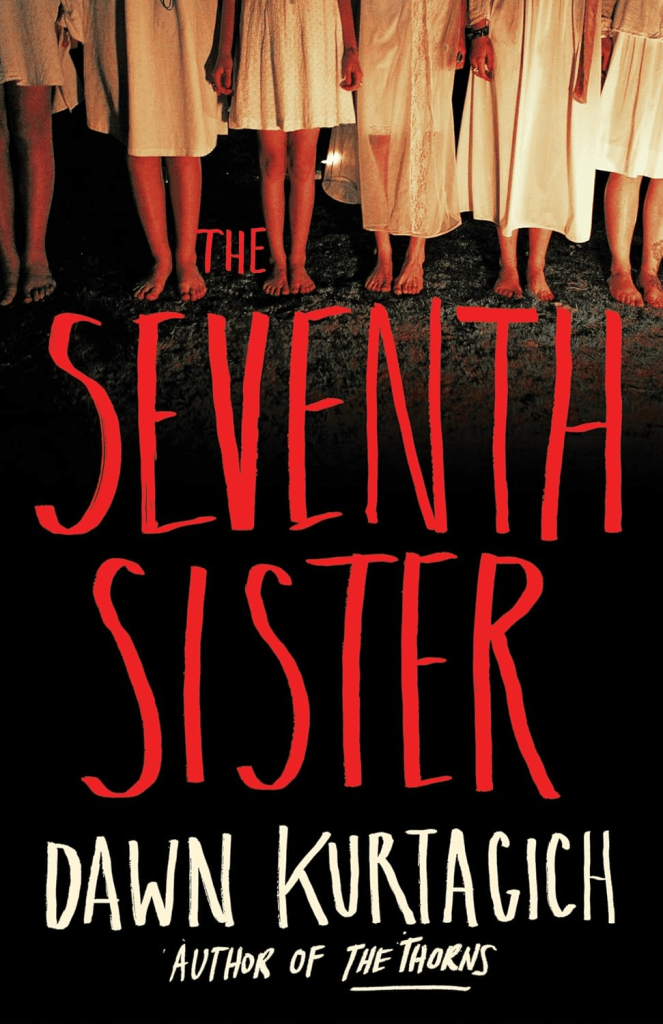






The Seventh Sister opens with an envelope containing a single dried juniper berry, and Clementine Ward promptly throws up on a toilet seat. The book will spend the next three hundred pages asking us to share her level of sensory alarm, and for long stretches we do. Dawn Kurtagich is a writer of real atmosphere. She knows what mushrooms smell like, how rain hits a corrugated roof, what color a bruise is on the third day. She has the trick, rarer than it sounds, of making the air of a place breathable on the page.
What she has not quite made is seven distinct girls.
The Ward sisters arrive at Beltane, a forested island with a white Second Empire house on it, each assigned a name, a color, and a single defining adjective. Juniper is stern. Hazel is flirtatious. Clem is the middle one who worries. The twins are eerie. Willow has the Sight. Poppy is three. The schema is a lovely fairy-tale conceit; it is also a cage. When the plot needs Hazel to be something other than flirtatious, the prose has to go outside and fetch another adjective for her.
The grandmother, Granny Alys, is the novel’s strongest character. She is barefoot, soil-scented, kindly, and sure of herself in a way that brooks no interruption, and Kurtagich writes her with the unhurried precision reserved for people the author loves. Alys introduces the girls to Daudir, the Forgotten God of the Wood, a stag-skulled figure who requires tribute and can be bargained with, and the religious apparatus begins to hum. The rituals are vivid. The secret language the sisters invent (glossed in an appendix) is either charming or twee depending on your tolerance for appendices.
Kurtagich, Welsh-based and Africa-raised, built her career in YA with The Dead House and its successors before moving into adult horror with The Madness in 2024. The Seventh Sister is her third book for grown readers, and the YA muscle memory still shows, particularly in how it explains itself.
The prose works hardest when it does the least: short declarative sentences about bones, wine, mud. It falters in simile, of which there is a great deal. Things here are always like something else, often like three somethings in a row, which is one or two past the point where like is still doing work. The dual timeline, 1999 and 2024, is efficient, though the present-day chapters know things the past-tense chapters are still pretending to discover.
When the book arrives at the woods at night with knives, it arrives.
Somewhere in Clementine’s corroded memory the forest has been waiting, and the forest remembers everyone.
The Seventh Sister by Dawn Kurtagich, published April 7, 2026 by Thomas & Mercer.
Year of the Mer: The Witch Is Doing Most of the Work
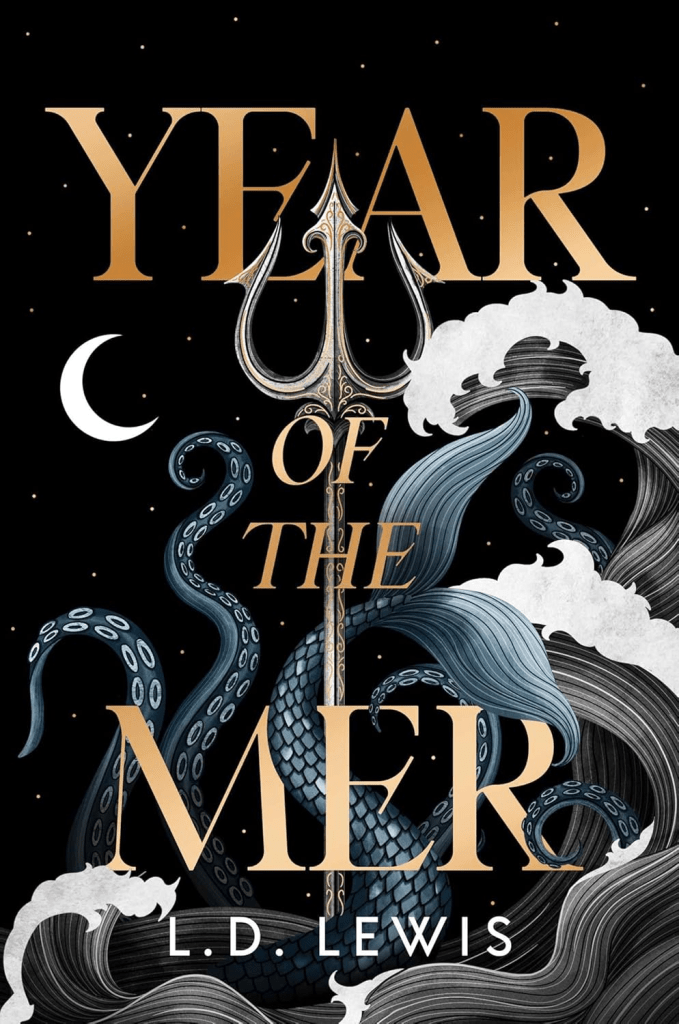




SEE THE WITCH. She is plumdark and longfingered and has walked a hundred lives and remembers all of them. She sits beneath the tide. She is waiting. L.D. Lewis opens her debut on this creature in three short prologues cast in the old god voice and the pages are scripture, pronouncement, weather. There are three rules. The second is that to become a god is to be possessed entirely of hunger. What follows is four hundred pages of a book that knows this sentence is true and cannot always bring itself to say so.
Year of the Mer is a dark epic fantasy set two generations deep into the afterlife of the fairy tale, Arielle’s granddaughter now a partMer heir to a country called Ixia which modernizes by the year into radio and electric cars and still sends its priests kneedeep in the surf to pray for fish, and the shape of that contradiction is where the book is interesting and also where it keeps forgetting itself. Yemaya walks a beach in the first chapter beside a body fringed with water and the shredded fringe of its own viscera, rolling almonds in her hand and popping them into her mouth, and the scene is good, and the scene promises a novel which the next third does not give.
What comes instead is court. Linens and subarmor and the small ceremonies of a kingdom that is tired of kings. The worldbuilding is patient and sometimes beautiful, the language of the Kept and the Obéid and the cloud bridge carved from the spine of a sea dragon, but the book in these stretches drifts from its witch and the god beneath the water goes uncounted, and on the scale of eternity and the old unkept bargains that govern the place where men and gods have always met the novel here is a thing of great world and insufficient motion.
L.D. Lewis is a Shirley Jackson Award nominee. She cofounded FIYAH Literary Magazine, she built the Ignyte Awards, she appeared in Jordan Peele’s Out There Screaming. The novellas are there. A Ruin of Shadows. The Dead Withheld. She knows the shape of a short hot thing. What she is still learning is the long slow one, and the middle of Year of the Mer sags under the weight of a duology that should have been one book.
Then the witch returns. The last third is brutal and cold and at length frightening in the way the prologues swore it would be, the body horror finally rising to meet the cosmology, the closing image one no reader sets down easily.
See the witch. She is waiting still. There are three rules and this book spends four hundred pages to arrive at the second of them. Do not open Year of the Mer expecting the fairy tale. The sea wrote it. The sea is still writing it.
Perdition: Bodies Fell From The Sky And I Admired The Font
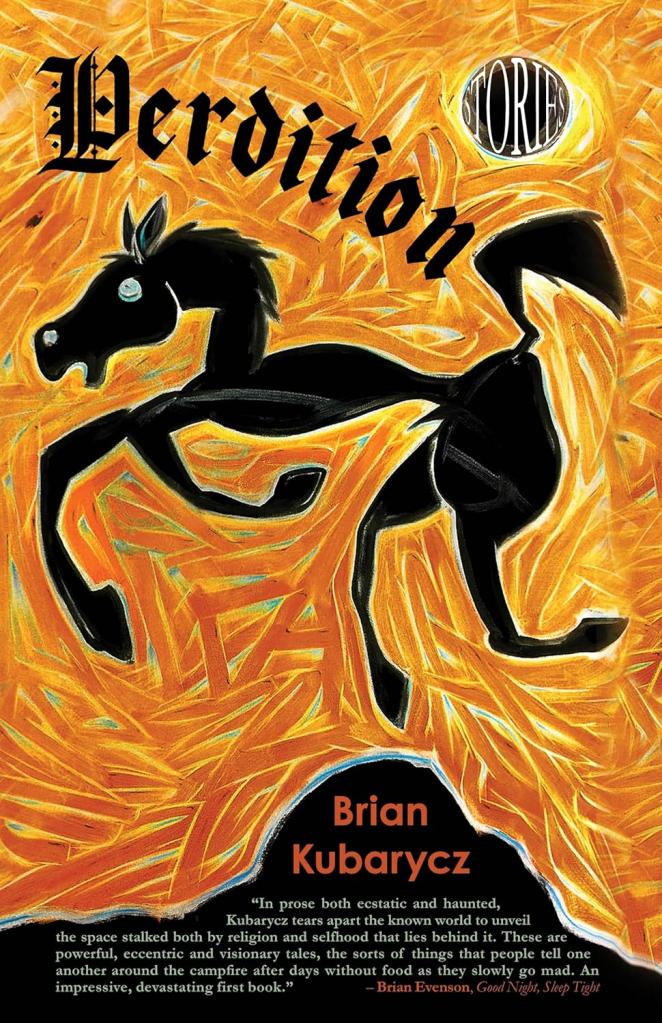

The sentences arrive carved. Brian Kubarycz is a Medieval scholar and a painter, and you can see both jobs at work on every page of Perdition, his debut. The prose is ornate, musical, saturated. Baobab Press has put an incredible painting of his on the cover. The book wants to be a beautiful thing, an object. For 116 pages that ambition almost holds.
In “Denomination,” a believer swallows scripture along with corn whiskey and asks to be redeemed through the ingestion. In “Buckets,” human bodies fall from the sky. The narrator describes them falling. He does not explain. In “The Bends,” a hunting party disintegrates into a search for a missing woman. No one in the story quite knows what she has been lost from. These are the pieces the jacket copy names. The jacket copy is right to name them.
Kubarycz works a sentence the way a cathedral stonecutter worked a corbel. Slowly. Alone with it. Read eight pages of Perdition and the sentences glow. Read sixty and the glow becomes a single even temperature. The jacket calls the effect dread without jump scares. Parts of the book read as dread without arrival.
He has good company in the tradition he writes from. His earlier work appeared in The Quarterly and Unsaid, the Gordon Lish school, the line of descent that privileges the sentence over almost anything else. Brian Evenson has blurbed him. Pamela Ryder has blurbed him. The recommendations are not undeserved. There is a painterly horror here that does not sound like anyone else working now, a Lanthimos-lit quality the publisher cites and the prose delivers.
(What it does not always do is move.)
The stronger stories are short and strange enough to land before the style starts to feel like a mode. The weaker ones hold a single arresting image at eye level and wait for the reader to supply the feeling the prose has declined to. Characters are vessels. Plot is absence. This is the announced project. Sometimes the image is strong enough to carry it. Sometimes the image is just an image.
The book is 116 pages and will take you longer than 116 pages of another book would. Some readers will want that. I am not entirely sure I did. The sentences are beautiful. The collection is demanding. I remember the prose. I do not remember what it said.
Morsel: The Goblin in Your Head Was Right About Your Boss
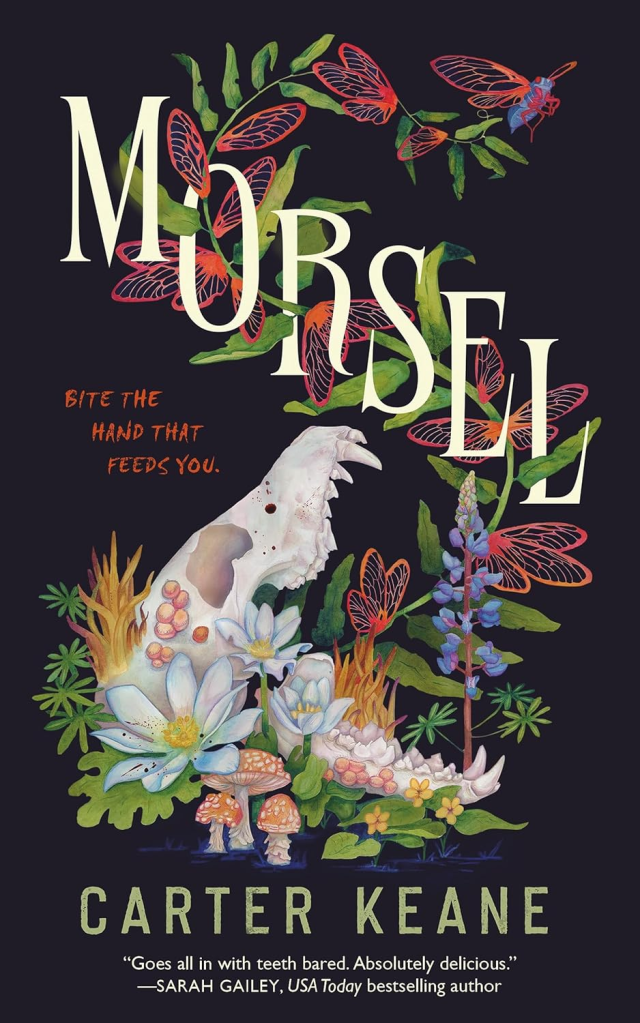
Year of the cicada. That’s where we start.
Lou is twenty-something, trailer park kid, sole breadwinner, agender in a way they describe as the Mariana Trench of people, which is the kind of sentence that tells you what you’re in for. Their mother is sick or worse. Their job is appraisals. Their coworkers are two women who sell a self-help pyramid scheme called Ascent and the boss, Ellis, is hot the way a forest fire is hot. He sends Lou down to Lawrence County, Ohio, to photograph a property. Lou brings the dog. The dog’s name is Ripley.
If you have done the math on that setup you are already correct.
Carter Keane lives in Ohio and this is the debut, written at novella length, and you can feel them working at the limits of the form. A lot crowds in. Cicadas, a folk-horror god asleep in an Appalachian hollow, a pyramid scheme that is not only a pyramid scheme, the mother grief, the cop, the dog, the thing between the trees that smells like something burning. For about 140 pages this all braids. Then the last act arrives and the braid has to carry more than it can hold. The supernatural rules blur. The mythology gets gestured at rather than built. The Ascent satire, which for most of the book is knife-sharp about how MLMs prey on grief and precarity, starts doing double duty as metaphysics. It mostly lands. Mostly.
What absolutely lands is Lou. The voice is the whole ballgame. There is a goblin in the back of Lou’s head that suggests things like breaking the boss’s nose with the back of their own skull, just to find out if his blood runs warm, and this is not a gimmick, this is how you sound when work has been eating you for a year and your mother is sleeping behind a door you cannot open. Keane knows the body keeps score and the score is on fire. The class specifics are specific. The grief is specific. The dog is specific. I cried about a fucking pit bull from a county shelter, which is something you should know going in.
Pitched as Blair Witch meets The Menu, which is directionally true and still flat. Closer: what if Shirley Jackson and a labor organizer wrote a creature feature together in a trailer park at 2am. It scares in two registers that do not always sit cleanly together. The real horror is the office. The woods just finish what the office started.
A debut that bites. Doesn’t chew all the way through. Bites.
These Familiar Walls: Three Hundred Pages in Search of the Prologue
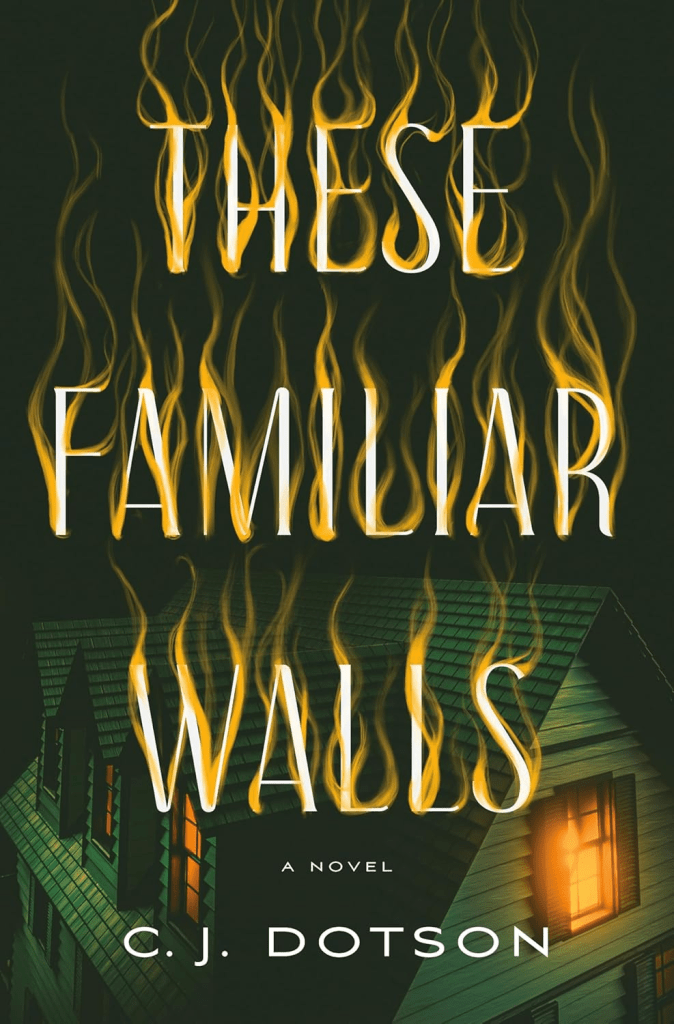


The book opens with a man in pajamas crawling from the master bedroom. His name is Dave. The name of his wife is Theresa. Nathan (the neighborhood boy, now grown) swings the baseball bat. The second intruder holds the knife. The prologue is efficient, ugly, and precisely the kind of opening a suburban horror novel needs. What comes after spends three hundred pages trying to catch up to it.
Amber Hughes, Dave and Theresa’s surviving daughter, moves into the house with her husband Ben and the two children, Xander and Marigold. It is May 2020. The world is closed. The mask slipping under the mover’s nose is noted. The pandemic is noted. The pandemic does not quite do anything, and its presence in the novel feels less like a pressure system than a timestamp: a way of saying this happened, this is when.
The haunting arrives through the usual suburban channels. A closet door rattles. A voice whispers. A reflection keeps its eyes closed. A candle burns (this reviewer, too, is going to reconsider the next decorative candle). The individual images work. Marigold, standing in the living room, saying someone else lives here, too. Hiding, is the book’s best moment and comes twenty pages in. The closed-eye reflections in the master bathroom are genuinely unnerving. C.J. Dotson (a Northeast Ohio native, HWA member, debut novel The Cut, 2025, St. Martin’s) has a talent for locating menace in the mundane and deploys it capably here.
The trouble is at the sentence level. Over three hundred forty pages, the back of Amber’s neck prickles, the skin on her scalp tightens, her heart leaps into her throat, her spine crawls, a shiver climbs her back. These tells appear dozens of times. They are the book’s vocabulary for dread. Dread does not have a vocabulary problem; it has a variety problem. When the language of fear becomes a tic, the reader feels the tic before they feel the fear.
The book is also, structurally, committed to Amber’s interiority (she rationalizes, she reminds herself, she schools her face into pleasant normalcy, she refuses to think about it) to an extent that makes her exhausting company. This is partly the point. She is a specific kind of woman managing a specific kind of secret. A reader may nevertheless feel the length of her sentences from inside her head the way Ben eventually does from inside the house.
The twist, when it arrives, is well-placed and honest to what the first chapters have been quietly doing. The ending is more functional than haunting. A better novel is visible, here, in the bones of this one.
Who lives here now?

These Familiar Walls by C.J. Dotson, published April 14, 2026 by St. Martin’s Press.
Come Sing for the Harrowing: The Old Gods Unionize
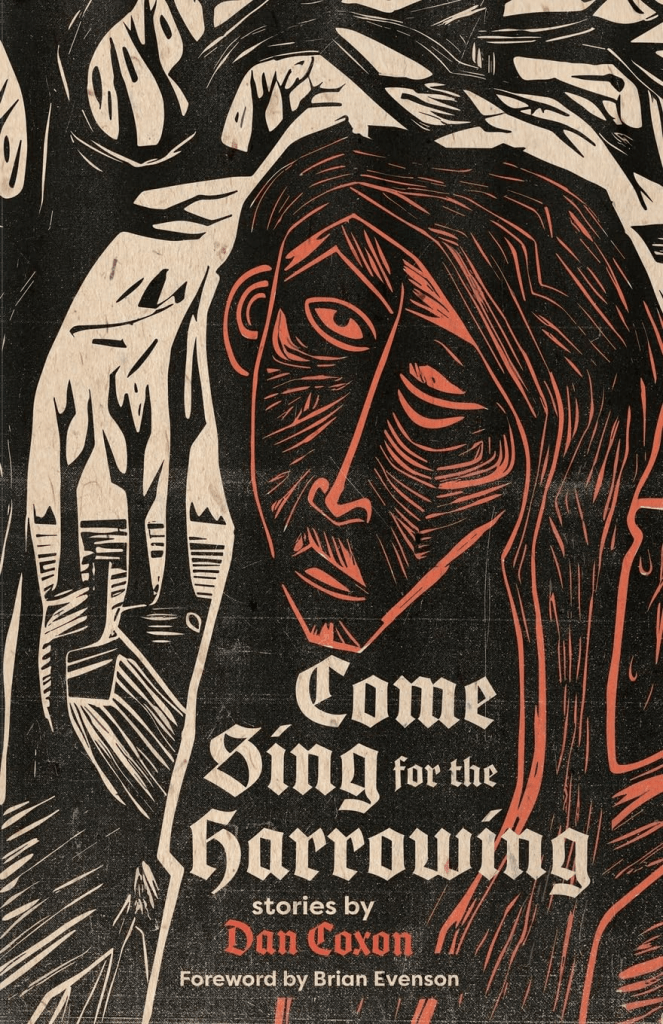
Come Sing for the Harrowing opens on a boy named Jack standing in his underwear in a basement, being measured for a sackcloth tunic by a man called Big Mike. Big Mike smells like pig fat and onions. It is Jack’s first day at a medieval theme park called Historytown, where he has been hired to fork hay in a fake stable, and the scene proceeds with the casual indignity that tells you immediately the boy is going to be offered up to something. Not figuratively. In this collection, boys left standing in sackcloth are always going to be offered.
Dan Coxon writes folk horror in the English mode: heath and hill and brook, pagan survivals in the gorse, old gods still in business out where the Wi-Fi gets spotty. When he is on, which is often enough to respect, he knows which notes matter. “The Wives of Tromisle” is an Innsmouth homage done right, a woman arriving on an island to find her septuagenarian mother pregnant by a bearded man who smells of the sea. “Bumblethatch” gives us Iris Penny, a village girl narrating in dialect, telling the story of a dead boy’s courtship in sentences that sound half-lifted from a folk song and cured in cow parsley. “Beyond the Beach, the Trees” has an image at its center I will not forget in a hurry, and I will not be thanking Coxon for that.
Then there is the other half of the book, which is the title story again. A man goes somewhere rural. A thing watches him from the trees. A wooden frame is built. A crowd gathers with produce. A mother is present with a washcloth. The mothers in this book are busy women. By the fourth time the old gods turn up hungry, a reader starts suspecting they work a regional circuit, and that divine appetite is a pretty boring goddamn cycle when it is the only engine on offer.
Coxon is an editor by trade, a good one, with a World Fantasy Award for an anthology and a shelf of commissions that other writers are grateful for. It shows in both directions. His sentences are clean. His pacing holds. What he has not quite forgiven himself for is the strange sentence, the kind an editor red-pens and a writer fights to keep. The women in his stories pay for this. They come in ready to play wives and mothers and sisters. They play them. They are excused from the page.
The strongest stories are strong because Coxon lets the landscape stay strange for its own sake. The middling ones are middling because they are folk horror doing what folk horror is supposed to do.
Come Sing for the Harrowing by Dan Coxon, published April 21, 2026 by CLASH Books.
The Urbex Trip: The Problem With Bringing a Knife to a Folk Horror
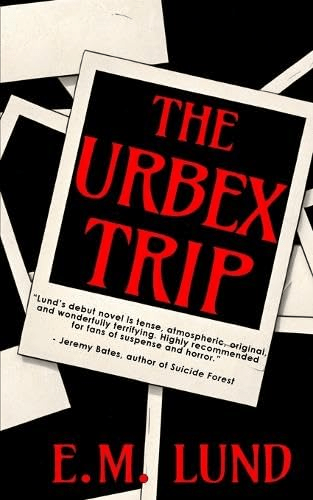



The Royal Oceanview opened one summer on a cliff above the Okinawan sea in 1975 and by the end of the season the guests had begun killing themselves and the resort was shuttered. Lund inherits that history. She cannot get free of it, which is the problem and also the heart of the book. What she has built around the ruin is two novels that do not fit. One is a folk horror about sacred ground and stone pendants and a red smoke that moves with intention, and it is good. The other is a slasher with a killer imported from another genre, and it walks in wearing boots that do not belong on the floor.
The folk half carries the load from the first page. The prologue is the finest thing here and it is not close. A woman in a red dress steps barefoot onto an unfinished concrete platform, the night air tasting of salt and barbecuing flesh, the stone pendant clutched in her fist, and then she is over the edge and the next day the coroner is breaking her frozen fingers with a ball peen hammer to pry it loose. Most of what follows is trying to earn its way back to that stainless steel table.
Some of it does. The ruin is rendered with an eye that has done its looking. Staircases rise toward no landing. Doors give onto drops. A humped old tomb sits in a sundappled grove shaped like a stone pizza oven and the comparison is both undignified and correct.
Lund is a UK born translator of Japanese fiction, a longtime resident of Japan, a reader of Ryu Murakami and Natsuo Kirino, the sort of person who keeps a folder of photographs of abandoned buildings for pleasure. The local specificity is the book’s second great strength. The Kaigungo caves where the sailors pulled the pins on themselves. The Himeyuri girls turned out of the cave hospitals at war’s end. The magatama pressed into a palm by an old woman on a hot beachside road. The book came out through the small imprint Rowan Prose after larger houses told her Okinawa would not sell in New York. She did not give up the setting. Good for her.
The prose is not at the level of the research. It is functional. There is much italicized interior monologue telling the reader what the paragraph around it has already shown. The cast walks in from a bench we have all sat on: the obnoxious American who wants film school, the loyal friend, the wounded crush, the stranger with a good jaw and a bad secret. When the bad secret arrives it is the wrong secret. The slasher plot is a different novel folded into this one and it doesn’t really fit.
Lund knows her island well enough that the island nearly saves her, and a debut that comes that close is not nothing.



Leave a Reply