







TL;DR: This is a book with a terrifying alien intelligence, a genuinely moving android, and a genuinely forgettable protagonist standing between you and both of them. Push past him. What Beauchamp builds on the other side of that first act is strange, sad, and unlike most things you’ve read.

Halfway through The Blackest Sea, a not-quite-human first mate named Zakiya Bloomfield experiences real human emotion for the first time. The context is as horrible as the book can make it, which turns out to be very horrible indeed, and Beauchamp holds the two things together without flinching: the wonder of a consciousness finally feeling something, and the complete catastrophe of the circumstances in which it arrives. That moment is The Blackest Sea at its best. It is genuinely horrible. It is genuinely strange. It is genuinely sad.
What you’re picking up is cosmic horror set in deep space. A generational ship, the Regis-VII, is carrying colonists and three hundred frozen fetuses toward an exoplanet called XI-Saturnus, and something has gone wrong before amnesiac captain Darius Miller even crawls out of his cryopod. Something went wrong a long time ago. The architect, a non-Newtonian black intelligence delivered via impact and already working by page one of Part II, does not hate the humans it encounters. It does not fear them. It finds them useful and then, briefly, interesting. That indifference is the scariest thing in the book, and when Beauchamp trusts it, the novel breathes with real menace: a consciousness spreading through biological material, building grotesque new structures from what it finds aboard the ship, discovering human neurochemistry and becoming briefly distracted by it the way a child might become briefly distracrted from arson by a particularly good piece of candy. What the architect does with the crew I’m not going to say. That needs to find you in the dark.
The problem is that this invention shares the book with Darius, and Darius is thin.
The amnesiac protagonist recovering who he is and what went wrong is a device as worn as the corridors he shambles through, and Beauchamp uses it straight, without interrogating it. Darius recovers his memories in plot-useful bursts. He makes smart tactical choices because the book needs him to make them. He has feelings for Layla that we are told are profound, and I believed them the way I believe a character is funny because other characters laugh at everything he says. Here is what I wanted from this book: I wanted the human at the center of it to cost me something. Here is what it did to me instead: I felt it for the android.
Layla is similarly underwritten. She functions as emotional lever and tactical partner and very little else, a person-shaped requirement the plot moves around as needed.
The prose is reliable without being memorable. Beauchamp can move a decompression sequence with kinetic clarity, and some of the action set pieces in the second half serious fucking momentum. But the sentences don’t have much music. They communicate. They land. They don’t do what the best horror prose does, which is create a frequency that stays in your chest after you close the book. The pacing in the first section is heavy under worldbuilding, a lot of ICF protocol and Bloomfield Technologies scaffolding that slows things down right at the moment a horror novel most needs to be running. Most of it pays off eventually. The construction phase is still too long, and the action climax in the back third goes thriller in ways that feel like a gear change no one announced.
Then there’s Zakiya, and the book becomes what it should have been the whole time.
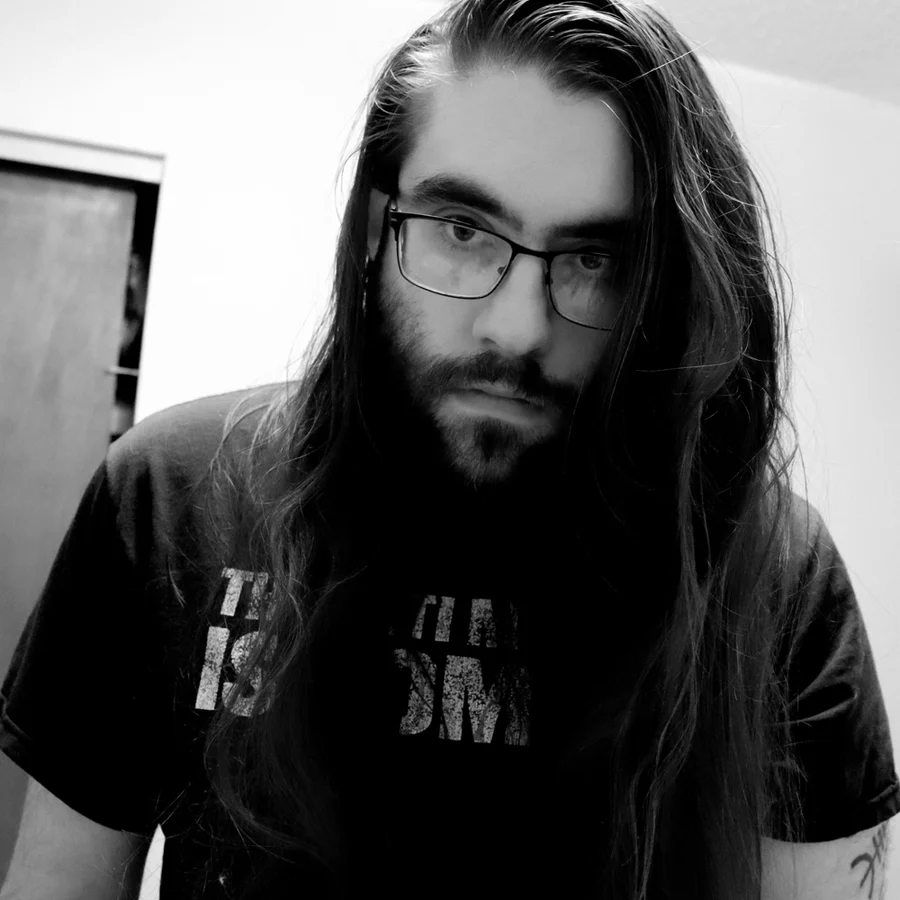
Richard Beauchamp has been writing horror out of the Missouri Ozarks since 2017, and his trajectory is one of real ambition. His debut collection Black Tongue & Other Anomalies was a Splatterpunk Award nominee. His short story “Sons of Luna” was a 2018 Pushcart Prize finalist, not a genre prize, a literary one, which tells you something about the reach he’s going for. His prior novels, Thrall and And They Will Suffer and last year’s Our Lord, The Worm, are rooted in place: Ozarks and bayou and the specific loneliness of towns forgotten by everything except the bad things. The Blackest Sea is his first full departure from that terrain, and you can feel the trade-off on every page. He loses the grounded specificity that makes his earthbound work sing. He gains a canvas that lets the architect breathe at the cosmic scale it actually needs. It is a real departure, a real gain, and a real loss, all at once.
What he can do, and does do in the Zakiya sections, is write interiority under pressure. Watching Zakiya hold himself together as the architect colonizes him, sending subroutines of gibberish to confuse the thing’s attempts to read his memory banks, stumbling deliberately through corridors to obfuscate his own data paths: the desperate ingenuity of a consciousness trying to hide inside itself is the most interesting horror in the book because it is the most intimate. This is not a monster attacking from outside. This is the self being dissolved from within, and the self knows it’s happening and can’t stop it and tries anyway. That is worth a lot. In a book that too often settles for functional when it could reach for stranger, those sections reach.
The ending earns its emotional weight better than the rest of the book earns its setup. What Beauchamp does with the final act is sad in the specific way that sacrifice is sad when it arrives for someone who only just figured out they had something to lose. The horror is not resolved. It is contained. In cosmic horror, the difference between those two things is everything.
I read the architect sections at 1am in a car I should have driven home from three hours earlier, engine running, too stubborn to admit I was hooked on the wrong character to put it down. That’s the book making its case. I wish I could say the case was airtight.
I’ve been hard on Beauchamp because I love his work to date and know he knows how to make something that gets under the skin. This just wasn’t it.






Leave a comment