
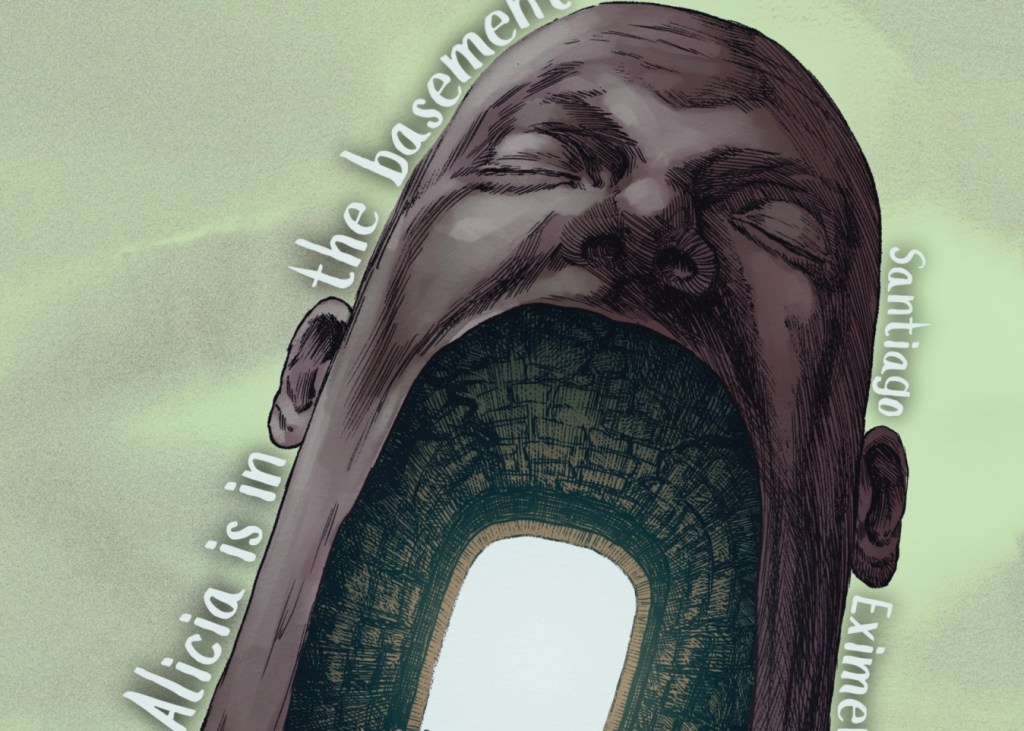
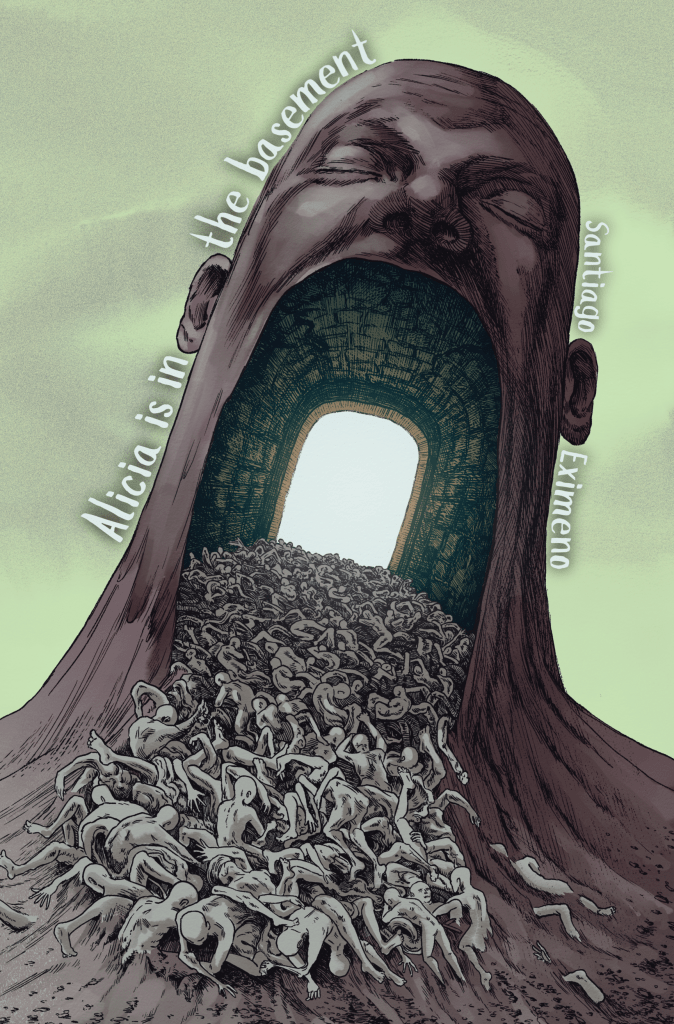








TL;DR: Alicia is in the Basement is a 126-page sucker punch disguised as a parental grief story. Santiago Eximeno builds domestic realism so convincing you forget you’re reading horror, then pulls the floor out and drops you into something ancient and awful. One of the most emotionally devastating novellas in recent memory. It earns every goddamn thing it does.

The Crocs come up early. Black, pink, matching. A family discount if every member of the family bought a pair. The narrator’s are the black ones; his daughter chose them. He is wearing them at the park on the afternoon she disappears, and he will be sweating into them later, in the police station, while a woman with an iPad asks questions about his marriage.
The Crocs are how Santiago Eximeno‘s novella (originally Alicia en el sótano, Libros.com, 2015; translated from the Spanish by Alicia L. Alonso for Tenebrous Press) does most of its work. The brand names accumulate: Lidl, FNAC, Hello Kitty, Lighting McQueen, Sennheiser, Samsonite, Pokémon, Invizimals trading cards. Tonopan for the migraines. Fairy washing-up liquid because his mother always insisted on Fairy. This is all the mechanism by which the daughter’s absence enters the prose. The named real thing in the wrong context, accumulating, repeated until the catalogue itself is the bereavement. A father missing his daughter looks at a yellow slide and remembers a discount.

The premise is what it sounds like. Six-year-old Alicia goes missing from a Madrid park while her parents are arguing on a bench. Her mother is twenty weeks pregnant. The father, Santi, drinks too much, works in IT, is the kind of man who calls his own grief weight an “emphatic pregnancy.” A five-year-old friend of Alicia’s knows part of what happened. An old woman at the park entrance knows more. There is, somewhere, an old man who does not speak with children. He takes them. He has been taking them.
What follows is a descent and Eximeno commits to it without flinching. Part One is the disappearance, Part Two is the search, Part Three is the encounter, and the proportions are exact. The first half is almost entirely domestic. The wife begins to bleed. The mother-in-law says it would not have happened if Alicia had been baptized. The narrator’s boss tells him to take the week off (“we’ll make do without you. No one here is indispensable, you know”) and he wonders, in real time, whether his boss is just thoughtless or the biggest son of a bitch he has ever known. The horror is in routine. The horror is in the catalogue of who you have to tell. The phone calls to make. The cashier at the supermarket. The baker.
The voice’s most ambitious move arrives after Santi has lost the house. He is staying in a friend’s apartment by then, and the prose splits in two. The main line continues to insist that Santi is at home, that the books on the shelves are Alicia’s books, that the kitchen is his kitchen. Italicized parentheticals, lowered slightly, contradict him. (not your kitchen.) (not your house, not your house, not your house.) The italics are the part of the narrator that knows. The unitalicized line is the part that has decided not to. The technique is unsubtle and it is the right kind of unsubtle. Eximeno is not asking the reader to decode anything. He is asking the reader to sit inside a head that is rejecting its own information in real time, and the parenthetical voice is the rejected information waiting to be heard. The book is at its strongest in this register, and the register is the book’s actual subject.

A briefer chapter pivots the novella sideways into 1885 Munich. A grandmother arrives by train at a Leichenhaus, the kind of nineteenth-century mortuary where corpses were watched for days before burial in case they woke up, threaded to a central bell that would ring at any movement. Hufeland’s Scheintod, the suspended state between life and death. Her grandson is gone from the cold room. The director suggests, of course, that the boy must have walked out on his own. This sequence is the book’s quiet showpiece. It folds a real medical anxiety, premature-burial paranoia, the threadwork bells of nineteenth-century Bavaria, into a supernatural one without strain. It does not explain what it is doing. It does not have to.
What the book gets right, it gets right in images that are difficult to set down. Sand running from a child’s mouth. A swing chain. A blank, wide-open look at the sky. A fountain in the park that has never worked. The bone-white staircase that emerges from the side of a road and overlaps reality “like a badly Photoshopped image.” The phrase is a small joke and it lands. The image stays. Some books generate dread by what they imply; this one generates dread by what it sees, in plain light, and refuses to soften.
Eximeno’s larger fictional project includes a place called Umbría, the surreal underground city he has been writing toward for over a decade. The 2013 collection Umbría won Spain’s Premio Nocte; he has been awarded the Premio Ignotus four times and is a member of the Horror Writers Association, with work translated into Japanese, Korean, French, and Bulgarian. Alicia is in the Basement is the household-level entry into that geography. The basement opens off a Madrid park where children eat sand and parents stare at their phones. The mythology is the lived domestic detail. The lived domestic detail is the mythology. That this fusion should hold across an entire book and not collapse on either side, into pure realism or pure mythos, is the achievement.

The nitpicks. The translation is mostly transparent and occasionally stiff; a few sentences register as Spanish-shaped English. The narrator’s recurring self-flagellation (idiot, asshole, ostrich, fat man in shorts) sometimes lands as a tic rather than a tell, although the line between the two is exactly where Eximeno wants the reader. And the supernatural figure in the third act gets a long monologue that briefly tilts toward the operetta register the rest of the book has avoided, complete with phrases like “Mr. I-don’t-know-your-name-and-I-don’t-care.” It is brief. It is recovered from. The descent reasserts.
Tenebrous Press has put the book in good company. Jenna Cha (The Sickness and Black Stars Above) supplies the cover and interior illustrations, which arrive at the right intervals and stay out of the prose’s way. Alex Woodroe edits. The imprint has been steadily building a catalogue of New Weird translations and originals, and Alicia is in the Basement is the kind of acquisition that makes the catalogue look smarter retroactively.
What kind of father would do this? The book asks the question. It does not, in any clean sense, answer.

Alicia is in the Basement by Santiago Eximeno, published May 19, 2026 by Tenebrous Press.


Leave a comment