
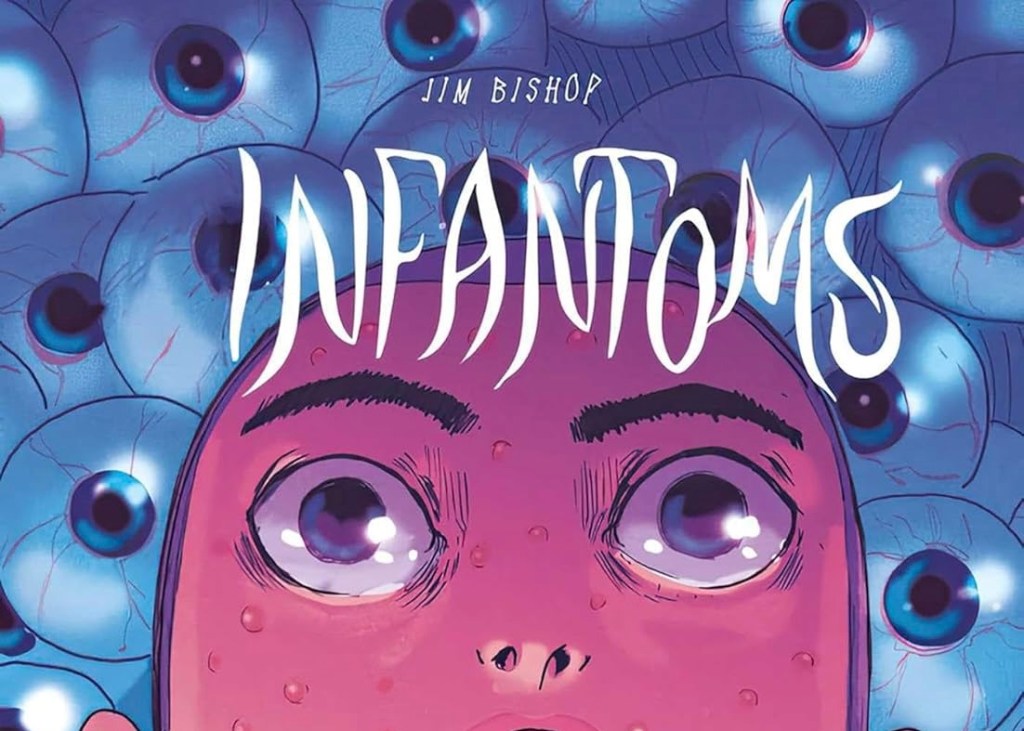
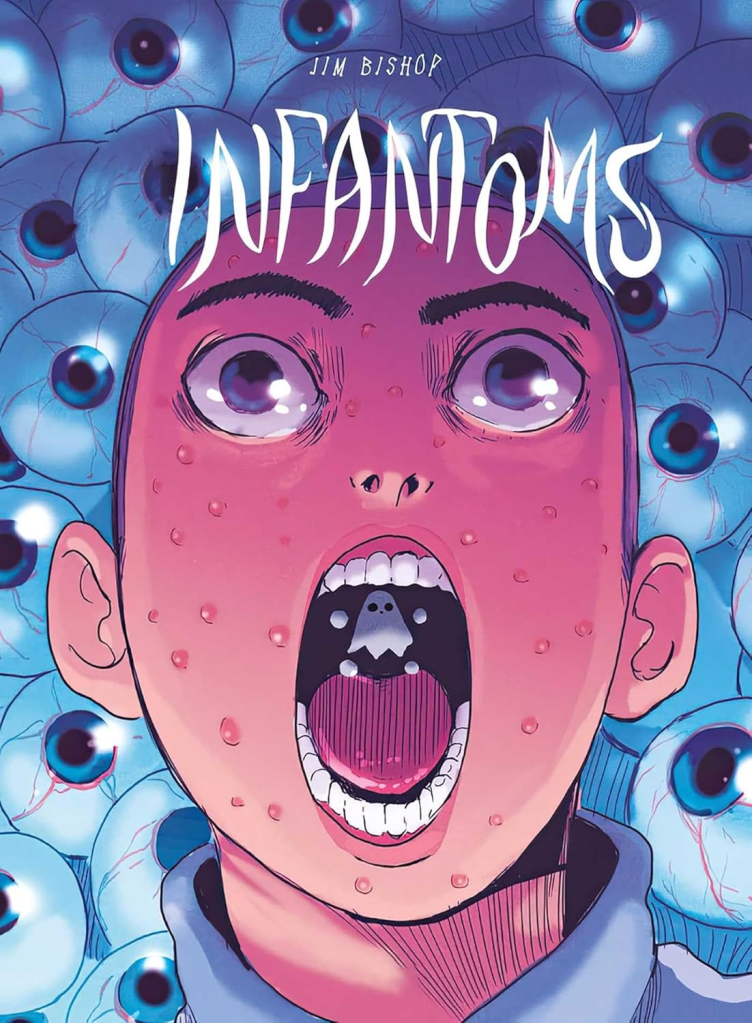





TL;DR: Infantoms is coming-of-age horror where the real haunting is institutional cruelty and domestic dread, and the ghosts are just the brain’s way of making it visible. Bishop’s pacing weaponizes silence, his palette stays bruised and intimate, and the “cute” phantoms curdle into accusation on the page. Tender, nasty, unforgettable.

The first thing Infantoms does is lull you with softness. The linework is clean but never sterile, with that slightly scratchy texture that makes faces feel lived-in. The colors swing muted and bruisy, like the world is permanently lit by an overcast sky and a half-broken desk lamp. Then, right when you’re comfortable, Jim Bishop drops these little sheet-ghost cuties into the frame, and your brain goes, “Aww.” And then your gut goes, “Oh no, this is the kind of aww that bites.” It’s a comic that understands a brutal truth: childhood horror is rarely about the monster under the bed. It’s about the monster in the next room, the one who pays rent and decides whether you get to feel safe today.
Maran is a kid trying to survive school, home, and the humiliating circus of growing up while adults lob expectations like bricks. A guidance counselor meeting becomes one of those “we’re here to help” scenes that somehow turns into a public trial. Along the way, strange little phantoms start showing up, sometimes adorable, sometimes deeply wrong, like emotions learned to walk and now they’re following you around. As Maran gets older, the world expands, but the dread does too, and the book keeps asking what it costs to be seen when you’d rather disappear.
Bishop knows exactly when to compress a scene into brisk beats and when to let a moment rot. Early pages often use clean, readable grids, the kind that make school offices and bedrooms feel like boxes you can’t climb out of. The page turns are weaponized in a quiet way. You’ll get a normal conversational rhythm, then a hard cut to a close-up or a sudden visual intruder that makes you re-read the previous panel like, “Wait. Was that thing there a second ago?” Silent beats show up at the right times, especially when Maran is absorbing a hit, verbal or otherwise. The comic understands that the scariest pause is the one where someone decides whether they’re going to speak up or swallow it.
Even when the book leans surreal, bodies stay readable. Facial acting is the secret sauce here. Maran’s expressions shift from defensive bravado to that hollowed-out stare kids get when they’re trying not to cry in public. Adults are drawn with weight and presence, sometimes literally looming, sometimes just taking up the emotional oxygen in the room. There’s a particular knack for making small gestures feel catastrophic. A hand on a paper, a knock at a door, someone leaning in a chair. Normal stuff, framed like it’s a threat, because for a kid in the wrong house, it is.
Dialogue “sounds” natural, with balloons that don’t overstuff the panels or turn every exchange into a brick wall of text. When the comic wants emphasis, it goes there cleanly. Sound effects are used like little jumps, not constant noise. That repeated knock, the “TOC TOC,” is a perfect example of how a tiny SFX can become a stress trigger. Captions are not constantly narrating your feelings for you. The book trusts the art to carry the dread, which is honestly rare as hell.
Most of the palette sits in restrained blues, greens, and washed-out skin tones, then you’ll get an abrupt shift, a warmer or harsher field of color that signals a mood swing like a migraine aura. Negative space gets used to isolate Maran when the world is too loud. And when things tilt into nightmare, the textures get rougher, lines jitter, and the page starts feeling less like a window and more like a cage. There’s a recurring contrast between the soft, almost cozy look of the “phantoms” and the hard, ugly reality of what’s happening around them. That contrast is the point. The book is telling you that trauma can wear a cute mask. It can even look helpful at first.
Infantoms generates tension by turning ordinary institutions into haunted houses. School becomes a tribunal. Home becomes a place where you listen for footsteps and measure your words. The supernatural elements feel less like an external invasion and more like a pressure leak, the mind’s way of making the invisible visible. The phantoms show up like symptoms, like manifestations of fear, shame, loneliness, and that awful adolescent sense that everyone is judging you and somehow they’re correct. The comic also loves repetition as horror. Repeated phrases, repeated situations, repeated feelings, until you realize the loop is the monster. There’s a sequence built around self-loathing that’s simple, devastating, and way too real, and it lands because the form itself becomes the spiral.
The horror of the book is mostly psychological, but when it chooses to show violence, it hits hard. It’s not splatter for the sake of splatter. It’s a sudden, ugly intrusion that reminds you this story is not fucking around. Bishop is smart about what to show versus what to imply. A silhouette can be scarier than a detailed face, and this comic leans into that, especially with a shadowy figure that reads like a fairy tale threat that wandered into a school hallway and decided to stay. When something awful happens, the panels don’t dance around it with coyness, but they also don’t gawk. The horror is staged to hurt, not to perform.
It’s all about how kids get shaped by adult failure. It’s about being told you’re worthless until you start writing it yourself. It’s about the lie that growing up automatically means gaining control, when sometimes you just gain new rooms to be trapped in. It’s also about how imagination can be both refuge and infection. The phantoms are cute, yes, but they’re also a symptom of a world that won’t meet Maran where he is. When your reality is intolerable, your brain builds companions, villains, and symbols. Sometimes they save you. Sometimes they demand a price.
My qualms are mostly about taste, not quality. If you want a clean, plot-forward horror machine that delivers big twisty set pieces every ten pages, Infantoms might feel too interior. It’s a coming-of-age dread bath. It lingers. It loops. It hurts. Some readers will want more external momentum and fewer emotional sinkholes. But if you like horror that treats adolescence as a haunted biome, if you like surreal supernatural elements that feel welded to character psychology, if you want a book that can be funny and tender and then suddenly make you feel like you swallowed a rock, this is your shit.
Read if you like coming-of-age horror where the “monster” is school, family, and the quiet moments where nobody helps.
Skip if you hate stories where the scariest thing is realism: adults failing, institutions shrugging, homes that aren’t safe.
Written and Illustrated by Jim Bishop. Translation by Ivanka Hahnenberger. Lettering and Layout by Mike Kennedy.
Published April 7, 2026 by Magnetic Press.


Leave a Reply