




TL;DR: A single unforgettable image, a rowboat keeping pace with a cruise ship across decades, carries Grecian’s slim novella most of the way on its own. The Boatman himself, when he finally comes ashore, is a small marvel of courteous menace. A late pirate detour softens the dread, but the closing pages still land.

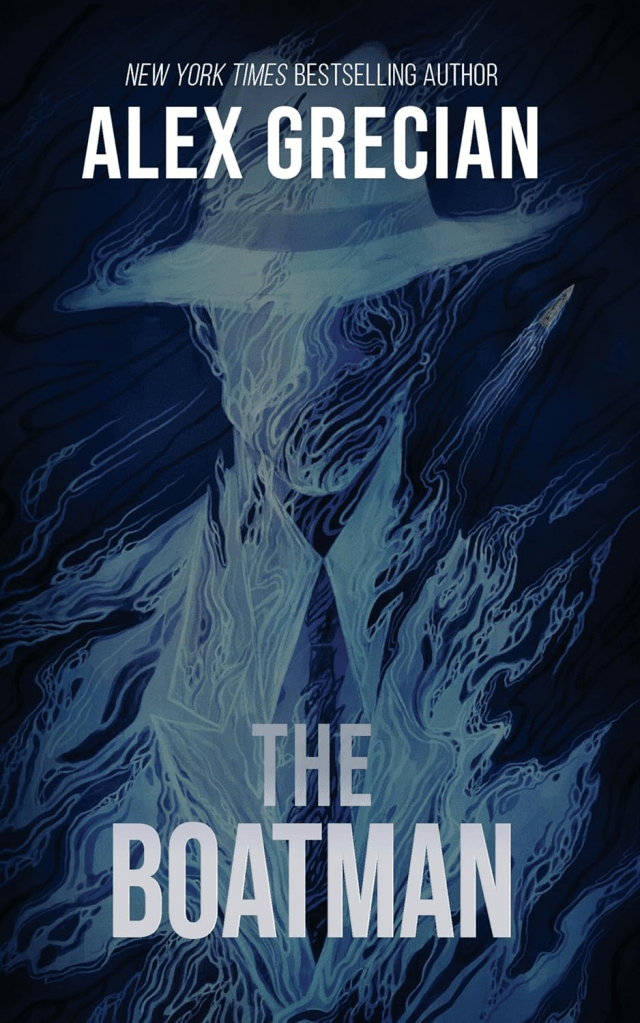
The image is clean. A rowboat keeps pace with a cruise ship. The man in the rowboat wears a white suit, a green tie, a white Panama hat with a green band. He stands and poles his little craft like a gondolier. The ship is the Maria Calypso, out of PortMiami in May of 1977. The captain has a heart attack at the wheel the day the Boatman appears in the wake, which tells the passengers what they need to know. As long as the ship keeps moving, the captain does not die. Neither does anyone else. They buy the ship. They keep moving. Decades pass.
(The premise is enough for a while, which is another way of saying it is not enough for all of it.)
What the book is good at is objects. A plastic honeymoon lei, purple and pink, traded between two men as the stakes of small bets for fifty years, its purple petals fading to gray, its pink petals fading to white. A Nambu pistol from a stall in a bazaar, carried across three acts in the waistband of a pair of capris. A stuffed purple rabbit a child hugs in her sleep forty years after she is too old to. A cardboard cigarette carton with the lei coiled inside, left with a boy at a graveyard with instructions to wait. The catalogue is where the book lives. The catalogue is where most of the book’s dread lives, too, when it is working.
The book is interrupted four times by Wikipedia pages. Advent Island. Port of the Everglades. Vallvidrera. Fake citations, deadpan tone, geographies reshaped by rising water. The pages do not say what year it is. They are how the book tells you what year it is without making the characters have to notice. Miami is raised three times and then drowned. Barcelona goes under and Vallvidrera becomes the coast. The American alligator goes extinct, the Florida panther goes extinct, the West Indian manatee goes extinct, and then later a young woman on a rice farm built on submerged land hears a panther at night. (She is the adopted daughter of the couple on the ship. The rice farm is in what used to be Florida.)

The Boatman eventually comes ashore and has a cup of coffee with the protagonist and a child in a courtyard on Advent Island. This is the best scene in the book. He is slightly built. He wears gold hoops in his ears. He orders kopi tubruk for all three of them and tells a story about a beautiful boy whom he let live, once, decades ago, and what the boy did afterward. He says he was a doughboy in the Great War. He says his rifle went off by accident and that was how he inherited the job. He says he lacks ambition. He is courteous. He is reluctant. He is the book’s best invention, and the book is not quite what it would have been without him.
(It should not work. A chatty Death at a café, ordering coffee, telling a parable. In most hands it would collapse. It does not collapse.)
The book could have been a slow rout. A ship emptying itself out across decades. Passengers choosing their own exits, or not choosing them, or being chosen for. That book exists inside this book, in flashes. Kaye Vega in an airport in Sydney, sitting with a plane ticket stuck in an unread paperback, calculating how long the flight would take, calculating how long until the ship weighed anchor without her, choosing the ship. Larry Reeves lowering himself into a dinghy and rowing out to meet the Boatman because he had been dying of cancer for fifty years and would like to stop. A woman on the lido deck with a ham sandwich and a bottle of Blue Moon and a mustard stain on her blouse, watching her friend jump from the deck above her. These are the pages where the book is what it is supposed to be.
Halfway through, the captain and the safety officer decide to throw three passengers off the ship to slow Death down. They discuss this with the doctor in the captain’s office. There is a bottle of Scotch. The doctor picks up the bottle, sniffs it, sets it back down. Later in the scene, the doctor picks up the bottle and drinks from it. Later still, the doctor takes a second swig and slams the bottle down. The captain proposes a toast to a long life and one hell of a cruise and they agree to be friends again. Three people are dead. The book moves on. (This is where you are supposed to feel the horror, presumably.)
The supporting cast is cataloged by function. Pete the lawyer does lawyer things. Betty the web designer does web designer things. Amanda the safety officer carries the gun. A sentence, or a role, or both.

The author is Alex Grecian. He is in his mid-fifties, based in the American Midwest, lives (according to his author bios) with his wife, his son, a dog, and a tarantula named Rosie. He spent the 2010s on a five-book Victorian series set around Scotland Yard’s Murder Squad, starting at Putnam’s in 2012. He pivoted to horror proper in 2023 with Red Rabbit at Tor Nightfire, a supernatural western, then a loose sequel in 2025. The Boatman is a side project, 110 pages, from Bad Hand Books, the small press run by the Bram Stoker Award-winning editor Doug Murano. Interior layout by Todd Keisling under his Dullington design imprint. Grecian has also written graphic novels for fifteen years (Proof, Rasputin). The graphic novel habit shows. The Wikipedia interludes have the load-bearing brevity of captions. The pirate attack in the final act is structured like a sequence of panels, and not a very long sequence.
The pirate attack arrives in the last act. A freighter. Two Sunseeker yachts. Grenades. A long-range acoustic device bolted to the deck. A water cannon. A woman on one deck with a rifle, a man on another strapped into a cannon’s swivel chair. A different book starts here, briefer than the book it is interrupting, and then it is over. The Boatman is not in the pirate scene, which is the scene’s tell. The book’s central threat has been, for most of the book, a man in a small boat who never closes the distance, and now the threat is something else, and then it is not the threat anymore.
It is a good slim book. It is not a scary book. It works on a reader the way a long Sunday works on a person who is avoiding a phone call. Somewhere out there, at the same distance as ever, a man in a white suit stands in a rowboat and poles it steadily through the water. He is not in a hurry. He has all the time in the world.






Leave a Reply