
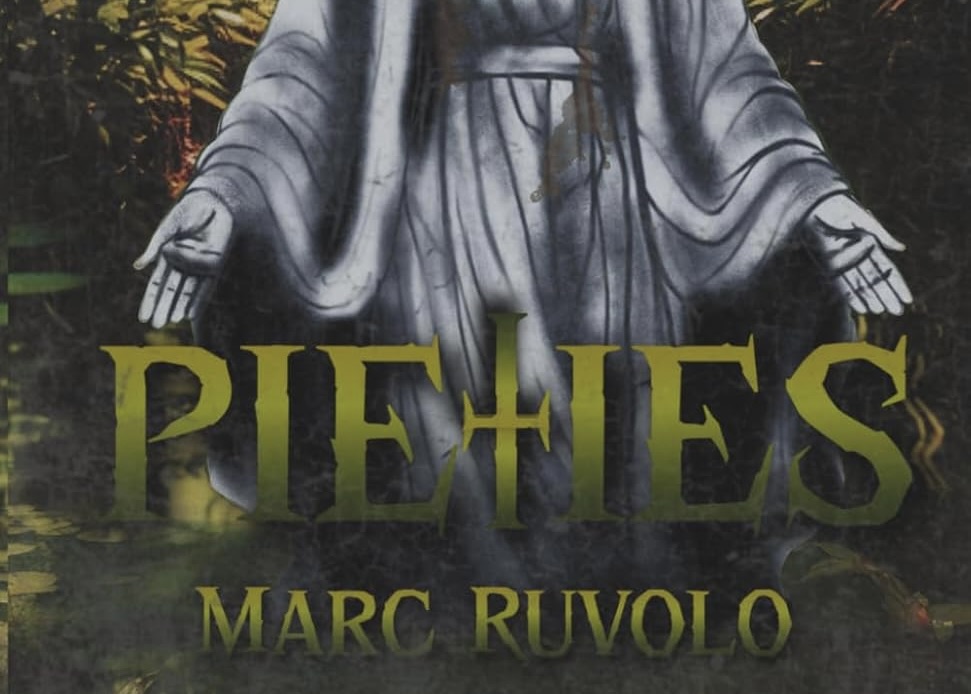
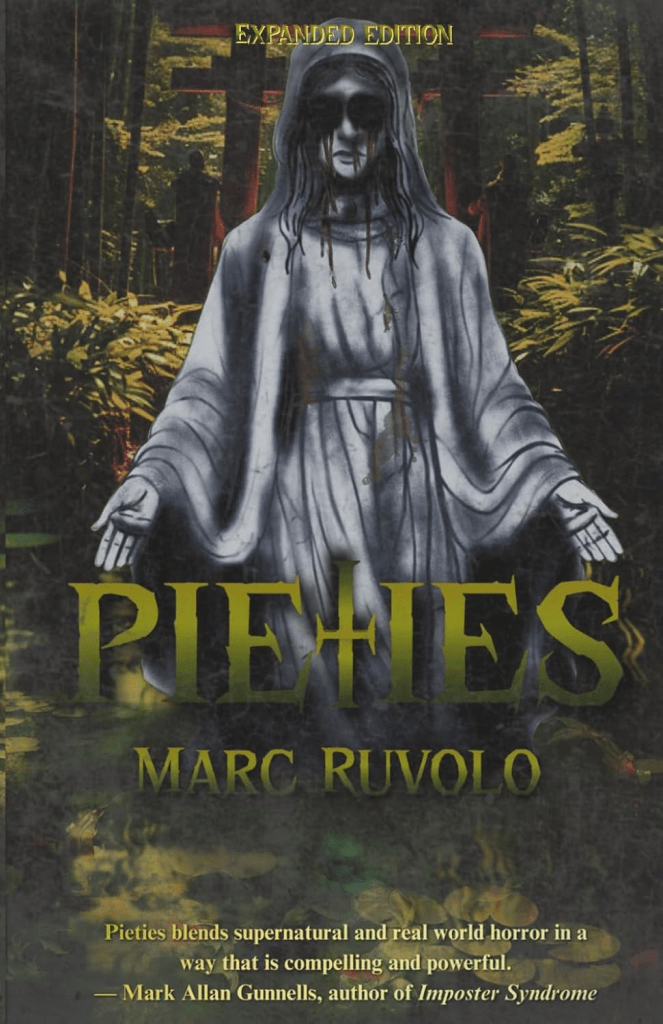





TL;DR: Ruvolo writes about 1981 the way someone writes about a wound they cleaned themselves: carefully, without flinching, and with total knowledge of what the dirt looked like going in. Pieties is a queer horror novella built from fake pearls, dead cats, and one immaculate Japanese garden hiding something ancient and hungry beneath the lily pads. It will follow you home.

The town of Wheaton, Illinois, has more churches per capita than almost anywhere in the country. This is the kind of fact a place repeats about itself until it becomes a boast, a warning, and a structural wall all at once. Marc Ruvolo‘s Pieties opens in 1981 with Andrew Fineman leaving a doctor’s office at Mount Sinai, having just been told he has something called Gay-Related Immune Deficiency, which they are abbreviating GRID because the medical establishment has always preferred its horrors in acronym form. The doctor shakes his head. Andrew tracks the burst blood vessels in the man’s hideous potato nose and stops listening. By the time they agree on a follow-up date, Andrew has already decided not to show up.
He goes home instead. Not to the West Village apartment he has been living in, but home, the real one, the one you never stop owing rent on: Wheaton. Circle Avenue. Number 37, a pale blue Victorian with two chimneys and red maples twisting their branches into a canopy so dense the backyard might as well not exist. His mother Enid meets him at the door in heels and full makeup, a rope of fake pearls accenting a lavender jacket with outrageous shoulder pads and a cat she has named Patch the Pirate cradled in her arms. His father Dick has arranged a custodial job for him at the local college. Dick never allowed Enid to dress down, not even at home. The cat squirms, trying to get away.
Everyone in this novella is performing a devotion they do not fully believe in, which is the only kind of piety Ruvolo seems interested in. Enid performs maternal warmth with the frantic precision of a woman whose hands, we are told, flutter like two dying birds when she senses she has failed. Dick performs patriarchal authority with hedge clippers and church attendance and a Japanese garden he built after returning from World War Two, three terraced levels of manicured foliage surrounding a koi pond where green water lilies cover the surface like perfect umbrellas for the schools of ravenous carp lurking beneath. Andrew performs the role of dutiful, sexless son. His mother told the neighbors he went to college in Europe. He did not have the grades for Florence, Alabama, much less Florence, Italy. Christine, his best friend, performs the role of the woman who is fine, who can handle it, whose sister with muscular dystrophy and deadbeat father and two jobs and drinking are all just weather, nothing structural.
The performances are the book’s real horror. Everything underneath them is worse.

Ruvolo came to fiction through the Chicago punk scene, where he fronted No Empathy throughout the 1980s and 1990s and ran Johann’s Face Records, a label that introduced Smoking Popes and Alkaline Trio to anyone who was paying attention. He later founded Bucket O’ Blood Books in Logan Square, a genre bookshop specializing in horror, sci-fi, and the kind of strange paperbacks that smell like basements and bad decisions. He has since relocated to Portland and published two prior novellas, Sloe (Unnerving Books, 2023) and Waste Ground (Slashic Horror Press). Pieties was originally released in 2024 by Off Limits Press; this expanded edition comes courtesy of Slashic Horror. The acknowledgments reveal the book is dedicated to his first boyfriend, Dwight Glass, who died of HIV complications in 1994. This is not incidental information. It is the fire.
The prose has the texture of someone who learned to write by reading paperbacks in empty bookstores and listening to people talk in bars. It is plain, physical, and ruthlessly specific. Christine’s teeth are too small for her mouth, pale-yellow Chiclets set in bright pink gums. A cocktail is described as a hard pour, mostly cheap vodka, with hardly any cranberry to soften it up. Dick examines his well-oiled hedge clippers while telling Andrew to thank his mother for letting him come home. The sentences are short, declarative, and built to carry more weight than their grammar suggests. Ruvolo does not reach for lyricism. He reaches for the detail that is also an accusation.
Where the book is strongest, and it is very strong, is in the slow reveal that every safe harbor Andrew finds is not one. The town that raised him produces a drunk named Rory in a faded Led Zeppelin shirt who calls him a slur and then hits him. The gay social world Christine introduces him to, a pool party in Wilmette hosted by a man named Tonio with a Marine Corps tattoo and gin on his breath, turns predatory within an hour. His coworker Ellis, who plays guitar during lunch breaks and asks the kind of questions that feel like someone leaning closer, turns out to be another closet with sharper walls. Even Christine, his constant, his ride-or-die since high school in the Country Squire with its corny faux wooden side panels, is carrying a resentment Andrew cannot see. She has been performing the caretaker so long she has confused it for friendship, or maybe she hasn’t, and that is the meaner thought.

The supernatural element arrives through the garden. The cats keep disappearing. Patch turns up eyeless in the koi pond. The water bubbles at night with gold and silver fins churning in ways that should not be possible. Dick vanishes into the bamboo thickets after dark and comes back diminished, and what he is doing back there, what has been calling to him for forty years, is the book’s central revelation.
The novella’s proportions are its one real limitation. Ruvolo spends the first two-thirds building Andrew’s world with the patience and physical specificity of someone writing a full novel, and then the final act arrives at a sprint. The confrontation between Andrew and Dick, which the entire book has been angling toward, is powerful in its content, ugly and impossible to look away from, but the pacing compresses what should devastate into something closer to a series of events. The shift to Christine’s point of view near the end is a smart structural choice that reframes everything the reader thought they understood about loyalty, but it gets roughly ten pages to do work that wants twenty. Several reviewers have noted the book feels like it ends abruptly. They are not wrong. The trap snaps shut before you have finished admiring the mechanism.
Ruvolo has written a book about a man who is dying in a house where everyone is already dead in the ways that matter, and he has done it with the flat, physical precision of someone who is not interested in your sympathy. He wants your attention. The difference is that sympathy lets you feel good about yourself, and attention requires you to sit with what you have seen. Pieties requires you to sit with it. The door shuts, and you are still outside, and the clouds are coming.



Leave a Reply