


TL;DR: Mormon missionaries turned vampire missionaries, in Portland, in January, with their sacred garments burning off their bodies. The premise alone should get Rhodes on a panel. What keeps them there is the psychological precision underneath the horror, the genuine tenderness underneath the comedy. An uneven but confident second novel from a writer worth watching.

Here is a premise with the velocity of a vampire who just smelled blood across a parking lot: two Mormon missionaries in Portland, Oregon wake up with fangs, their sacred garments burning their skin, prayer sending electric shocks through their bodies like a cosmic bug-zapper aimed at the soul. Vampire Missionaries announces itself with the confidence of someone who knows they have the good idea. Kathleen Rhodes does have the good idea. The book has other things going on too, some of them less good, but the idea is enough to carry you through a fair amount of what follows, and occasionally far enough that you forget the stumbles entirely.
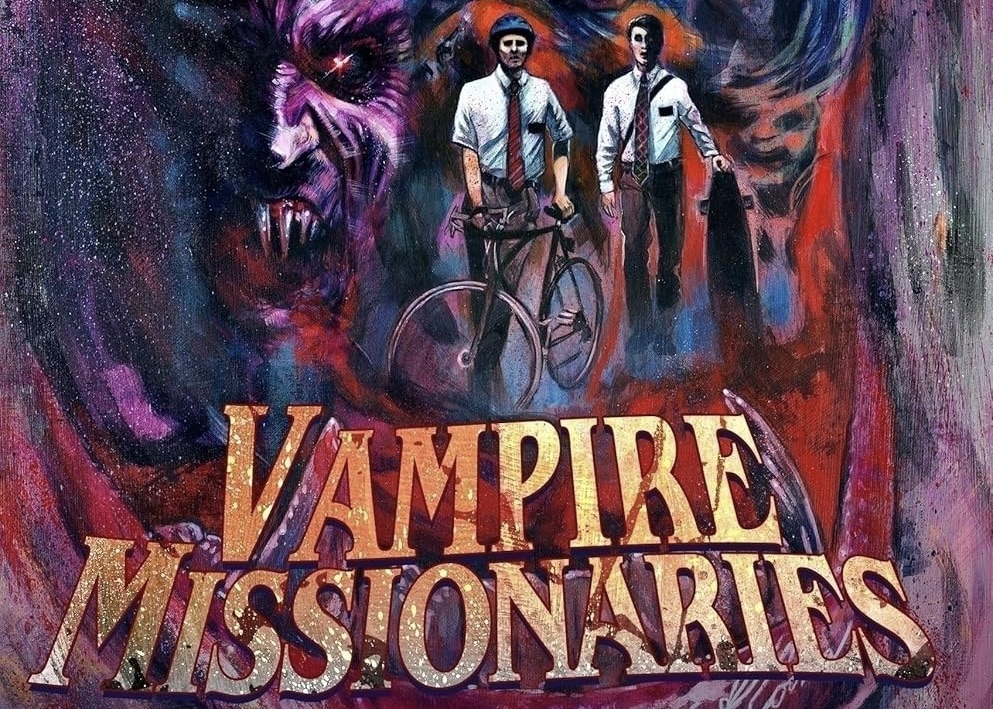
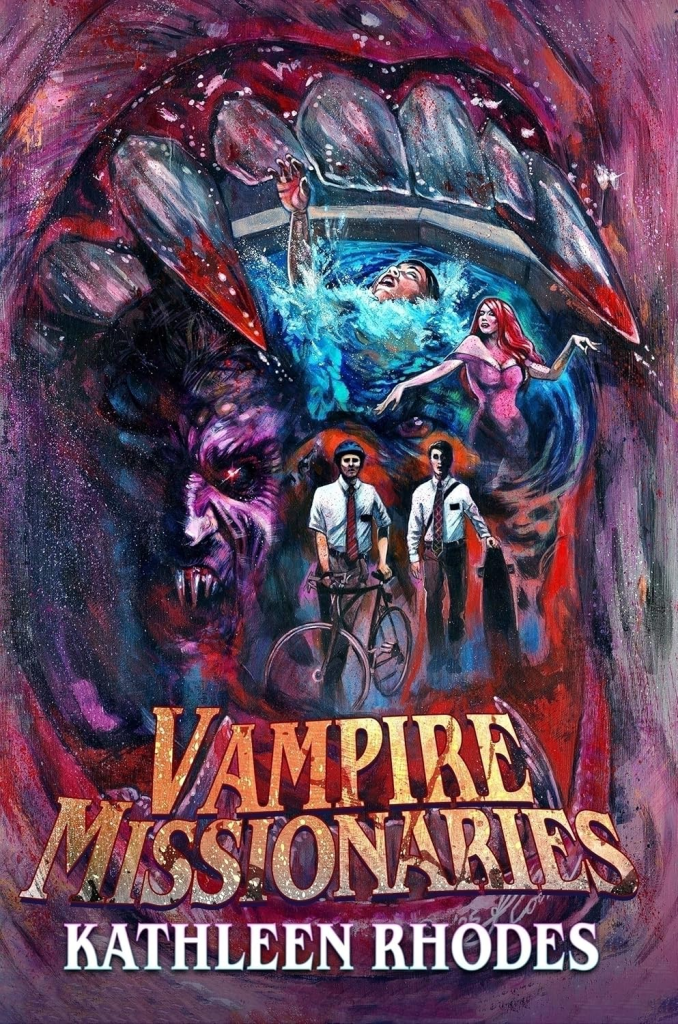
Gabe and Luke are nineteen-year-old elders in the Hawthorn Branch of the LDS church, shipped to Portland for two years of faith delivery. Gabe is from Idaho, earnest to the point of pain, carrying his dead father and his drunk mother and eighteen years of devotion like a backpack that has rubbed all the skin off his shoulders. Luke is from Southern California, gay in a family that treated the discovery as a medical emergency, and here on a mission that is less about faith than about surviving until he can disappear somewhere his father will never find him. They wake up in their apartment without remembering the night before, no reflection in the mirror, two puncture wounds each on their necks, and the slow horrible dawning of what has been done to them. Their sacred garments, once soft linen pressed against their skin as covenant, now light them up like they are standing on a live rail. Gabe tries to pray and gets zapped. He tries a workaround. He says “Gaud.” He prays “lead me, darkness.” He is a teenage vampire in his church clothes trying to find a loophole in God’s firewall, and I wanted to stay in that scene for a hundred more pages.
The premise alone earns its existence. Vampirism as predatory religion. Missionaries turned into missionaries for a different master. The horror is already structural before anyone spills a drop of blood: these two kids have been turned by a creature who wants to weaponize the very infrastructure of their faith, their trained willingness to knock on strangers’ doors and ask to be let in. There is something genuinely unsettling about that, something that works past the jokes, and Rhodes knows it.
The jokes land, by the way. More often than you’d expect and better than they should. The boob-shaped door knocker at the maker’s house. The snake named Percy. Gabe trying to explain to Luke why stepping on stair thirteen in a sequence is nonnegotiable. A mother in waders and overalls who would rather hose down four teenagers than discuss what her son has done to them. Rhodes has a gift for the exact absurd detail that arrives without setup and doesn’t bother waiting to see if you caught it. The humor holds hands with real discomfort in a way that is harder to pull off than it looks.
What Rhodes has clearly lived in, and what comes through with authority, is the psychological interior of people in crisis. Twenty years working mental health, jails, emergency rooms, addiction services, the full catastrophe of what happens when human beings can’t hold themselves together. That expertise coats Gabe and Luke, not as case studies but as texture. Gabe’s guilt about his father’s death and what led to it. Luke’s hypervigilance, the practiced smallness of someone who learned that taking up space invites punishment. The way a young man who has been beaten for being who he is can still hear that voice in his head louder than any vampire’s whisper. These are not horror-novel gestures at trauma. They are specific, and they cost something.
Rhodes is also a non-practicing Mormon, and the satire has the specificity that only insider knowledge produces. The garments. The CTR ring. The anointing oil. Sacrament Wonder Bread. The sacred covenants that turn lethal against the body making them. This is not mockery. It is something richer than mockery, something closer to grief, because the rituals Rhodes is pulling apart are ones they once watched believed in. You can feel that in Gabe’s anguish, in his attempts to keep praying after the prayers have been weaponized against him. Faith does not become a joke here. It becomes a wound.
The prose, however, is inconsistent in a way that keeps pulling you out of the experience. Sentences that earn their music are followed by sentences doing basic logistics. There are point-of-view slips that snag like a nail catching fabric. Passages where the style goes flat and functional at exactly the moment when the scene needs the language working. Rhodes can write. There are stretches here that move, that have rhythm and specificity and real charge. The problem is those stretches are not continuous. The book is written in two registers and switches between them without ceremony.
The pacing carries the same problem. The middle section, which should be doing two things at once (deepening the boys’ bond, building the threat of Bishop) does both more slowly than necessary. A subplot that is conceptually interesting runs about twenty pages longer than necessary. The climactic showdown is exciting in patches and overcrowded in others, four things happening simultaneously in a space where the staging keeps slipping out of legibility. The ending does not fully honor what the book has just done to you. There’s an emotional reckoning and then something too breezy, something that feels like a safer version of the honest conclusion. Not catastrophic. Just slightly wrong, the way a chord resolves to the wrong note when you know what the right one is.
There is a better version of this book not far from this one. The bones are good. The characters are good. The idea is fucking excellent. What it needed was a harder editing pass and someone willing to cut twenty pages from the middle without apology.
You should still read it. The premise alone is worth the price of admission. Luke Parley, the gay teenager from Southern California who came to Portland to hide from his father and ended up undead, with a chain in his fist and something to prove to a God he’s not sure is listening anymore, is someone I will think about for a while. Gabe Fitzpatrick, pressing his face through the bars of a vampire cage and trying to untie someone’s wrists while his arms are burning off, is one of the most earnest characters I’ve read this year so far. Earnest is not an insult. Earnest is the hardest thing to make land in horror and it mostly lands here.
Kathleen Rhodes grew up in Gresham, Oregon, below the poverty line. They came to fiction through two decades of mental health work, moving from therapist to registered nurse to Psychiatric Mental Health Nurse Practitioner, seeing patients in jails, emergency rooms, and addiction clinics. Their debut, The Dark Road (2024), was a psychological thriller about two strangers sharing a coma-world built from mutual trauma. Vampire Missionaries is their second novel, and the jump in ambition is visible. So is the jump in confidence. Rhodes already knows how to write characters whose interior lives feel clinically observed and completely human. What they are still building is a prose style that matches that knowledge for consistency. When the two things align here, they align well. There is enough of that happening in Vampire Missionaries that I want to know what comes next.
The CTR ring burning on Gabe’s finger in the first chapter is the image the whole book is reaching for. Choose the Right. The right thing keeps changing and the ring keeps burning. That’s horror. That’s also just being nineteen.
Vampire Missionaries by Kathleen Rhodes, published April 14, 2026 by Dead Sky Publishing.


Leave a Reply