
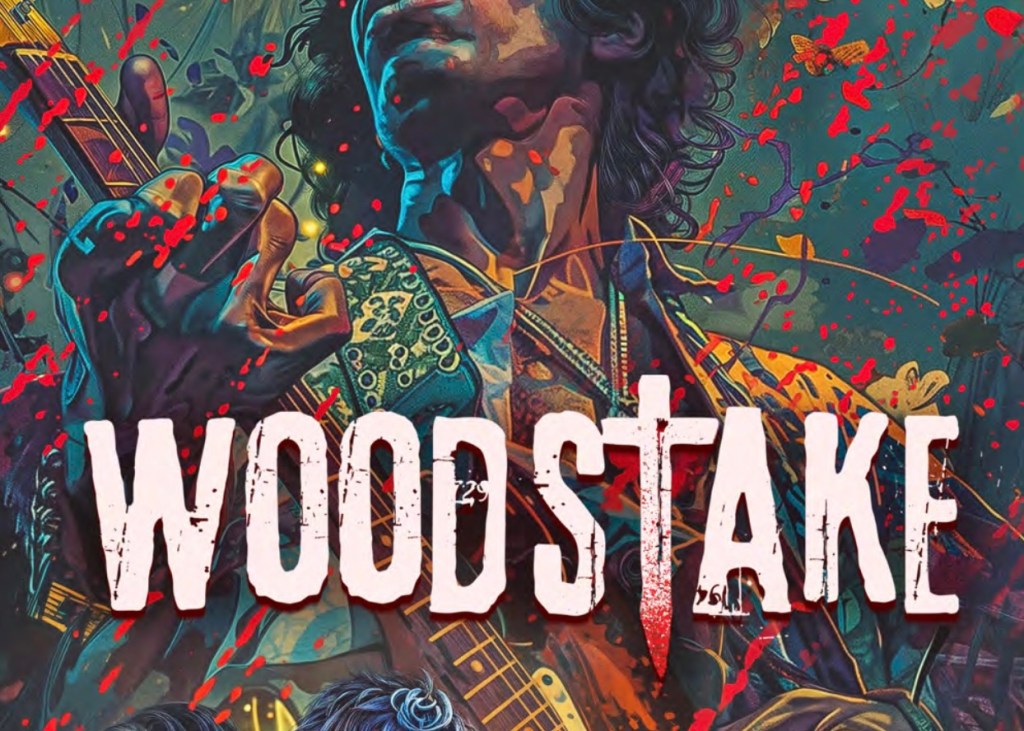
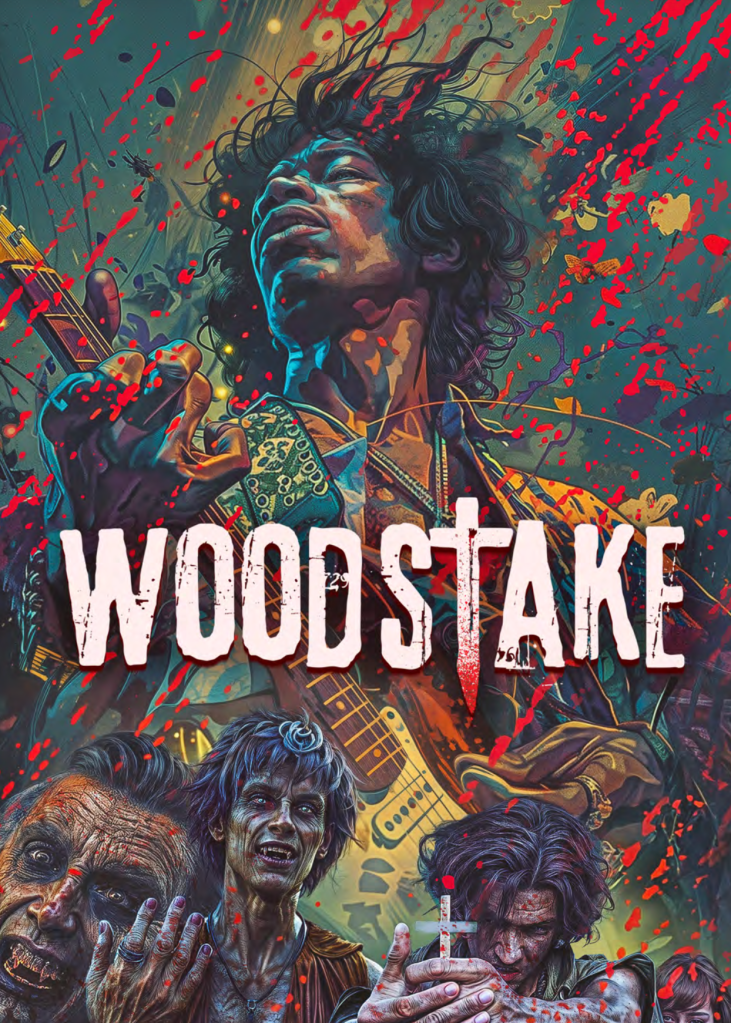


TL;DR: Woodstake is a grimy, overreaching, genuinely interesting collision of old-world curse horror and late-sixties American unraveling. Werewolves, bad vibes, doomed youth, and festival-era rot all get dragged through the same blood-mud. It is not clean, but that is part of its nasty, disreputable charm.

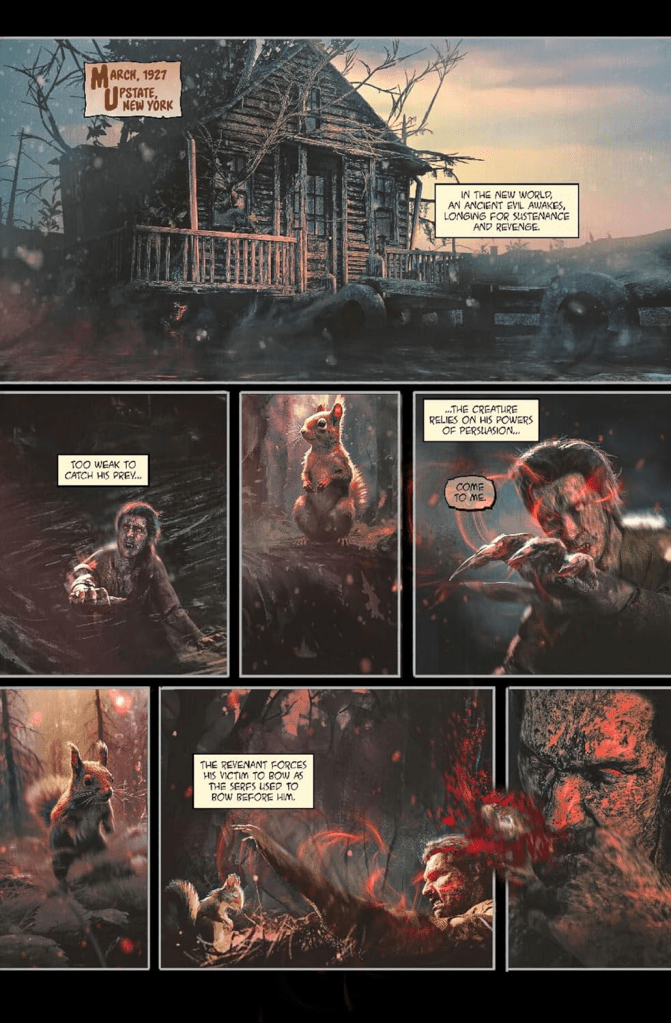
Woodstake is a full-on, shaggy, ambitious, overreaching horror comic that starts in 1927 with old-country curse rot and then spends the rest of its body trying to wire that rot directly into the American counterculture dream around 1969. The smartest thing Woodstake does is understand that “Woodstock but evil” is not enough. That would be cheap poster-shop bullshit. Darin S. Cape instead builds the book as an infection vector. The opening folk-horror material is not just lore slurry, but serves as seed material. A revenant/lycanthropic curse, a doomed young woman, a hungry creature, old-house rot, hunters, inherited fear, all that moonlit backwoods shit gets planted early, then the comic jumps decades forward and asks a better question: what happens when that same appetite reaches a supposedly liberated America full of music, youth, sex, antiwar anger, wannabe freedom, and enough chemical openness to invite the wrong god right in?
That is a real concept. It gives the book an actual heartbeat.
The chapter structure helps. You can feel the book widening from cursed-rural prologue into a road-and-scene comic, then into a crowded ensemble piece, then into something closer to a festival nightmare. Jonathan Harper, the young underground-magazine striver at the center of the 1969 material, is a useful protagonist precisely because he is not heroic in a square-jawed way. He is a drifter with ideals, ambition, immaturity, resentment toward the adult world, and just enough sincerity to get spiritually mugged by a story like this. The early San Francisco material, with the publishing hustle, rent pressure, family friction, Vietnam-era disgust, and yearning to get out toward Woodstock, gives the book social texture it badly needs. It is not just monster stuff. It is a comic about a generation trying to invent a new moral weather system while old blood logic keeps crawling up through the floorboards.
And that, for me, is where Woodstake gets its hooks in. The horror here is not simply “there is a beast.” The horror is contamination. Inheritance. The sick joke that liberation culture, with all its real hope and all its clownish self-mythologizing, turns out to be just as penetrable as everything else. The book’s best thematic move is making the counterculture feel vulnerable in its porousness. It believes in openness. Horror loves an open door.
Now, the bad news: Cape and Felipe Kroll do not always have the formal control to make that idea hit as hard as it should.
Kroll’s art is the book’s most divisive quality and also its main source of atmosphere. The painterly digital look can be gorgeous in a dirty way. When the comic leans into fog, moonlight, woods, bonfire glow, stage lights, smeared crowds, dead-eyed faces, and half-decayed bodies, it gets a genuinely weird storybook-from-hell texture. The prologue especially benefits from that instability. The creature work there has a feral blur to it. The woods feel conspiratorial. Some of the later festival pages, with people reduced to silhouettes, mouths, flames, hair, mud, and panic, also start to approach the kind of visual wrongness the book is aiming for.
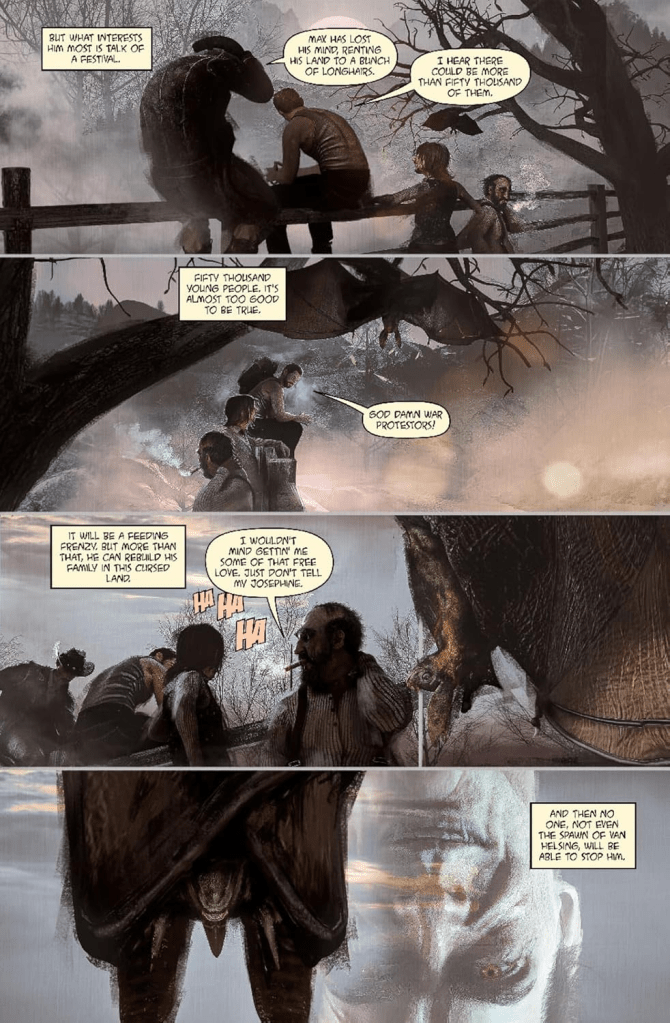
But the same visual method often works against the comic. Faces can get mushy. Spatial relationships blur when they should clarify. Some pages read less as comics pages than as illustrated incident summaries. That matters because this book desperately needs panel rhythm to carry fear, and too often the rhythm is just competent. Readable, sure. Occasionally handsome, sure. But rarely unnerving. The gutters move information. They do not often generate dread. For a horror comic built around infection, hunger, possession, crowd-energy, and bad transformations, that is a real miss. I kept wanting the page-turns to feel meaner than they are.
And then there are the captions. Oh boy, the captions.
This thing likes to explain itself. A lot. Sometimes that pulp voice works. Sometimes the book gets a little EC-by-way-of-drive-in flavor and I’m on board. But just as often the narration boxes do the exact wrong job: they clarify mood that should be emergent, state lore that should feel discovered, and generally keep stepping on the comic’s own throat. Horror comics need room for the page to whisper, or snarl, or just stare at you like something dead in a ditch. Woodstake has a bad habit of leaning over your shoulder and saying, “Just so we’re clear, this is ominous.” Yeah, man, I got it. Shut up and let the swamp work.
That unevenness runs through the whole book. When Woodstake is doing folk-malediction monster pulp, it has conviction. When it is doing counterculture ensemble sprawl, it has energy and thematic ambition. When it tries to fuse those modes completely, it gets more interesting than successful. The best version of this comic would have found a more original page-language for the 1969 sections: something more unstable, more intoxicated, more erotically doomed, more formally infected by crowd psychology and bad transcendence. Instead, a lot of the transitional and talk-heavy scenes play it visually safe. You can feel the bigger book trying to claw its way out of the one on the page.
Still, I do not want to undersell what works. The scale helps it. By the time the later chapters kick in, the book has earned some breadth. It is not just throwing a werewolf at Woodstock because that sounds rad as hell on a napkin, though, to be fair, it does sound rad as hell on a napkin. It is trying to connect old-world predation to American self-invention, family pressure, state violence, celebrity aura, communal longing, and the weirdly sacrificial undertow beneath “peace and love” iconography. That’s a bigger swing than most horror comics take. I respect the fuck out of the attempt even when the execution buckles.
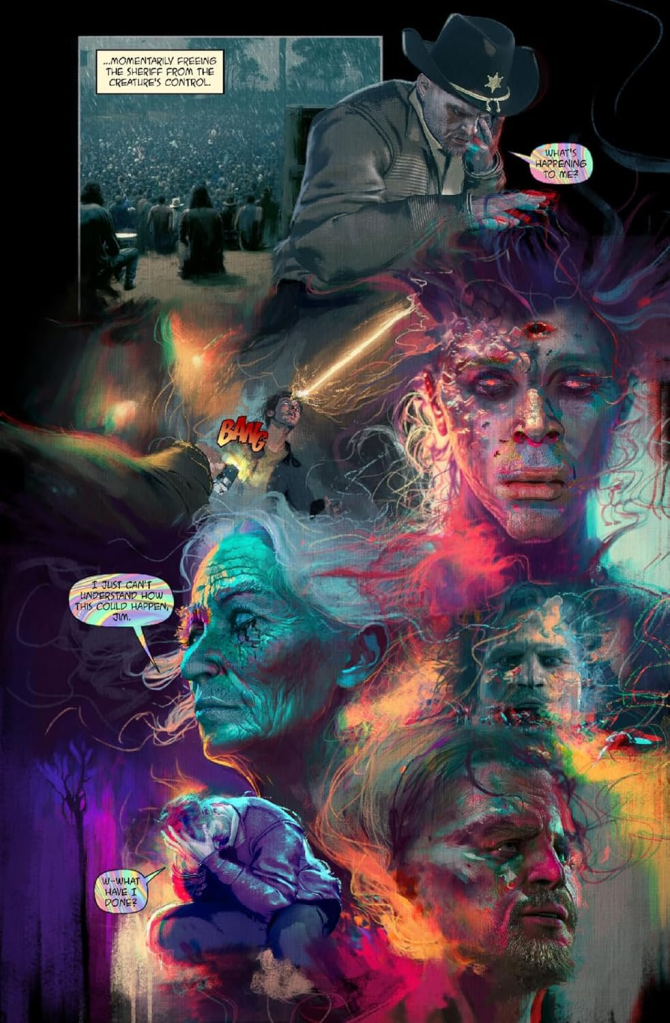
Lettering is functional. It rarely elevates the horror, but it does not wreck the reading experience either. In a book this visually smeared and tonally earnest, functional lettering is doing honest labor.
The ending, such as it is, is both a payoff and a limitation. This 182-page volume clearly wants continuation. It escalates, reveals, collides, and leaves you with fallout, but it is not the kind of ending that seals the curse into your ribcage and walks away laughing. It feels like the end of a major movement, not the final exhalation of a finished graphic novel. It’s a long first movement with real atmosphere, real thematic ambition, some nasty imagery, a strong central fusion of folk horror and counterculture collapse, and a recurring tendency to narrate over the very nightmare it should trust the page to perform.
So, Woodstake is too talky, too visually mushy in spots, and too conventional for how wild its core idea actually is. But it is also alive. It has stink on it. It wants moonlit curse-horror, doomed American innocence, festival delirium, and generational rot in the same bloodstream. That’s not nothing. A cleaner comic might be more polished. It would also probably be less interesting.
This one at least has the decency to get mud on the furniture.

Woodstake written by Darin S. Cape. Art by Felipe Kroll. Lettering by ES Kay. Published April 14, 2026 by SHP Comics.



Leave a Reply