







TL;DR: Blacktail is Watership Down with the mercy cut out and the teeth left in. Hawkins gives the animals a language, a grievance, and a theology, then lets them write scripture in blood and urine. It is funny the way the Old Testament is funny and merciless the same way. Amongst the best horror novels of the year, and the strangest.

The wolves in this book compose verse in urine and the verse is good. A lynx named Hate reads one such poem on the boundary of a wolf’s country in the first pages and sneers at it, because a lynx marks his ground with something like Mine, leave or die, and wolves have to make a production of everything, and by the end of the prologue there is a new mark on a rock in the lynx’s own valley and the lynx is not the one who wrote it. That is the whole method of Blacktail in small. Scott Hawkins gives the beasts a language, the language of the hunt, the one true tongue known to every creature that has ever eaten or been eaten, and then he lets them use it the way beasts would, and the reader who came for a talking animal story finds he has been handed a scripture.
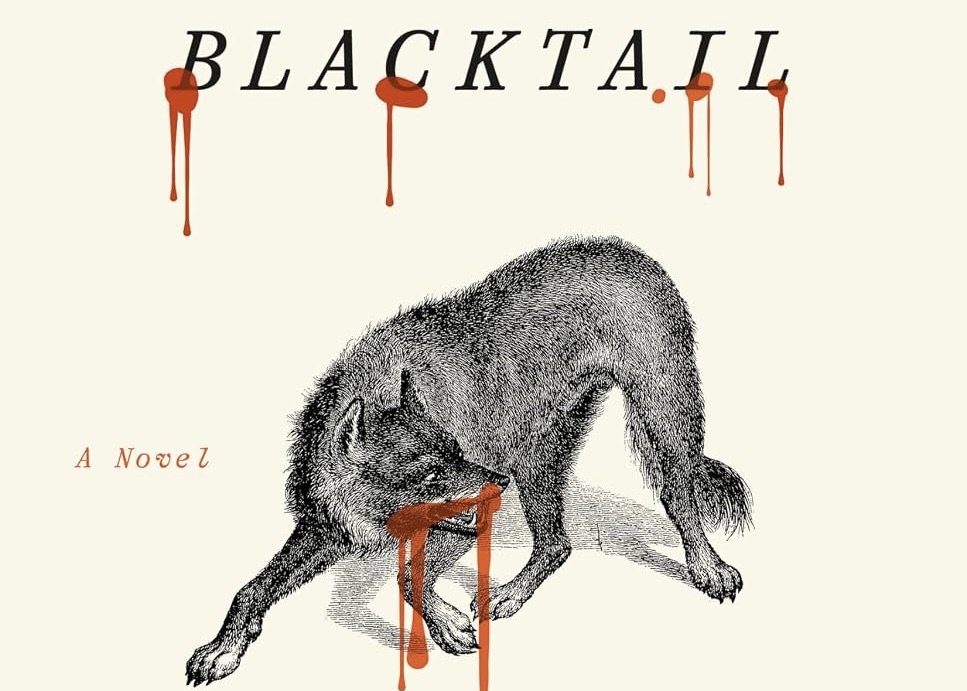
The wolf of the title is a halfwolf, last of his line on a nameless northern hill, his mother shot by hunters who took nothing from her body and left it to rot. Two years on, following a scent across the black road where the squirrels keep a death cult in honor of Car and their flattened dead line the shoulder, he comes to a black dog on a chain in a yard. Her owners put her in Car and take her to the den of pokes-with-metal-sticks and she comes home hollowed, and the book’s word for it is abomination, a sin against the hunt. What Blacktail does in the house after that is the premise on the jacket. What the book does with it is the reason the book exists. An ancient house cat, first among witches and long in traffic with hell, hears the thunder of his footfalls in the den of man’s pleasure and sends him south to find the Forest God, who has slept since before men gave their worship to a god of reason.
Hawkins writes plain. His sentences are short and unlovely and mostly true and he does not reach for the lyric when a beast can say the thing in six words. The beauty is in the vocabulary of the beasts, the book’s great invention: Car, House, gunshots, food-rocks, the metal birds, the waters-of-madness, the magic acorns that bring sleep. A highway seen through a wolf’s eye becomes a river of light that must be forded like water. A leash becomes a circle of stony gray earth traced in a yard, and beyond that circle all the world. Ordinary human objects arrive as atrocities. The author never says so. The reader has been made to stand where the animal stands and look up at them. It is the oldest trick of the beast fable, and Hawkins, who nods to Adams outright by way of a rabbit god’s name, takes it where it always belonged, which is horror.

And it is funny. The fact wants stating, because a book this pitiless has no goddamned business being funny and this one is, in the gap between the gravity of its subject and the fact that its prophets bear names like Snooky-Ookums and Miss Prissy Pants. The witch disciplines her cougar bodyguards with a spell called the Farts of the Dragon. A fox named Trap-Slipper waves his hindquarters at a truckload of bloodhounds and shouts insults about their mothers. None of this is relief from the horror. It is the horror’s other face. The rabbit dying under the lynx’s claw in the prologue makes a joke at his killer’s expense and then asks whether this is all there is, and the lynx says yes, it is hard, and snaps his neck. The book holds both registers in one paw and puts neither down.
When the dread comes it comes two ways. The first is the supernatural, and there is a sequence early on in which two bloodhounds are hauled across the threshold by a master who sees only blood and see what he cannot, a small annex of hell built from a charm of binding wound together with one of pain and one of forgetfulness, and a house cat on the windowsill licking his paw and explaining the workmanship. That scene is the coldest thing in the book and the cold comes from the cat’s courtesy. The second kind of dread is the plain kind, and it is worse. A dog driven out to a desert by the woman who fed him from her hand, certain for days that she would come back for him, learning that hell is hunger and then that hell is also burning and then that hell is also laughter. A hiker on a mesa telling the wolf that stalks her that he is a good boy, a nice doggie. Hawkins never escalates these. He sets them down the way he sets down rabbit dung on a trail and moves on.
Blacktail himself stays opaque even in his own chapters, a hunter who lost his taste for language early and is taken for thickheaded by everyone including himself, his eyes in the book’s own figure the flat surface of a lake beneath which much moves and is not seen. The book is built as a series of stations, a prologue and nine chapters with names like Dominion and Mercy and The Fire of God, each a fable complete in itself, and in the best of them the hunter is seen through the eyes of something that fears him or needs him or both. The pace is that of a walk south through a shrinking world, unhurried in the mountains and quick as a bite in the houses of men, and it does not sag. The one chapter that argues against the book, in which a fat beagle with a stump for a tail and a priest who is a terrier stand between the wolf and a woman who feeds the whole forest from her porch, is the best chapter in it, because Hawkins lets the beagle make his case in full and gives it weight. A lesser book would have cut that chapter. A lesser book would have needed its wolf to be correct.

Under all of it is the argument the witch makes to the wolf on a moonless night in the foothills, that the hunt is not a creature or a place but the thing that happens whenever one creature touches another, the feeding and the stomping both, and the argument a lesser cat makes to a severed head, that the hunt is eternal and can afford to be patient. The book takes this seriously as theology. It has a demon’s bargain and a crow who damned himself for his people and a god of lost things who comes to a lost child from under the bed, and it never winks. More than once the scale pulls back to eternity, to the sun gone dim and the last stars fading and a severed head still insisting that she was just a dog, and a chapter away a chipmunk is regarding a blueberry.
Scott Hawkins published The Library at Mount Char in 2015 and did not publish another novel for eleven years. That first book, about a girl and a handful of other orphans raised in a library by a man called Father and set each to a catalog, was called wholly original and resistant to categorization. The acknowledgments of Blacktail thank a houseful of dogs by name, the short-termers included, and the book’s tenderness toward starvelings makes more sense for it. But the telling detail is from an interview given not long after Mount Char, in which Hawkins described an earlier unpublished novel told entirely from the point of view of dogs and wolves. It was not quite hysterical animal rights propaganda, he said, but you could see the hysterical animal rights propaganda camp from there. Blacktail is that book come back with the propaganda burned out of it. It does not plead for the beasts. It gives them teeth and a god and lets them decide.
The grit in the meat is that the animals’ slang now and then runs a size too modern for the mouths that carry it, a sammich here, a my bad there, and that the last movement covers ground at a speed the earlier chapters did not train the reader for. These are small, the kind of thing found on a third reading, after the first two have gone by in a sitting each.
What stays is the mark the wolf leaves on the house before the snow starts, three lines that are the most frightening prayer in recent fiction, not quoted here because they should be come upon in their place. What stays is a rabbit under a claw asking if there is nothing more, and the answer he gets. What stays is the mark on the rock at the end of the prologue, written by something that was supposed to be a puppy. This is wolf land. None other may hunt here.
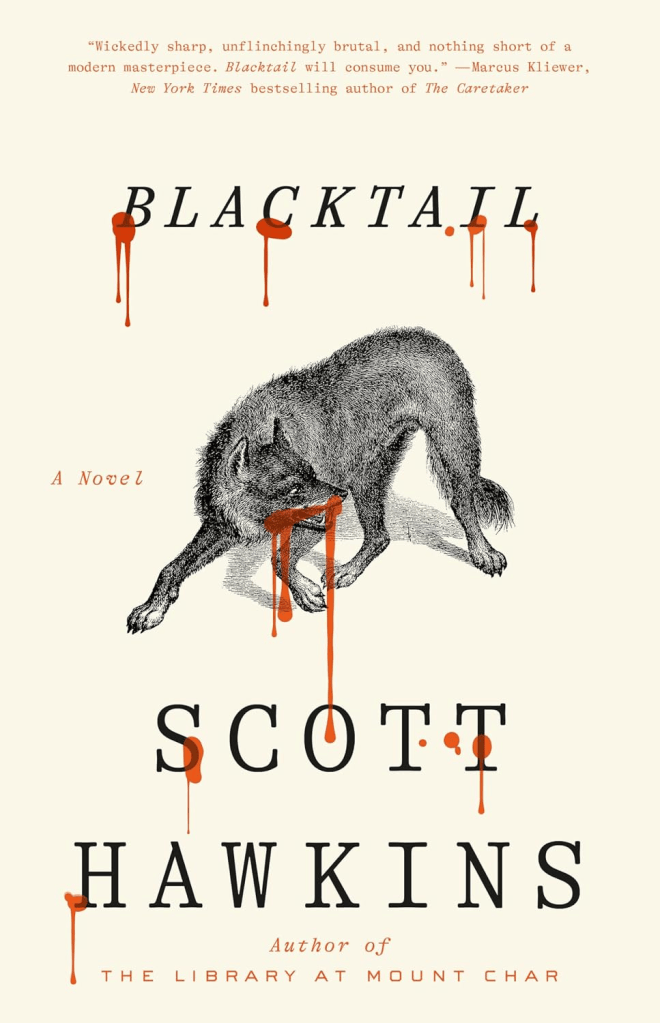
Blacktail by Scott Hawkins, published
September 1, 2026 by Crown.


Leave a Reply