
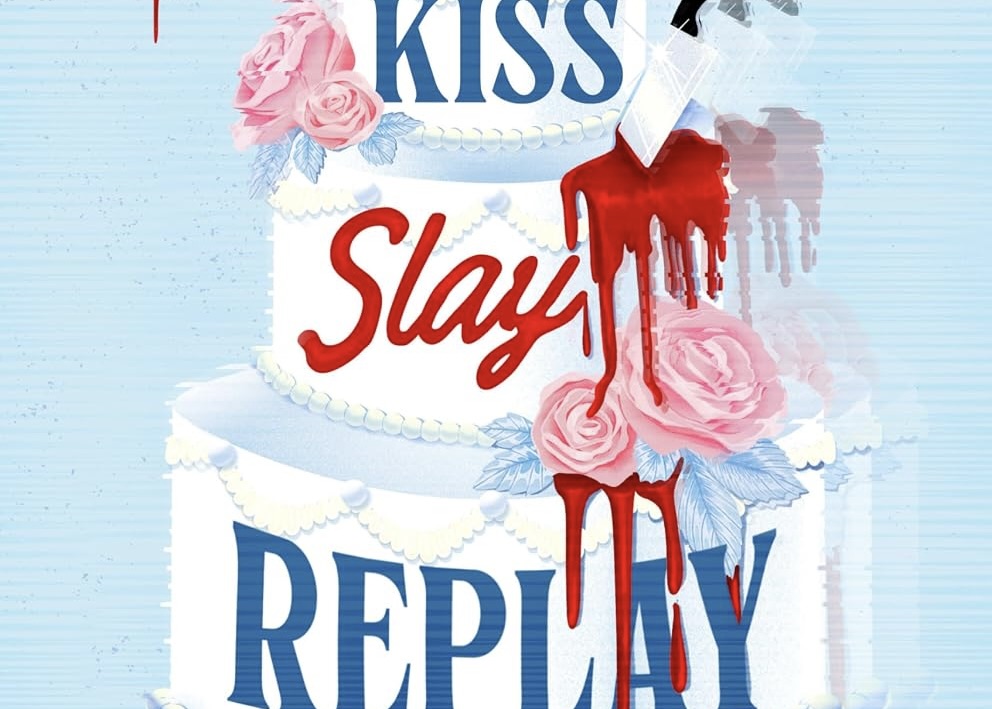
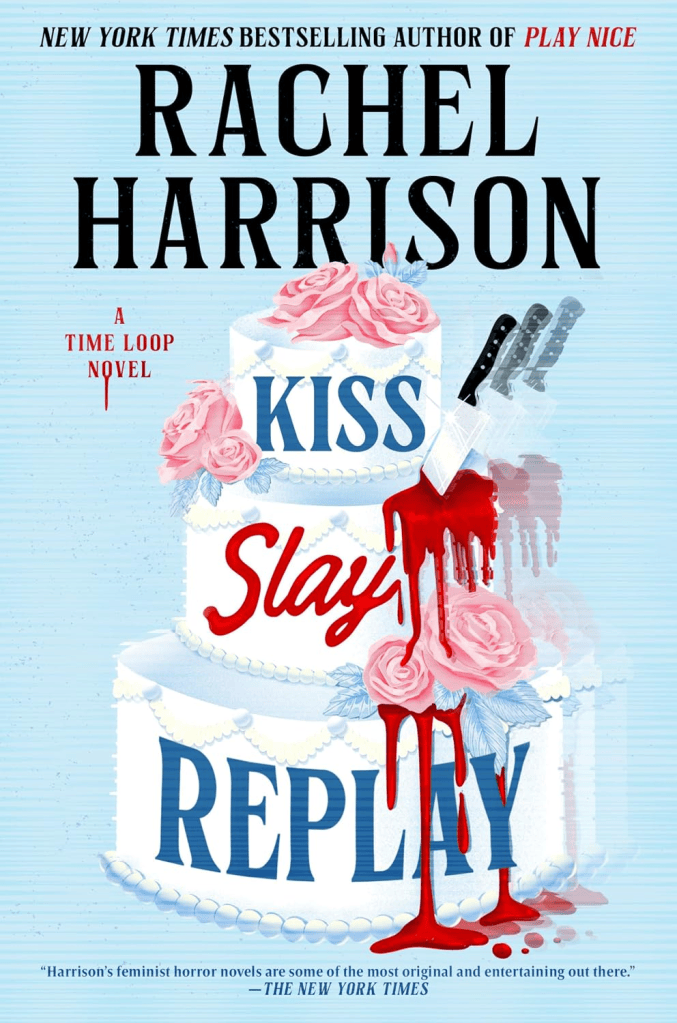





TL;DR: A wedding-weekend time loop in which a thirty-one-year-old woman who called off her own engagement dies at her best friend’s reception, wakes up on the same Friday, and dies again to a different monster each night. The friends are sharply drawn and the first killer is a real one, a man in a taped-up balaclava who keeps adding eyeballs to his mask. After that the book becomes a costume rack: it names every horror before the horror can touch anyone, kills the whole cast repeatedly at no cost, and hands its heroine a slogan instead of a wound. The acknowledgments call it a way of processing anxiety, and that is what it reads as. Fear the author controls is not fear.

Willa Ann Sullivan is thirty-one, newly single, and has just discovered that the man she left owned all the hangers. He owned the mirrors and the ironing board and the IRA too, but it is the hangers she keeps returning to, standing in a Jersey City studio with the six plastic ones she went out and bought and a dress for somebody else’s wedding that no longer fits her. His were velvet. She should have bought velvet. This is the register of Rachel Harrison‘s Kiss Slay Replay, and Harrison holds it for a good while: a woman who called off her own wedding weeks before the date, now building pitch decks for an actor’s tequila brand, feeding a cat who preferred the fiancé, and driving up to the Hudson Valley to watch her best friend get married at a renovated summer camp where the fiancé will also be, with a date.
The college friends arrive fully drawn, and I liked every one of them more than I liked the book. Cassie keeps her vape in her bra and her baby on her lock screen and sighs the way other women play the cello. Evan wears a bow tie to a campground and cannot whisper; the book says whispering is not among his many talents and then is honest enough to prove it. His husband Wyatt is six foot five in flannel and approaches a necktie the way a bear would. Luke does a backflip off a folding chair at the ceremony. And there is Danny, the groom’s rich boyhood friend, who drinks from a flask in the woods and keeps tucking his hair behind his ears so it can fall out again, and who, asked what he is doing out there, answers, “Satanic shit, mostly.” The venue used to be Camp Serling. Later Willa will say she feels trapped in the twilight zone, in case the name went by you.
The first night belongs to a slasher, and the slasher is good. He wears a balaclava with duct tape over the mouth and a red smile drawn on the tape with a zipper for teeth, and above the eyeholes he has stuck a pair of plastic eyeballs from a Halloween bin. Every time Willa sees him there are more of them, and by the end of the night they are not plastic. He carries a bowie knife and a hammer and a pair of pliers on a belt, like a man who came to hang drywall. He does not run. He waves. When he finally has his hand around her throat what he says is “I see you,” drawn out long, and she dies with the point of his knife between her eyes, and then she wakes up in Jersey City and it is Friday.

What follows is the book’s idea, and it’s a decent one. The day comes back but the monster does not. The second night is a man in a top hat with a pocket watch and a flock of ravens, and after that Willa works her way down the shelf at the video store, a genre a night, announcing each one out loud when it arrives the way a waitress reads the specials. Harrison has built a career one monster per book, the witches and then the werewolves and then the vampires, two of them subtitled so you would not mistake the animal, and here she hangs the whole closet on a single weekend. It is a costume rack. Nothing on a costume rack fits anybody. She also reprints her own first act, much of it word for word, three and four times over, which the loop excuses and the reader pays for.
I grew up around women who could tell you everything wrong with themselves before you had your coat off, and it took me years to understand that the recitation was a lock and not a confession. Nothing you said afterward could get in. Willa is of that species. “Maybe I’m hopelessly self-involved. Maybe I’m jaded. Maybe I’m depressed. Maybe I’m dramatic,” she says before the first chapter is out, and the book agrees with all four and considers the matter closed. She names her feelings before they can act on her and she names her monsters before they can touch her. By the middle of the book she has learned to tell Danny she is not looking for anything serious before he can tell her, and this is offered as growth. The prose runs on the same engine, present tense, in fragments, four rhetorical questions to a paragraph, everybody talking in the cadence of a podcast about boundaries. Willa dissociates. She has trauma bonded. The wedding is Pinterest Live. There is a real novel buried here, about a woman whose fiancé spent eight years telling her that things were in her head and who now wakes up every morning inside it, and Harrison walks past it on her way to the next creature. When Cassie tells her, “Willa, honey, you are in a hell of your own making. Is it hot?” and Willa answers that it is scalding, it is the best exchange in the book, and it is a bit.
Then the violence. It is gruesome, and I have no quarrel with gruesome. Eyes go. A throat opens far enough that Willa can report what is inside a neck. A man is taken apart on the dance floor during “Come On Eileen,” and Harrison has a sharp ear for the DJ. The trouble is that none of it costs anything. Steph dies on the floor of her honeymoon cabin with her eyes scooped out, and a couple of mornings later she has them back and is second-guessing the lavender. Wyatt takes a knife to the back of the skull and needs help with his tie again by two in the afternoon. There is one true moment in the whole slaughter, Evan on his knees in the grass refusing to leave his husband, putting a kitchen knife in the killer’s calf and telling Willa, “Run, you dumb cunt,” and the book gives it a paragraph and resets it. Violence that opens nothing is a screensaver. You can watch it for hours and it will never ask a thing of you, and Willa watches it for a week and walks out with a slogan.

The slogan is “the only way out is through.” Cassie says it, Willa says it back, Evan very nearly says it, and by the acknowledgments it is being said to you. Robert Frost gave that line to a farm wife in “A Servant to Servants,” a woman worn to a nub in her own kitchen, from a family that kept a madman in a cage in the attic. Here it is stitched on a pillow. The acknowledgments explain that the novel was written to process the author’s anxiety and depression, that the feelings are valid but “not unconquerable monsters,” and they close with a winking emoji. I do not doubt a word of it. I only note that a coping mechanism is something you do to yourself and a novel is something you do to someone else, and this book cannot tell the two apart. Its ear is a wedding DJ’s ear. It knows exactly what everyone will sing along to.
Harrison is a New Jersey native who studied writing for film and television at Emerson and worked in game shows, publishing, and a bank before The Return came out from Berkley in 2020 and picked up a Bram Stoker nomination for first novel. A book a year since. She has said the drama comes first, “there’s an issue or some question I have in my life that’s gnawing at me, and then the right supernatural element will present itself,” and she told an interviewer this month that this one started with a Blink-182 song and that she never thought of it as a slasher: “I was more concerned with the internal.” “On the page,” she says, “I control the fear. It’s catharsis.” Fear you control is not fear. People who loved the earlier books will love this one, since it is all of them at once.
The killer’s line is the book’s line, and the book knows it. “I see you” travels from the mask to the friends to Willa’s own mouth, until being seen is the one thing the entire novel is asking for. Her friends see her, or say they do. But the only person in this book who ever looks at Willa with total attention, who does not sigh or check his phone or steer her toward the bar, is the man with the eyes taped to his face. He waves. He takes his time. He tells her he sees her and he means it. She dies with his knife between her eyes and wakes up asking everyone else for the same thing.
Kiss Slay Replay by Rachel Harrison, published September 1, 2026 by Berkley.


Leave a Reply