
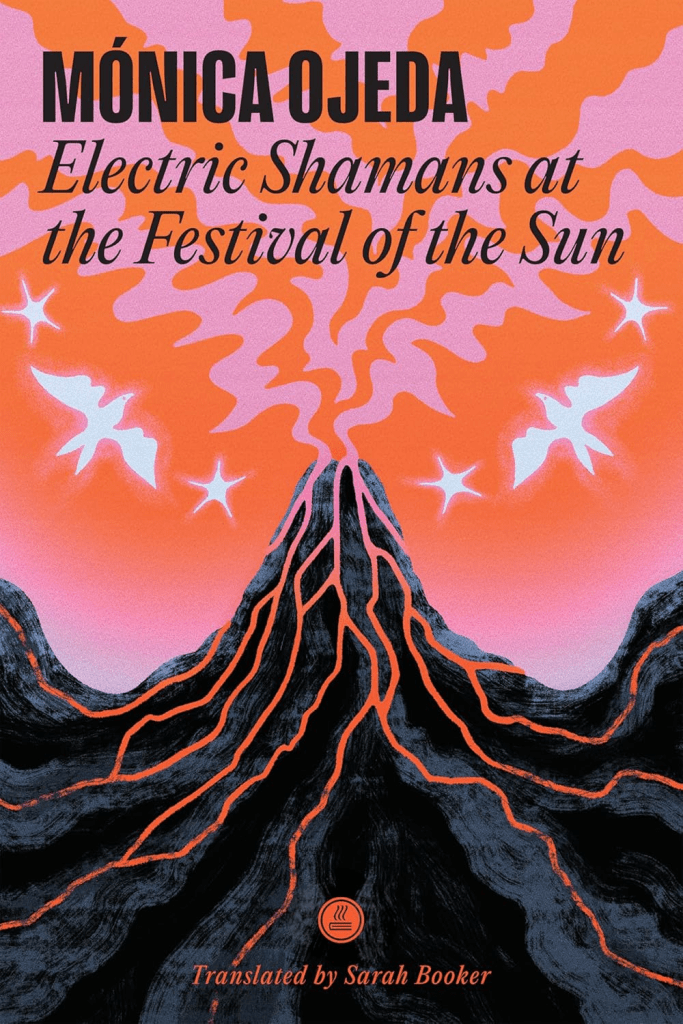







TL;DR: Mónica Ojeda’s Electric Shamans at the Festival of the Sun is contemporary gothic dragged through ritual fire and returned to you scorched and singing. Poetic, vicious, and culturally specific, it turns hunger, sound, and myth into a living engine of dread. Not cozy, not timid. A true standout that sticks in the gut.

There is a moment early in Mónica Ojeda‘s new novel where a yachak, the Andean shaman who knows, sits in a tent at a music festival on the slopes of Chimborazo holding a bear skull and playing chess with a blind girl on a Looney Tunes board. The casualness of the image. The specific cartoon. The volcano breathing somewhere outside the tent flap. The book is built out of these collisions. Ojeda has come up out of the dark academic interiors of her last novel into the open air of the páramo to write a book about two friends who run away from a coast city full of decapitated bodies to attend an experimental music festival on a volcano, where one of them is going to find a voice she does not entirely come back from. It is a horror novel, though the horror is less about anything specific that arrives and more about the rate at which everything keeps arriving.
Ecuador in this book bleeds hourly. Eighty-eight murders in a week. A man’s head floating in a canal called Death Canal. Two girls find a corpse on the way to a party and dance over the spirit of it. The mothers are organizing into neighborhood watches and learning to shoot. The gangs spell themselves on the walls. Choneros, Lobos, Tiguerones. Inti Raymi is approaching, and the volcano in the east has erupted, and birds are raining down a hundred and seventy-five kilometers away, and Noa and Nicole leave Guayaquil for Quito on the assumption that any direction away is up. The festival is called Solar Noise. It traffics in technoshamanic poetry, in drums sewn from goatskin, in shrunken heads inherited from a great-uncle who sold curios to Europeans in the previous century. Some of the people who go up there do not come down. The disappeared, they are called, said to live in self-governed valleys above the world.
Noa is the absent center. She gets no chapter, ever. She is rendered always from outside, and Nicole watches her change while Mario the Diabluma dancer who calls his rage his red devil watches her, and Pam the pregnant drummaker who is bigger than most men watches her, and Pedro the rock collector who hears singing inside igneous stones watches her, and a chorus of women called the Songstresses break across the chapters in unattributed lyric like weather. By the time the group is climbing El Altar to perform Inti Raymi at a crater lake the question of what Noa is becoming has been refracted through enough listeners that the answer no longer matters. She is what they hear.
This is the work of the Latin American polyphonic novel, the line that runs from Rulfo through the Boom out into Bolaño and Schweblin, an absence at the center and a chorus around it. Ojeda has done this kind of thing before, in Mandíbula, with adolescent girls in a closed room. Here she is doing it at altitude. The prose accretes. Phrases return like ritual. The ear is the organ of fear, the Yachak says, repeating Nietzsche and not crediting him. Pam’s chapters run breathlessly down the page in single sentences that braid fucking and pregnancy and goat slaughter and Lhasa de Sela without bothering with periods. Aloud, Pam sounds like a person. On the page, thirty pages of her in a row, she starts to sound like a person being transcribed by someone who cannot stop transcribing.

Here is the criticism. The chamanic register runs hot. The Poet, that drunk maestro of ancestral cli-fi who functions less as a character than as a public utility for the novel’s themes, says some version of music is the rebellion of our inner life or the song of the dead is the song of the living, and Ojeda lets him say it again two chapters later, and the Yachak says a version of it, and Pam says a version of it, and you start to understand that the book is going to keep hammering this nail until the wood splits. The Songstresses interludes, italicized, untethered from any speaker, are the book at its most weatherlike and at its most diffuse. Four pages of pure incantation will pass and you will feel them and afterward you will not be able to recall a single image from them. A handful of supporting characters, Adriana and Julián and Fabio, never quite step out of the smoke. By the time the company is climbing El Altar in storm and Diabluma masks the metaphor of music as resurrection has been articulated in so many mouths that one wishes the book trusted its atmosphere a degree more and its theses a degree less.
The cost is real. It isn’t fatal because Ojeda has built it into the design. The book is meant to wear you down. By the festival’s third day the prose is exhausting on purpose, and what was excess becomes accumulation, and what was repetition becomes ritual, and the reader who hangs on past the point where they think they should hang on is the reader the book is for.
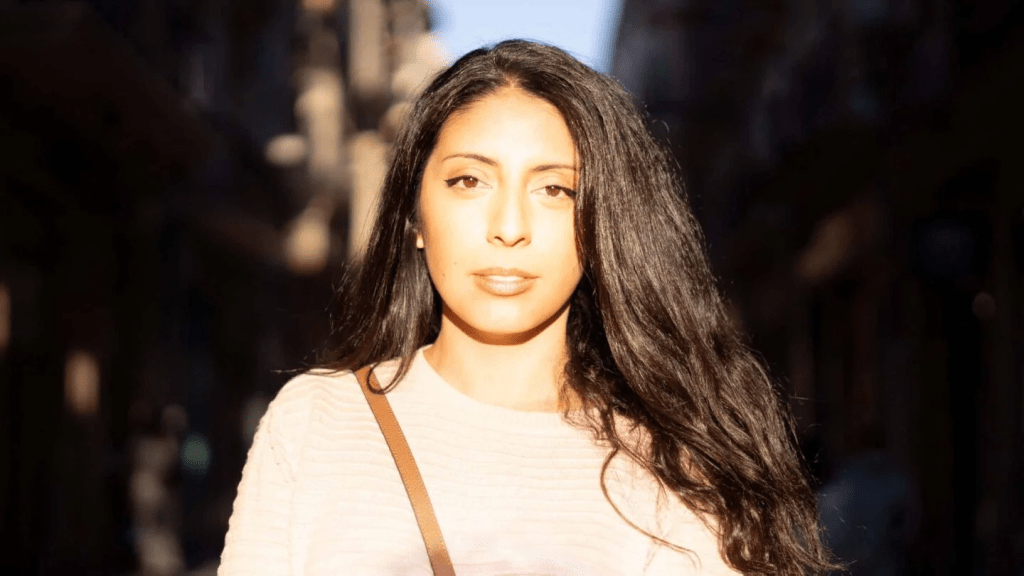
Mónica Ojeda was born in Guayaquil in 1988 and now lives in Madrid. She is the author of four novels, including Mandíbula, translated as Jawbone in 2022 by Sarah Booker for Coffee House Press and a finalist that year for the National Book Award in Translated Literature. Before Mandíbula came Nefando in 2016, a novel about an obscure dark web video game, and La desfiguración Silva in 2014. She has published two collections of poetry and a story collection, Las voladoras. She was named to the Bogotá39 list in 2017 and to Granta’s Best of Young Spanish-Language Novelists in 2021. She received the Prince Claus Next Generation Award in 2019. Her arc has been a steady rise in the Spanish-language firmament and a steady migration in subject from the dark interior corridors of girlhood toward something larger and looser, more topographical. The critics are calling it Andean Gothic, and they are not wrong, though the label is doing more work for them than for her. Sarah Booker translates her again here, with the same near-invisible competence she brought to Jawbone. The English carries the strangeness without flattening it, which is the second hardest job in literary translation. The hardest is what Ojeda is doing in Spanish.
The horror is geological. The volcano is a body whose arteries the characters move along. A mother tells her newborn she is cursed before the girl is out of her arms. A man in the Tixán forest weeps on the body of a shot mare for hours while his small daughter waits on a rock for him to come back to himself. Years later that man will go to live alone in a high forest with his dogs and his guns and his own mother’s ritual songbook and a locked room full of her chimerical taxidermy, half fish half bird mermaids holding charangos, alpacas with tortoise shells and duck feet. He will write notebooks. The notebooks are the second voice of the novel and they are its best section. Older, drier, scriptural where the festival voices are oracular. Broken into prose and indented fragments that read like the marginalia of a man who has decided to translate his life into Latin and stop making sense to anyone else. Read them after the chorus on the páramo and you feel like you have come inside out of a storm.
I will not say what happens at El Altar. The book will not let me. The climb is conducted under storm, in costume, with the Poet directing traffic, and the final pages of the festival sequence exhale.
Beneath all the shamanism, what the book is finally about is the human voice. Or rather: what people in collapsing places have to do to keep finding new ones. There is a song the dying grandmother sings in the high forest, and the granddaughter she never met, asleep down the mountain, sings it back without having ever heard it. The book asks whether any of that saves anyone. The dead sing through the living and the singing is not an answer. That there is singing at all is what Ojeda offers in the place of one.

Electric Shamans at the Festival of the Sun by Mónica Ojeda, published May 12, 2026 by Coffee House Press.



Leave a comment