
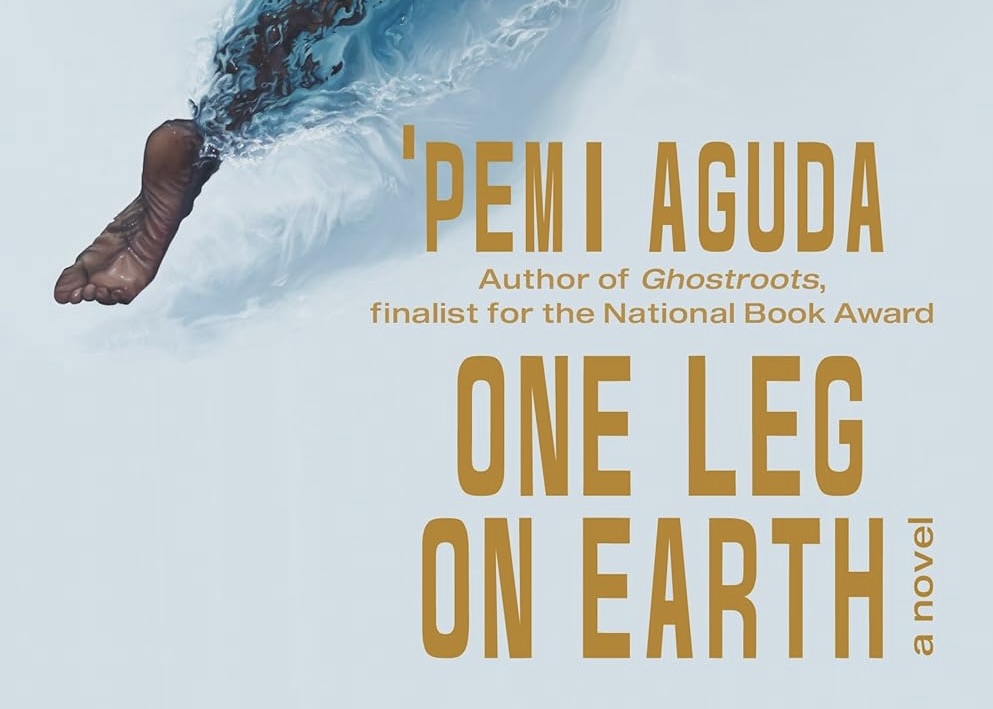
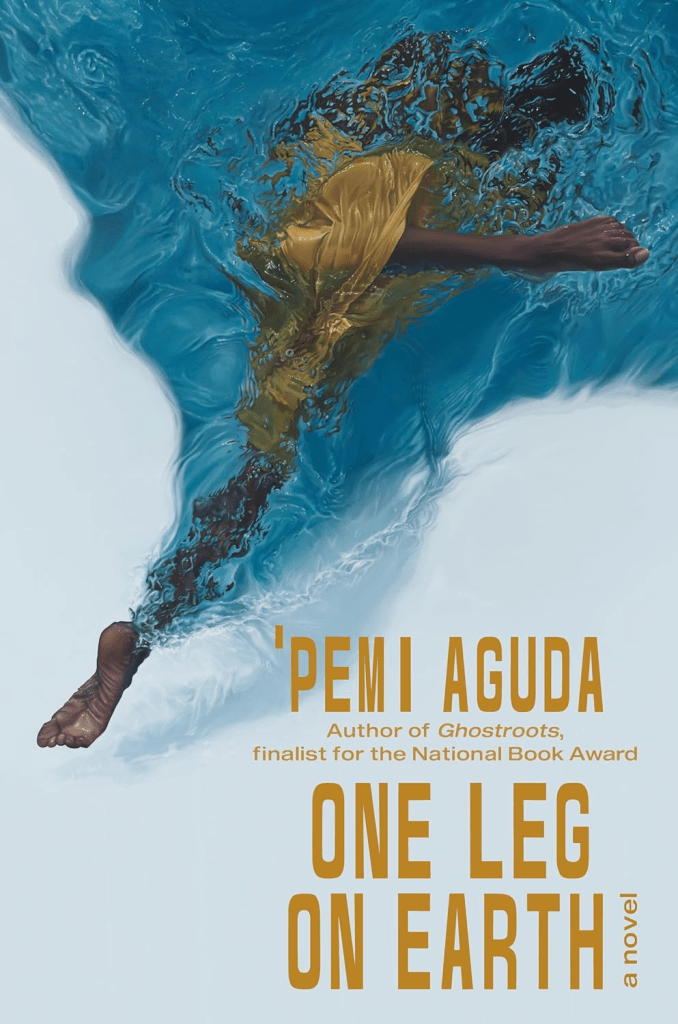







TL;DR: A pregnant woman dances off a Lagos bridge in the first six pages, and ‘Pemi Aguda spends the rest of this short, sharp debut novel making you understand why. One Leg on Earth is the rare horror book that opens a question instead of closing one. A Lagos novel, a daughter novel, a haunting.

A pregnant woman dances off the Third Mainland Bridge in the first six pages. Her name is Miriam Aiki. She has prayed thirteen years for the child she is carrying, the kind of prayer that takes the skin off knees. Now, in stalled Lagos traffic on the way to a cousin’s wedding, she is laughing at a joke nobody else can hear. She kicks off her fuchsia slingbacks. One heel strikes the bonnet of her husband’s car. She skips between idling vehicles, screeching and twirling, and goes belly-first into the lagoon, “like a child jumping into the arms of a beloved parent.” ‘Pemi Aguda writes this scene the way you would write a wedding: with attention, with affection, and with one short clean sentence at the end of it. Five pages in, the book has already shown its hand.
Here is the rest of the hand. A young woman named Yosoye Bakare, twenty-three years old, mass communications degree, only daughter of a withholding mother in Ibadan, arrives in Lagos for her NYSC year. She acquires, in short order, a one-night-stand pregnancy and a make-the-coffee job at the architecture firm developing Omi City, a luxury reclaimed-land project the firm has dredged out of the Atlantic. Pregnant women across Lagos, meanwhile, are walking into water. The architect-in-chief calls Omi City a pure blank slate, which is bullshit; something was scraped off to make it, and the women in the water and the people in the ground are working the same side of an old grievance. None of this is hidden by the author. She wants you to do the math out loud.

What earns the conceit, sentence by sentence, is texture. Aguda is the kind of writer who makes a reviewer retype passages and stare at them sideways. A purple stuffed elephant whose head, at some shift in air, falls forward drunkenly so that it watches its own buttonless navel. A keke driver with a cigarette held in his lips, never lit, while he tells a story so heavy he forgets to. Spices stolen from a mother’s pantry that, on the bus from Ibadan, collide and borrow each other’s flavors, so that the curry now carries the sneeze-inducing sharpness of Cameroon pepper and the thyme container is haunted by iru. The horror comes the way the spices do. There is no thing under the bed. There is the smell of brine in an office bathroom where no brine should be. There is the slosh inside a head. There is, once, a procession of three women slathered shoulder to thigh in wet mud, walking past the gates of the new city while a security guard panics; we are told later, almost in passing, that this is an old gesture, that Asaro warriors caked themselves in mud to lie down on riverbanks and rose in the morning looking like ghosts, that women in the old country wore mud to refuse a marriage and demand a canoe back. Aguda gives the image and the footnote and walks away.
The book is also, in long stretches, very funny, and the joke is not on Yosoye but adjacent to her. She has read internet articles about how to make friends in a new city. She works hard at maintaining eye contact at the recommended intervals. She announces her pregnancy to a woman she has known for fifteen minutes because an article promised that disclosing personal information forms intimate connections. She is a girl trying to become a person from instructions. Aguda renders this without contempt, which is harder than it looks.
The mother in Ibadan is a different kind of accomplishment. Olabisi sews boubou after boubou in the light of three candles and a rechargeable lantern, looking up only when she is startled to remember she is not alone. Her apologies, when she gives them, arrive like neatly typed memos, which is the worst thing apologies can do. She is one of the truest portraits of a particular kind of withholding parent, and the novel quietly bets its emotional ending on her.
Some midbook stretches where Yosoye scrolls through fictional comment threads read like a writer typing out her research in front of you. Beloved, the bald artist with a crushed cheekbone and a thesis that there is art in death, gets set up with real interior and then in her final scene functions as an argument; you can hear the gear shift. The architect villain talks the way architect villains in novels talk. The book’s title concept, “one leg on earth, one leg in heaven,” is delivered out loud in a single conversation by, of all people, the architect, which is a thing fiction sometimes does and shouldn’t. These are small fines for largeness of ambition. They do not undo what the book has done.
What it has done is what horror is supposed to do, which is open something rather than seal it shut. The mythology Aguda is reaching for, water spirits, drowned mothers, the displaced of an old waterfront pulling at the ankles of the new development, is doing the work that a more explanatory book would have ruined. Yosoye is acted on by something that is at once inside her and outside her, at once her own loneliness and a register of an older grief, and the question the book leaves you with is whether those two things are even separable, in a city built by erasing the people who used to live there.
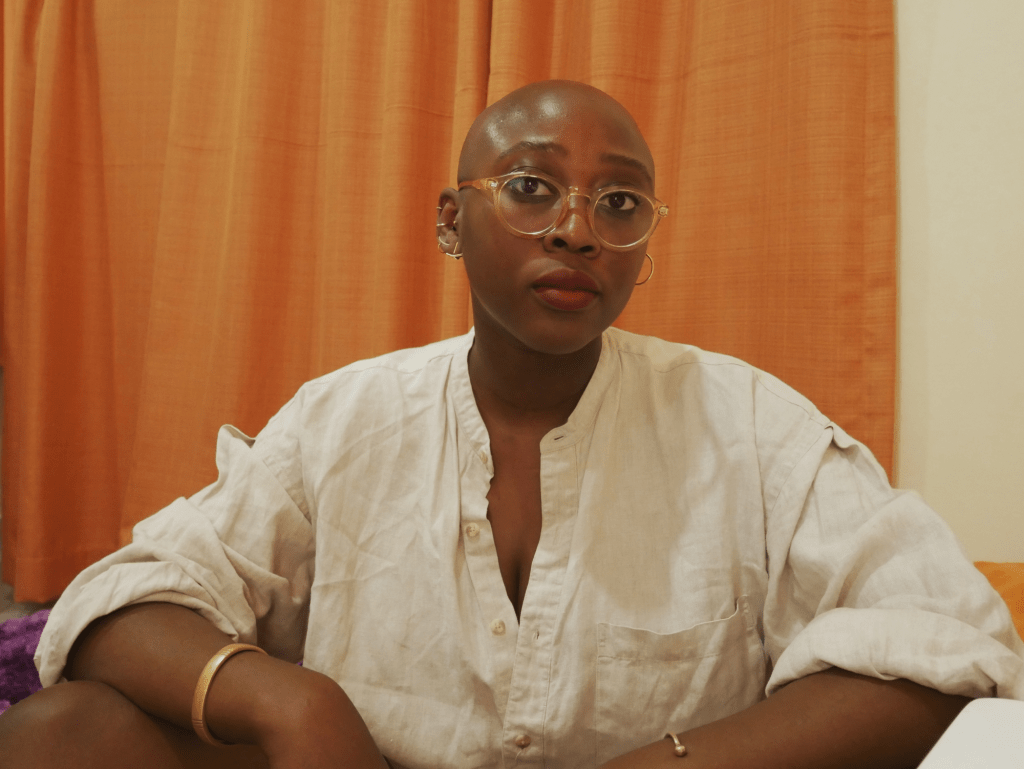
Aguda trained as an architect in Lagos before she did her MFA at the Helen Zell Writers’ Program at Michigan. Her debut collection Ghostroots was a finalist for the National Book Award, the PEN/Faulkner, the LA Times Book Prize, and the World Fantasy Award; it announced her as a stylist with a finished sensibility, which is a rare thing in a debut. The acknowledgments to this novel name a 2018 research grant that took her home to interview elders from the Otodo Gbame community whose waterfront homes had been demolished by the Lagos state government, and a 2021 fellowship that put her under the mentorship of Edwidge Danticat. The displaced waterfront in this novel has a different name on the page, but a reader who has read the news from Lagos in the last decade knows the name it answers to. Aguda also notes, at the end, that she lost her father in April 2025; the book is dedicated to outsiders. The closing line of her acknowledgments insists, “There is no darkness in my fullness.” The novel has spent most of its pages disagreeing with that sentence. The acknowledgments page is where she replies to it.
One Leg on Earth is short, just under two hundred pages, and it is the right length for what it does. It is a horror novel in the lineage Victor LaValle named in his blurb, which is the right lineage. It is also a Lagos novel, a daughter novel, and an architect’s novel about the specific trick of designing something so beautiful that you forget what was scraped off the seabed to make it. It is the kind of book that makes you walk past a construction site afterward and want to know what used to be standing there, and who. That is the work good horror is supposed to do.

One Leg on Earth by ‘Pemi Aguda, published May 5, 2026 by W. W. Norton & Company.



Leave a comment