






TL;DR: A kidnap thriller wearing folk horror as a coat, infested with fungal damp, surgical dread, and one image involving hair that will live in your throat for days. Pearce writes with muscle and music and the nerve to go straight at what scares her. Uneven in the middle, ferocious at the edges. The British horror writer to watch.

Daisy Pearce‘s fourth novel opens in hell. Specifically, in a childhood bedroom in October, with a hangover and a divorce and a mother at the window holding a brown envelope. Hazel Maddon is thirty next month. She has come back to the small Cornish town of Idless to housesit for her parents and to start over and to drink less, in approximately that order. By page ten she has poured the last of her gin down the sink. By page twenty she has called the sister she has not spoken to in five years. By page fifty she is in the cellar of a man she met at a bench, and the door is locked from the outside.
Pearce understands that the difference between a divorced woman in her thirties having a bad October and a horror novel is one bench, one stranger, one truck.
I am a sucker for a hot opening and Pearce gives me one. Hazel waking up with the Backstreet Boys still taped behind her vanity mirror, two Persian cats named Conquest and Celeste underfoot, the particular grief of moving back into the room you slept in at fifteen and finding it both exactly the same and entirely repainted. By page ten you know everything you need to know about this woman without being told any of it. By page fifty you understand that the cellar she ends up in is probably less haunted than she is.
Dark Is When the Devil Comes is a kidnap thriller wearing folk horror as a coat. Or the other way around. Hazel is a mycologist, an amateur, the kind that carries a 1980s field guide given to her by her ex-husband, annotated in the margins to the point of being almost illegible. She knows fungi the way some people know wine. She tells a man she has just met at a bench in the town square that she is hunting for a fungus called devil’s fingers. Red and pointy. Smells like rotting flesh to attract insects. The man is Andrew Garrison, fifty-something, gap-toothed, broken-nosed, sallow, charming in the way that men whose lives have not gone the way they wanted are sometimes charming. Hazel thinks, in plain print on the page, that this man probably wants to kill her. She gets in his truck anyway. Pearce makes you understand why, which is the harder fucking thing.

Behind every bad decision Hazel makes there is a brown envelope on the kitchen counter, a sister she has not spoken to in five years, and the surgical scar on her lower back from a tumor removed when she was a child. The grief of it adds up to a woman who would rather be killed by a stranger than be alone with herself. Pearce does not say this. She lets you do the math, and then she is generous enough to let the math be wrong.
The captivity setup that follows is the part I had read before. Water-stained mattress, blue cellular blanket, bucket with a towel over it, the name Diana scratched into the window from the inside. We have all met this cellar. What surprises is what Pearce is writing underneath: a folk horror novel about something teratoid and patient that has been with Hazel since the operation, riding her, eating her, that turns out to be considerably more than metaphor. The horror, when it arrives, arrives by way of hair. Not blood. Not bone. Hair. Long, wet, black, unbraidable hair, knotting in places hair should not knot, coming out of mouths and walls. There is one image in this book involving hair that… yikes. You deserve to meet it the way I did. I felt it in my throat for three days.
She is unfussy about the body, Pearce, and unfussy about the natural world, and the two keep crossing each other in her sentences. Damp earth bristling with inky-black mushrooms over graves you have not yet been told about. A weather vane shaped like a conger eel turning in the wind. Hazel says of an abandoned farmhouse that it smells like the water that collects at the bottom of vases, old fishtanks coated with algae, and you know exactly what she means. The book is best when it stays inside this contradiction: that the rot is also the bloom, that the woman with the surgical scar is also the thing being grown by the scar, that the predator at the kitchen sink can deliver a sentence about houses and foundations that is probably the wisest line in the novel and is therefore the one that hurts the most.
The structure is the gamble. Three women alternating points of view: Hazel in the basement, her sister Cathy outside trying to figure out where the hell she has gone, and Suzie, an old school friend, now married to a dentist called Teddy, scrubbing her hands raw at a pharmacy the new shopping center is bleeding dry. When this works it works the way good triple POV thrillers work, which is that rescue keeps coming and not coming and coming and not coming. When it does not work, which is most of the middle third, you feel the architecture instead of the story. Suzie has a subplot I kept losing the thread of. Cathy makes a decision involving a man at her front door that no woman who has lived in the world for ten minutes would make, and the book knows this is a problem and gestures, late, at a thematic argument about women trained out of saying no. The argument is real. The argument is good. The argument is doing more goddamn load-bearing than it can hold.

When Pearce commits, though, she commits all the way. The climax does not flinch.
Pearce was born in Cornwall, lives in Lewes, works in a library. She read Stephen King’s Cujo too young and grew up on a smallholding surrounded by hippies, which is the kind of biographical detail you would assume a marketing department invented if it were not true. This is her fourth novel. The first two, The Silence and The Missing, came out together in 2020 from Thomas and Mercer, with The Silence going to number one on the UK Kindle charts and The Missing longlisting for the Mslexia Novel Award. Something in the Walls landed last year from Minotaur, picked up a Library Reads slot, and got a Fangoria notice describing her sentences as weapons. You can feel a writer here who has been at this awhile, who knows what scares her, and who has the nerve to write straight at it.
This is not the great one yet. The good in it is very good. The saggy parts are saggy in the way another draft might have caught and a sympathetic editor probably should have. If you came to the woods looking for hair, the book has hair to spare. If you came for a kidnap thriller, the book has that too, more or less. If you came looking for a writer with the beginnings of something nobody else in the British horror space is doing right now, that is the part that stays with you.
The good in this book is the kind of good you remember. The rest is the kind you forgive.

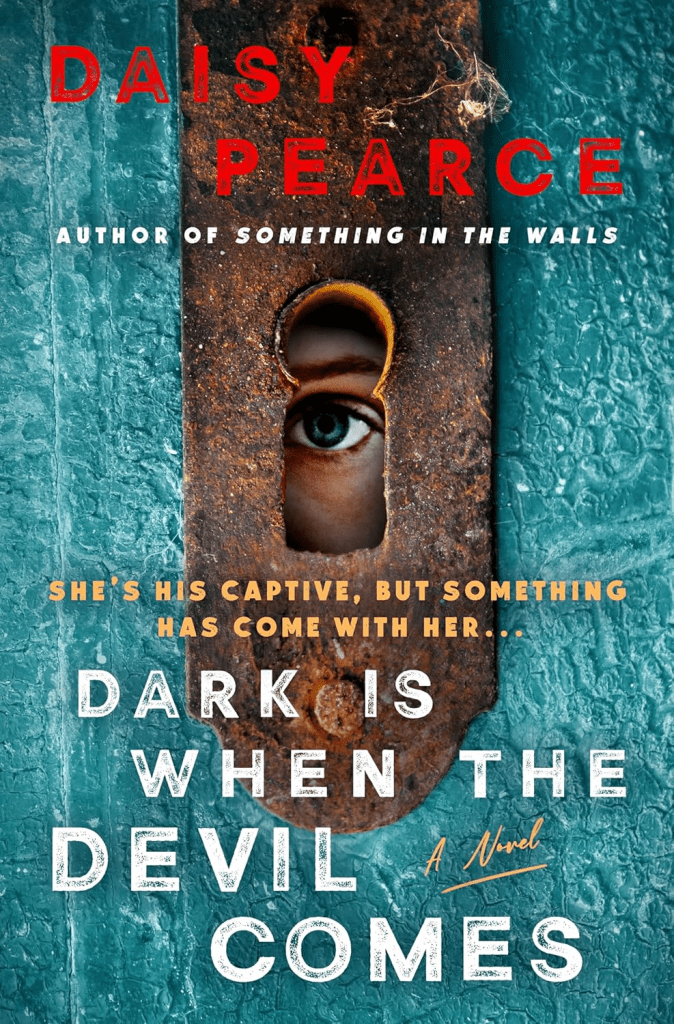
Dark Is When the Devil Comes by Daisy Pearce, published April 28, 2026 by Minotaur Books.