




TL;DR: Ten years on, this collection still feels like somebody took Thomas Ligotti, a ventriloquist’s how-to pamphlet, and a mindfulness app, shredded them, and fed them through a haunted dummy’s mouth. A couple stories feel like bonus tracks, but the core ventriloquist cycle still hits like a weird little religious conversion. If you like your horror philosophical, suffocating, and strangely funny, you should absolutely bump this up your TBR, you sick fuck.

Padgett’s book dropped in 2016, right in that moment when “new weird” and the Ligotti renaissance had congealed into a mini-scene rather than a secret handshake. Tiny presses like Dunhams Manor and chapbooks like The Infusorium were carrying the torch for people who wanted horror that read more like metaphysics in a clown mask than like a Netflix pitch. You get an intro from Matt Cardin that basically plants a flag: this is about Voice with a capital V, the same way Poe or Jackson or Ligotti bend everything toward one disturbed, unmistakable consciousness. A decade later, that context matters, because Ventriloquism reads less like a random debut collection and more like a mission statement for a certain strain of contemporary weird.
On the surface, it is “just” nine pieces: a guided meditation, several stories, one play script, and the long title novella. Underneath, they all share one ruptured reality. We move from the second-person breathing exercise of “The Mindfulness of Horror Practice,” where you are coaxed into inhabiting your skeleton and its “deep aching” as a kind of spiritual homework, to “Murmurs of a Voice Foreknown,” where a bullied kid discovers that the only way to survive his brother’s sadism is to become something colder and more poisonous than the brother or the imaginary Sam that haunts them. The world widens in “The Indoor Swamp” and “Origami Dreams,” which treat reality itself like a rickety theme-park ride, always leading you deeper into a flea market of dead lives and bad choices.

Then there is the spine: “20 Simple Steps to Ventriloquism,” the most fucked-up self-help manual you will ever read, walking you from basic lip control to the cheerful suggestion that everyone around you, including your own family, are “animal-dummies,” and that your job is to become an empty conduit for something else’s voice. That doctrine bleeds into “The Infusorium” and “Organ Void,” with their industrial fog, non-killed citizens, and mottled oxygen tanks, drawing a line between pollution, consciousness, and cosmic suffering. Finally, the title novella pulls the threads together into a full mythos of Greater Ventriloquism, the Ultimate Ventriloquist, and a universe that only speaks through puppets and static. By the time you get out, if you get out, you kind of feel like your own inner monologue has been fucked with.
What still endures most violently is that central concept: ventriloquism as both craft and cosmic condition. Cardin points to the climactic claim that the Greater Ventriloquists “speak with the voice of nature making itself suffer,” and that line still lands like a brick. It turns the usual cosmic-horror move inside out. The universe is not indifferent; it is actively torturing itself, and you are one of its hobbies. The collection keeps circling that idea through different shells: the scripted calm of “Mindfulness of Horror Practice,” the childhood nightmare of “Murmurs,” the industrial smog of “The Infusorium,” the endless ride of “The Indoor Swamp.” The other standout is the image system of toys, rides, and instructions. This is horror built out of things that should make you feel safer: guided meditations, how-to lists, family homes, amusement attractions. Padgett weaponizes all of them, and ten years later those images still feel sticky and gross in the best way. The weakest bits are only weak by comparison: “Escape to Thin Mountain” is more of an in-joke for Ligotti devotees, and a couple of the shorter pieces feel like satellites orbiting the main ventriloquist sun rather than equal planets. But the core constellation is unforgettable.
This book is sly as shit. You get multiple modes: the faux-audio script in “Mindfulness,” the childhood memoir voice of “Murmurs,” the theme-park brochure tone of “The Indoor Swamp,” the found-document diary of “Origami Dreams,” the numbered manual voice in “20 Simple Steps,” and, finally, the more straightforward but still queasy narration of the title piece. It could easily feel gimmicky. Instead, the shifts all feel like facets of the same skull. Padgett’s background as an actual ventriloquist and his obsession with performance bleed into the prose; even when he is parodying spiritual teachers like Eckhart Tolle in “Organ Void” and “Mindfulness,” there is this weird sincerity that keeps it from just being a bit.
Reading it now, some of the stylistic DNA is obvious. This is very much post-Ligotti, with dense, slightly archaic sentences and a fixation on work, illness, and spiritual frauds. The difference is that Padgett leans harder into black comedy. “20 Simple Steps” hammers home how ridiculous the cult mindset is even as it drags you along, and the repetition of phrases like “animal-dummies” or “They are all dummies” has a nasty little sitcom rhythm that makes the horror land even harder. From a 2020s vantage, maybe the biggest “dated” element is that particular flavor of weary office-drone nihilism, which was everywhere in weird horror a decade ago. Also, women mostly appear as suffering spouses or spectral figures, which is not exactly radical. It is not gross about it, just limited. The tech landscape barely registers, which ironically helps the book age better. Nobody is doomscrolling. They are just breathing in smog and listening to the wrong voice in their head. That shit never goes out of style.

The themes are blunt and chewy. First and most obvious: selfhood as illusion. Every story hacks at the idea that you are a stable person. You are a skeleton, a habit loop, a commuter on an infinite ride, a dummy that other things speak through. The gradual stripping away of agency in “20 Simple Steps” and “The Secret of Ventriloquism” is basically a how-to guide for ego death that swaps enlightenment for cosmic self-harm. Alongside that runs environmental and industrial dread. “The Infusorium” mythologizes pollution as something sacred and corrosive, a fog that does not just kill lungs but rewrites reality. And then there is grief and abuse: “Murmurs of a Voice Foreknown” is one of the rawest depictions of sibling cruelty and the birth of a little monster you will find. That story turns the whole ventriloquism thing into a survival strategy, which makes the later cosmic stuff feel less abstract.
The aftertaste, ten years later, is a strange combination of fatigue and clarity. You put the book down and feel like you just finished a particularly intense meditation session led by someone who hates you. There is a question humming at the end that has only gotten sharper in an age of parasocial media voices and curated identities: if most of what moves through you is static from elsewhere, what parts of you are actually yours, and what are you willing to give up to silence it?
In terms of legacy, this book did not reinvent horror for the masses, but it absolutely left fingerprints all over the weird-horror niche. Padgett went on to help steer Vastarien, which became a hub for Ligotti-inflected criticism and fiction, and you can feel the Ventriloquism mindset in a lot of the short work that followed: the fondness for instruction-manual horror, the “guided meditation that goes to hell” format, the way industrial landscapes and spiritual language get smashed together. If you see a story today that looks like a wellness app trying to murder you, there is a decent chance the writer read Padgett first.
Placed on the shelf, The Secret of Ventriloquism sits right next to Ligotti’s Songs of a Dead Dreamer and Jackson’s more poisoned stories, but filtered through a distinctly twenty-first century lens of therapy-speak, mindfulness culture, and precarious labor. It is also one of those rare debut collections that feels conceptually unified instead of “here are twelve things I happened to sell.” Among 2010s small-press weird, it is easily top tier, weird and ambitious enough to justify the hype that clung to it in chapbook form and beyond.
The ventriloquist mythos, the instruction-manual nightmares, and the voice that keeps talking in your head long after you close the book make this an excellent, genuinely memorable collection, even if a couple of pieces feel like extra limbs on an already very sharp puppet.

Read if you want cosmic horror that feels like a fucked up self-help seminar rather than tentacles.
Skip if second person narration and pseudo-spiritual patter make your teeth itch instead of delighting your inner sicko.
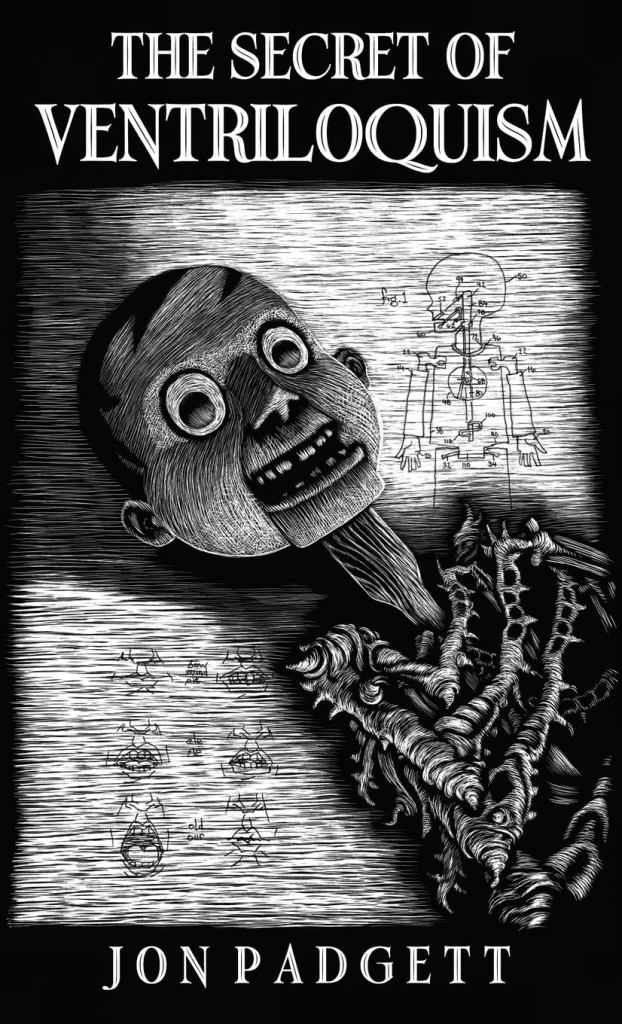
The Secret of Ventriloquism by Jon Padgett,
published October 31, 2016 by Dunhams Manor Press.