
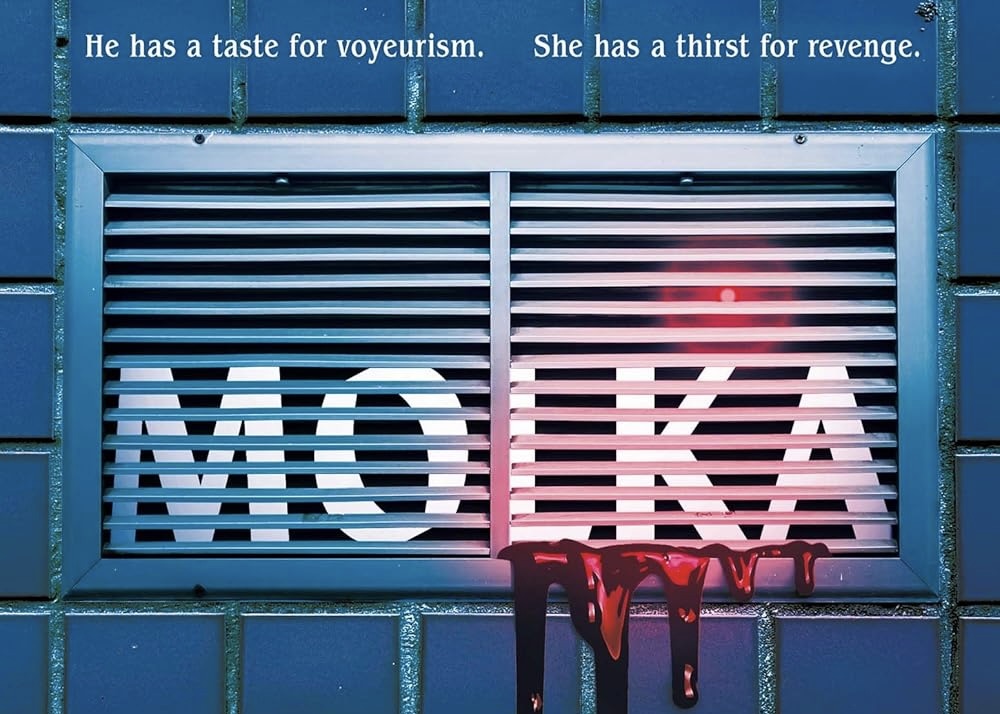
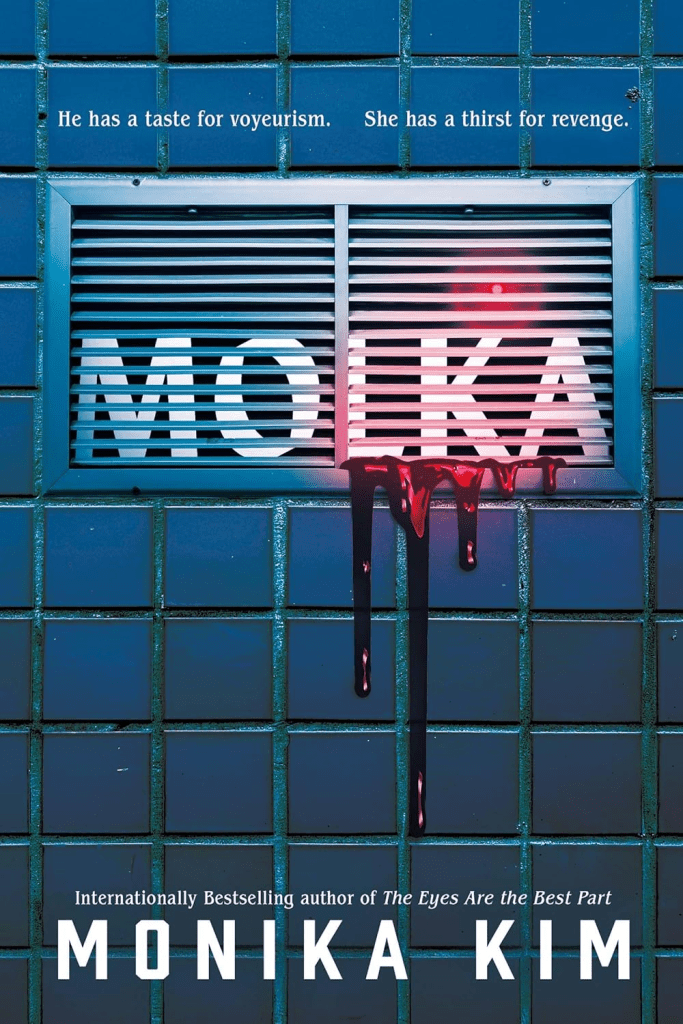







TL;DR: Monika Kim plants a ghost in the plumbing and a camera in the wall and builds a feminist horror novel around the gap between them: the seen and the unseen, the violated and the unaccounted for. Molka is propulsive, disturbing, and angry in exactly the right direction. The ending will stay with you. So will Eunhye.

Cho Junyoung organizes his desk by date, keeps a brand-new notepad with a green cover, and checks the women’s bathroom camera feeds forty times a day. He is tidy almost to the point of prayer. He has detailed opinions about what women’s underwear reveals about their character. He says “I’m happy to help” with complete sincerity, and the reader will understand, even if Junyoung never does, what kind of sentence that is. Monika Kim spends a generous portion of Molka inside his head, and the picture is clear and efficient and eventually, structurally, a problem.
Molka is named for the Korean term for hidden spy cameras. Miniature, illegal, drilled into the walls of public restrooms and hotel rooms and office stalls. The molka epidemic in South Korea is documented and ongoing. Women have been filmed in bathrooms, dressing rooms, classrooms. The footage circulates in chatrooms, traded among men who understand themselves to be collectors. When perpetrators are caught, the sentences are light. The government has taken steps. The steps are inadequate. Kim opens with an author’s note that says all of this plainly, and then writes a novel to make you feel it in the body.
The book runs on two tracks. The first is Junyoung, who works in IT at a Seoul office building and has installed tiny cameras in every women’s restroom on every floor. He is building what he thinks of, in his most candid moments, as a kind of archive. He has a dead father who told him that boys will be boys and that women are inherently weak and that instinct is its own justification, and Junyoung has taken this as holy scripture. He is thirty years old and still living with his mother, whom he treats with a steady, quiet contempt he has mistaken for authority. The second track is Dahye, one of the women on Junyoung’s screens, who is also being filmed, in different rooms, by a chaebol heir named Hyukjoon who understands all women as a resource and Dahye specifically as a temporary amusement like a very large fish in a tank it has no reason to fear, reading its own ease as a personality. And then there is Eunhye, Dahye’s dead sister, who drowned in the Han River five years ago at seventeen and has been keeping a certain kind of company since.

Eunhye arrives the way Korean gwisin traditionally do: wet, patient, with her long hair covering her face and petechiae scattered across the whites of her eyes and the smell of standing water following her into every room. She is furious and grieving and deeply tired. She has not finished something, and she intends to finish it. Kim refuses to let her be only terrible or only sorrowful. She is both at once, and sometimes she is also funny, which is the right move. The scene where Eunhye assembles herself, wet and slow, from a clump of hair that has fallen out of a bathroom vent, it is as strange as the book ever gets, and as good.
What holds Dahye’s story is the romance that precedes the horror. Kim lingers on Dahye’s infatuation with Hyukjoon with something close to patience, letting the reader feel the whole weight of wanting before beginning to undercut it. Dahye’s desire is not stupid. It is not naive in the way her mother means when she calls her naive. It is the desire of a woman who grew up in her dead sister’s shadow, who was told in a hundred small ways that she wasn’t quite enough, who met a man who told her she was. The scenes where this gets dismantled are among the better pages in contemporary horror. The chat messages, rendered in cold transcript, are the book’s actual blow. They describe something that is happening right now, in real chatrooms, with real women on the screens, and every one of the men involved believes himself to be basically a good person. That is the most frightening sentence in the novel. It appears between the lines.
Kim is a second-generation Korean American from Los Angeles’s Koreatown, and her debut, The Eyes Are the Best Part, won the kind of first-novel attention that can make a sophomore book into a contest with its own publicity. That novel, about a college student driven toward cannibalism by grief, rage, and her mother’s catastrophic new boyfriend, was a Bram Stoker Award nominee, a Goodreads Choice finalist, and a best-of-year selection from the New York Times, TIME, and others. It announced a writer with a specific and unadorned talent: flat prose carrying ugly freight, social commentary embedded in plot rather than announced above it. Molka extends that project into new territory. It is angrier and more ambitious, and it has the problems that come with both.
The Junyoung problem is structural. Kim needs him. He is the book’s central argument that the voyeur and the rapist and the charming chaebol heir are variations on a single theme, that the system protects all of them, that the women on the cameras and in the chatrooms are the only ones actually paying attention to the shape of things. But Junyoung’s interior becomes repetitive before the novel’s midpoint. His obsession cycles through the same logic with diminishing variation. By chapter thirteen we understand him completely, and what follows does not add to that understanding so much as confirm it. The reader waits for Dahye while Kim attends to Junyoung, and the imbalance costs the book momentum it would need later.

The institutional machinery is handled with precision and contempt. The police inspector who hears Dahye’s case is a man whose sympathy is exactly as wide as his desk, and he is not a large man. He makes a speech about process. He has a folder. He will call in five to seven days. He will not call in five to seven days. The whole apparatus, the inspector, the reporters who will eventually make Junyoung a hero, the officers who will shrug at the bathroom footage on his phone, is described with the accuracy of someone who has watched this operate and found it, finally, a bastard institution.
The ending has nerve. The final image is the kind of thing that stays and Kim earns it. She doesn’t earn everything that precedes it by about forty pages.
What Molka asks, underneath all the blood and the ghost and the institutional failure, is a question with no comfortable answer: if the system will not move, what is the shape of an adequate response? The book offers one. It doesn’t pretend it is clean. It doesn’t pretend Dahye’s fury constitutes justice, only that justice wasn’t available. Eunhye’s voice in the final street is still and faintly singing. The camera blinks. The guard sleeps on.





Leave a Reply