

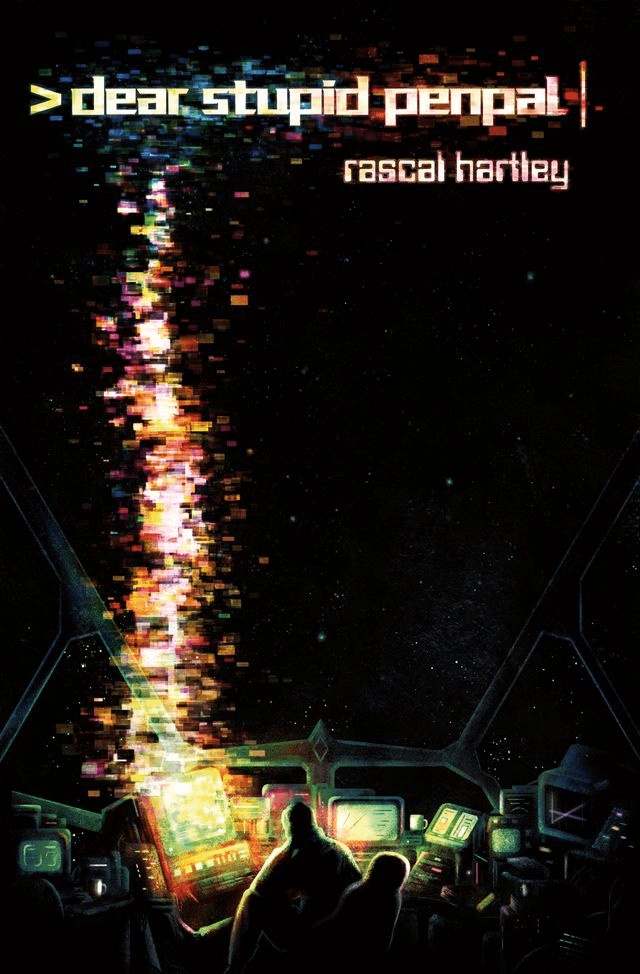





TL;DR: Two voices, one spaceship, one stargazer, a whole lot of yearning, plus a Bermuda Triangle ghost-meal to curdle your stomach. Funny, tender, and quietly terrifying, this is cosmic horror by way of love letter, where language becomes a lifeline and the void blinks first.

Dear Stupid Penpal arrives from Tenebrous Press, with cover art by Carly A-F, interior illustrations by Matt Blairstone, and editing by Alex Woodroe. Rascal Hartley’s voice reads like a debut that already knows exactly what it’s doing, confident and allergic to filler. File it next to the house’s other sharp novellas that bend genre while staying delightfully raw and original.
The conceit is diabolically simple: Finch, a snarky linguist on a long-haul space mission, is required to maintain a pen-pal exchange with someone on Earth to “maintain earthen roots.” Enter Aku, a nocturnal stargazer with old-soul vibes, a passport stamped by centuries, and a knack for slipping myth into casual observations. Through messages vetted by a ground-control minder named Tolstoy, the two riff, bicker, confess, and gradually start orbiting each other emotionally. Around them, a real spaceship crew with real jobs keeps not dying in hilarious ways, while bigger, stranger stuff ripples in from the periphery, including a gooseflesh Bermuda Triangle account and Akkadian starlore that may or may not be more than trivia. The plot moves like correspondence itself, from petty complaints to existential gut-punches, until you realize you’ve been dragged somewhere tender and uncanny without noticing the footpath give way to sky.
Forget “two people texting with vibes.” This is two people writing themselves into being, and Hartley makes it feel electric. Finch comes out swinging in letter one, all caps-locked sarcasm and “space sucks, send tacos,” a chaos gremlin who uses profanity like punctuation and jokes to armor the soft parts. Aku counters with deliberate cadence, a pilot’s steadiness, and this disarming tendency to drop a sentence that sounds like he just remembered a god’s real name. The chemistry is stupid good. The book weaponizes voice, then lets the voices tangle until you feel the cord tighten between them. If you have a pulse, you will grin like an idiot.
On originality, the thing slaps. An epistolary sci-fi horror that toggles between deep-space tedium and Earthbound nocturnes is already a fresh lane, but Hartley keeps throwing curveballs. There are the clipped shipboard details, the crew’s larky personalities, the petty tech jokes about calipers and Lego spheres, the strange rules of what Mission Control will or will not allow through. There is also Aku’s Bermuda Triangle narrative which, I’m sorry, is creepy as hell: sand like fog, food that tastes like food but doesn’t feel real, a vanished island that eats time, a femur in a seaplane like a punchline from the abyss. The set piece is compact and clean, an intrusion of maritime liminality into a starbound romance, and it works because Hartley refuses to underline it with neon. The confidence to just tell it straight, then let your skin figure out the goosebumps, is chef’s kiss.
Pacing is the quiet trick. Because it is letters, we get jump cuts: a hangover apology, a philosophy digression, a chemistry in-joke that finally lands, a whisper about coordinates so the two can point telescopes at one another across impossible distance. It should feel herky-jerky, yet it glides. The episodic rhythm creates stealth escalation. Jokes about ramen fires and rehydrated milk soften you up; discussions of violence, harm, and whether monsters deserve moral calculus open your ribs; then the book knifes in a little deeper with longing as a survival skill. By the time Finch drunkenly admits he “dreams about you sometimes,” you’re too invested to be cool about it. The dread never vanishes, it threads under the sweetness like fishing line. If you’re here for jump scares, wrong novella. If you’re here for the brand of cosmic terror that tastes like loneliness and hope in the same mouthful, welcome to the buffet.
Character work is the whole engine. Finch reads like the guy who loudly claims he hates everyone five minutes before he hand-knits the crew’s Christmas stockings. He is funny, prickly, and yearning, with hearing aids he custom paints and a wildly endearing compulsion to learn everyone’s languages. Aku radiates warmth with a knife in his boot: courtly, grounded, maybe dangerous, maybe immortal, or maybe just someone who’s seen too much and decided kindness is the only sane rebellion. The supporting cast is sketched with brisk charm, especially Meredith the chemistry gremlin and Chloe the astronomer with a right hook. Even Tolstoy, the communications hall monitor, evolves into a straight-man foil who drops a heart emoji at the exact right moment. The crew dynamics start as workplace cringe and resolve into a low-key found family, mostly because Finch can’t help being a peacemaker despite protestations that he is a gremlin. That rings true and sweet without getting sticky.
On style, Hartley keeps a tight grip on tone. The letters are alive with contemporary banter, yet Aku’s replies carry this antiquated gravity that never reads as parody. The Akkadian terms for celestial bodies, the aside about Sin and Shamash, the “do no unnecessary harm” credo, the refusal to backspace, the way both narrators start mirroring each other’s syntax, it’s all deliberate craft disguised as casual chat. The occasional profanity doesn’t feel like seasoning, it feels like blood pressure. The jokes land because they’re doing psychological work, not because the book is auditioning for Twitter. When the lovers point telescopes and stare toward Uranus for hours, Armstrong-level dad joke included, it plays cute and cosmic at once, which is the exact center of this book’s bullseye.
Any fear here is existential and erosive, more Ligotti than slasher, more signal-to-noise dread than monster-in-the-vents. The Bermuda Triangle chapter is a compact gut-twister, and the constant drum of distance, surveillance, and “what if I die out here” lends real unease. But the horror is braided with romance, so the spikes of terror feel sharper for arriving in a field of soft grass. The final impression is not panic but ache, like the good kind of homesickness that says home might be a person you have not hugged yet. That’s a mean magic trick, and Hartley pulls it off with a grin.

Recommended for: Readers who want their cosmic dread served with flirtation, anyone who has ever pointed a telescope and whispered “look back,” believers in the church of found family, chemistry-joke sickos, and people who think bread-making might also be a love spell.
Not recommended for: Folks who need a body count per chapter, and anyone who thinks the Bermuda Triangle should stay in Florida Man headlines rather than sneak onto their spaceship like a polite nightmare.
Dear Stupid Penpal by Rascal Hartley,
published November 11, 2025 by Tenebrous Press.

 The Blog Without a Face
Leave a comment